
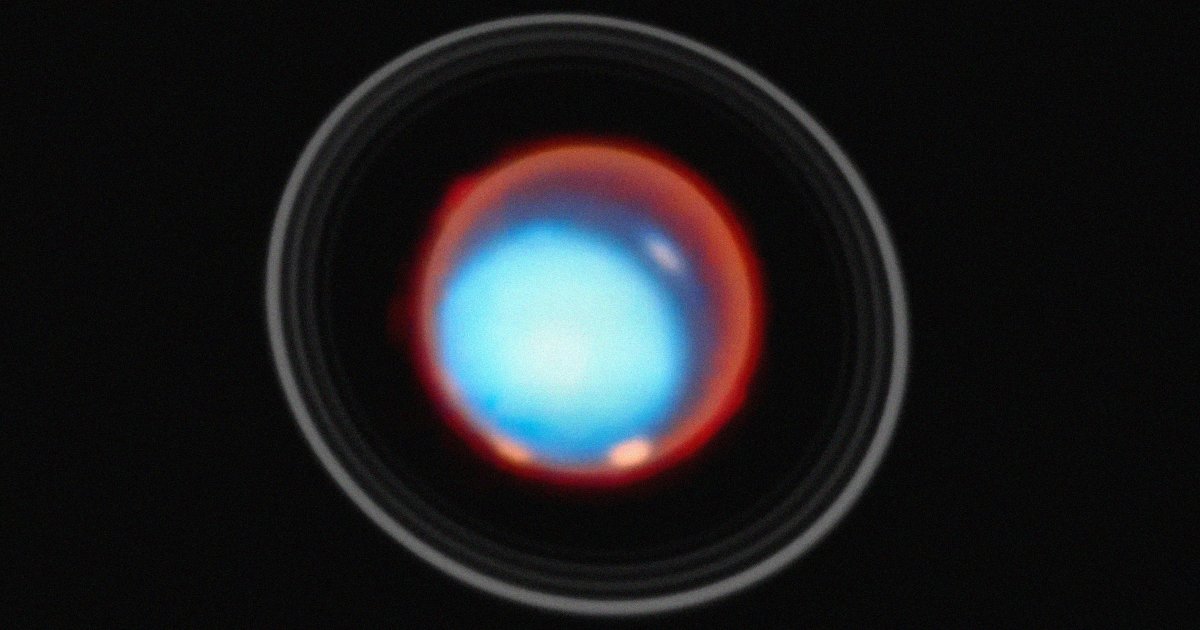
New images from the James Webb Space Telescope are providing unprecedented detail about the atmosphere of Uranus, revealing how energy moves through the planet and offering clues about its unusual magnetic field. The observations, made with the telescope’s Near-Infrared Spectrograph (NIRSpec) during a full rotation of the planet over a year ago, represent the most detailed picture yet of Uranus’s upper atmosphere.
The data shows how Uranus’s ionosphere – a layer of charged particles – interacts with the planet’s magnetic field. “This is the first time we’ve been able to see Uranus’s upper atmosphere in three dimensions,” said Paola Tiranti, a PhD student at Northumbria University and lead author of a new paper published in the journal Geophysical Research Letters. “With Webb’s sensitivity, we can trace how energy moves upward through the planet’s atmosphere and even see the influence of its lopsided magnetic field.”
Uranus is unique in our solar system for its extreme axial tilt of 97.77 degrees, effectively rotating on its side. This tilt, combined with a magnetic field that is too significantly tilted and offset from the planet’s rotational axis, creates a complex magnetosphere unlike any other in the solar system. The Webb observations are helping scientists understand how these factors influence the planet’s auroras.
Even as Earth’s auroras are typically concentrated around the north and south poles, auroras on Uranus appear as glowing patches of orange and red light that extend beyond the edges of the JWST observations, sweeping across the planet’s surface in complex patterns. “Uranus’s magnetosphere is one of the strangest in the Solar System,” Tiranti explained. “It’s tilted and offset from the planet’s rotation axis, which means its auroras sweep across the surface in complex ways.”
The new findings also support previous observations indicating that Uranus’s upper atmosphere is cooling, a trend first noted in the early 1990s with near-infrared observations. The Webb data provides a more detailed understanding of this phenomenon and how it relates to the planet’s energy balance.
“These auroral detections are hugely important because they are a direct manifestation of the planet’s internal magnetic field,” said Heidi Hammel, a JWST interdisciplinary scientist who was not involved in the study, in an interview with Scientific American. “We really have no other way to probing the magnetic field remotely without a spacecraft in situ.”
The observations could inform future missions to the ice giant. NASA’s Voyager 2 was the only spacecraft to have flown by Uranus, performing a flyby in 1986. However, the future of such missions remains uncertain due to budgetary constraints. As Tiranti stated, “Webb has now shown us how deeply those effects reach into the atmosphere. By revealing Uranus’s vertical structure in such detail, Webb is helping us understand the energy balance of the ice giants. This is a crucial step towards characterising giant planets beyond our Solar System.”
