
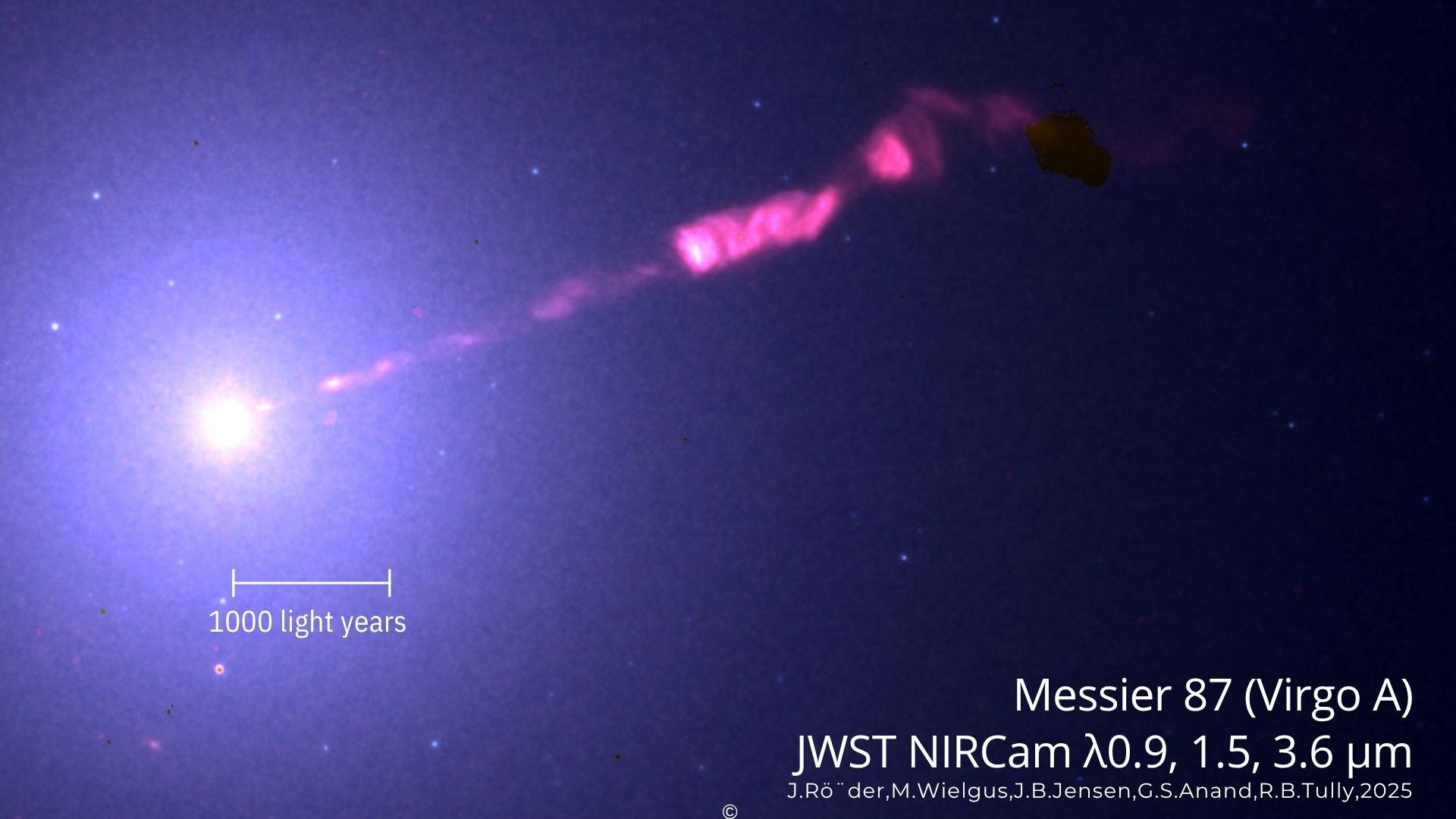
Webb Telescope Delivers Unprecedented View of Black Hole Jet in M87 Galaxy
September 26, 2024 – The James Webb Space Telescope (JWST) has captured the most detailed infrared image to date of the jet emanating from the supermassive black hole at the center of the M87 galaxy, located 55 million light-years from earth. This jet, previously imaged in 2019 by the Event Horizon Telescope as part of the first-ever direct photograph of a black hole, is a powerful outflow of energy and particles.
A team led by Jan Röder of the Institute of Astrophysics of Andalusia in spain utilized JWST’s near Infrared Camera (NIRCam) instrument, observing in four infrared bands. Researchers meticulously removed starlight, dust, and background galaxies to reveal the jet’s structure. the findings were published last week in the journal Astronomy and Astrophysics.
The new image reveals a helical structure close to the galaxy’s core, showcasing a slow-moving feature called “knot L” and a brighter region, HST-1, known for its rapid motion. Webb’s observations show HST-1 splitting into two distinct substructures, indicating shocks and complex particle dynamics near the black hole.
Further from the black hole, approximately 6,000 light-years away, the counter-jet appears as two filaments connected by a hotspot, forming a faint C-shape consistent with previous radio observations.
The data confirms that the jet’s light is produced by synchrotron radiation - emitted when charged particles spiral through magnetic fields. By analyzing color variations across the infrared bands, the team mapped particle acceleration, cooling, and twisting along the jet.
These jets,powered by supermassive black holes,serve as natural laboratories for studying extreme physics,allowing astronomers to understand how black holes impact their host galaxies by regulating star formation and distributing matter and energy throughout intergalactic space.
