JWST Mystery: Are Little Red Dots Baby Galaxies or Supermassive Stars?
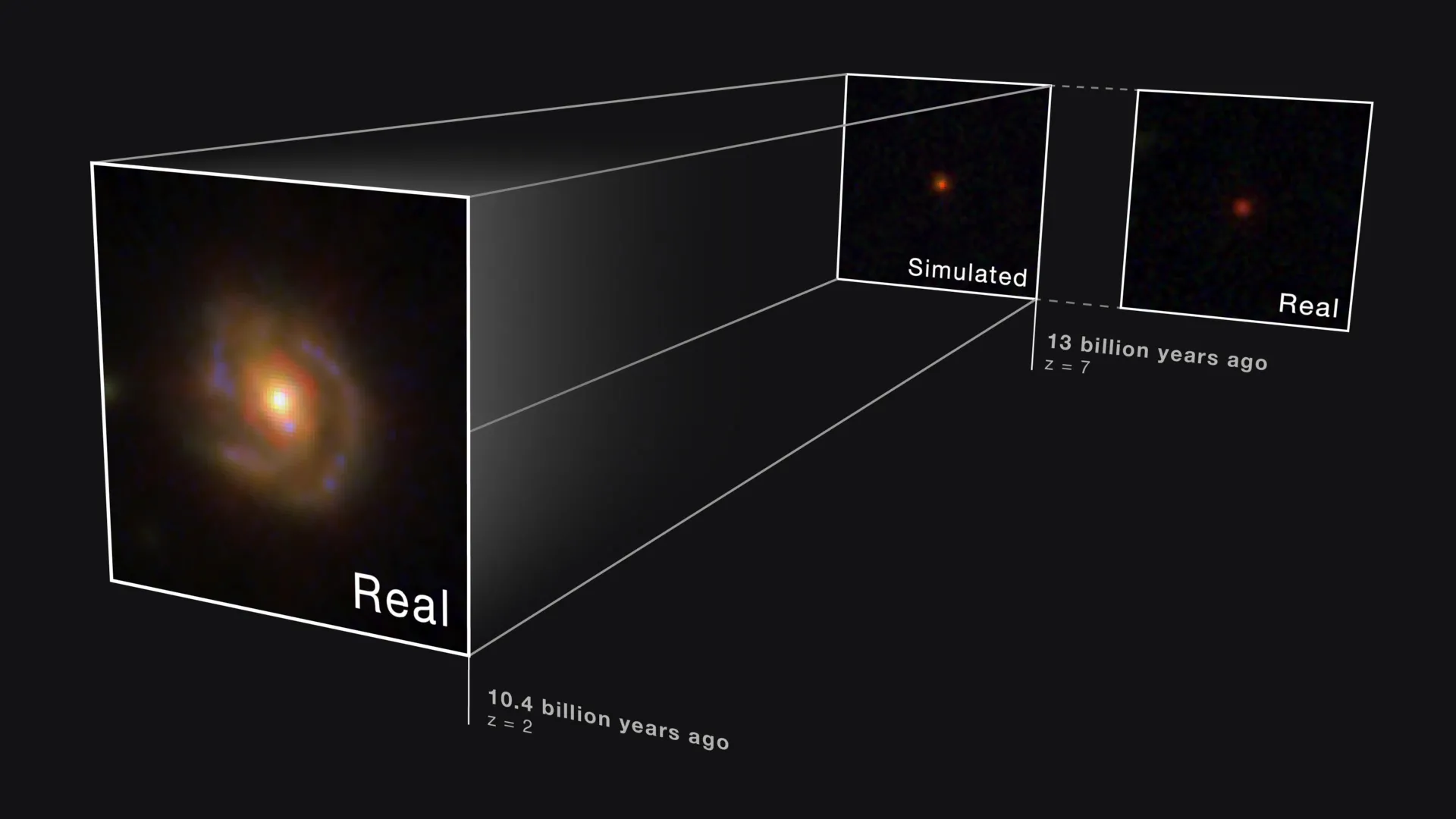
Fresh data from the James Webb Space Telescope (JWST) indicates that the enigmatic “little red dots” (LRDs) populating the early universe may actually be globular clusters under construction or compact galaxies, challenging assumptions about primordial black holes. First detected in deep-space images, these compact, highly luminous objects appeared just a billion years after the Big Bang, displaying a distinct V-shaped spectrum characterized by a blue ultraviolet continuum and red optical light.
- The Core Discovery: JWST observations have isolated compact, red distant galaxies from the cosmic dawn that do not align with standard black hole models.
- The Competing Theories: Researchers propose these objects are either messy globular clusters powered by hypothetical Supermassive Stars (SMS) or products of extremely rare, slow-spinning dark matter halos.
Deciphering the V-Shaped Spectrum of Early Cosmic Objects
For a while, the consensus among astrophysicists held that these distant LRDs were likely powered by giant, hungry black holes gobbling up surrounding matter in the early universe. However, as noted in reporting by Space.com, subsequent observations revealed properties distinct from known black hole populations. A study published on arXiv suggests an alternative framework: these dots represent globular clusters in their formative stages, powered by hypothetical Supermassive Stars (SMS)—short-lived, highly luminous stellar powerhouses significantly larger than typical stars.
This globular cluster model aligns closely with present-day populations. Researchers estimate the total number density of these LRDs across all redshifts to be around 0.3 per cubic megaparsec, a figure similar to local globular clusters. Furthermore, the observed redshift range matches the age distribution of metal-poor globular clusters tied to early structure formation. Despite these correlations, discrepancies remain. Current SMS models struggle to account for the observed temperatures and brightness of LRDs, indicating that atmosphere models must incorporate molecular opacities and parameters for stars cooler than 7,000 Kelvin.
The Low-Spin Halo Hypothesis and Dark Matter Mechanics
Complementing the stellar cluster hypothesis, researchers Fabio Pacucci and Abraham (Avi) Loeb at the Center for Astrophysics | Harvard & Smithsonian have introduced a separate physical explanation. Published in The Astrophysical Journal Letters, their work posits that these compact galaxies formed inside ultra-slow-spinning dark matter halos—rare cosmic environments representing the lowest 1% of the spin distribution, as covered by SciTechDaily.
According to Pacucci, these low-spin halos squeezed matter tightly together, naturally creating extremely compact galaxies. “Little red dots are very compact and red distant galaxies that were completely undetected before the James Webb Space Telescope,” Pacucci stated.
Computational Bottlenecks and Spectroscopic Data Processing
import numpy as np

def calculate_spectral_index(wavelengths, flux):
    # Filter out zero or negative fluxes to prevent log errors
    valid = flux > 0
    log_lam = np.log(wavelengths[valid])
    log_flux = np.log(flux[valid])

    # Perform linear regression to find the spectral slope (beta)
    slope, _ = np.polyfit(log_lam, log_flux, 1)
    return slope

# Example execution with dummy NIRSpec data points
lam = np.array([1.5, 2.0, 2.5, 3.0])  # Microns
flx = np.array([12.4, 22.1, 35.8, 52.0])
beta_value = calculate_spectral_index(lam, flx)
print(f"Computed Spectral Slope: {beta_value:.4f}")
Infrastructure Readiness for Next-Generation Astrophysics
Resolving the debate between supermassive black hole cores, slow-spinning dark matter halos, and infant globular clusters will require both expanded JWST observation time and improved atmospheric modeling software.

*Disclaimer: The technical analyses and security protocols detailed in this article are for informational purposes only. Always consult with certified IT and cybersecurity professionals before altering enterprise networks or handling sensitive data.*