JFE Engineering Launches Japan’s First Offshore Wind Monopile Plant
JFE Engineering has broken new ground as the first Japanese firm to manufacture core steel frames for offshore wind farms, investing approximately 40 billion yen into a dedicated production facility in Kasaoka City, Okayama Prefecture. According to corporate disclosures, the newly operational plant addresses a critical domestic supply chain bottleneck by producing extra-thick monopile foundations designed to meet the nation’s 2050 carbon neutrality targets.
Capital Expenditure and Facility Specifications
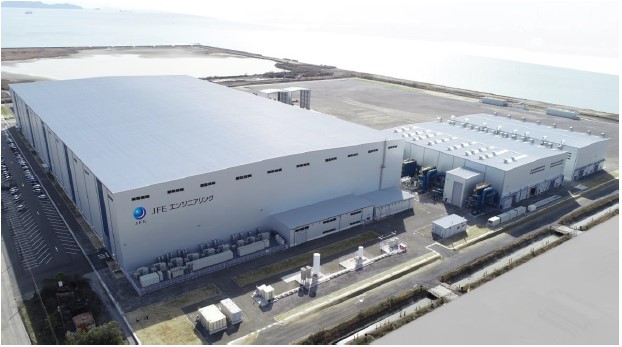
The strategic capital allocation covers comprehensive facility upgrades, mechanical equipment installation, and quay reinforcement across multiple operational sites. Per corporate project documentation, the primary monopile manufacturing hub spans approximately 20 hectares on the premises of JFE Steel West Japan Works in the Fukuyama area. This facility achieved operational status on April 1, 2024, following the formal launch of the offshore wind turbine project team in April 2021.
Engineering parameters for the Kasaoka site reflect the immense physical scale required for modern fixed-bottom offshore installations. Production capacities are projected at 80,000 to 100,000 tons annually, translating to roughly 50 sets of foundations per year. The facility features a 200-meter shipping quay—part of a total 400-meter quay length—with a depth of -11 meters to accommodate heavy cargo vessels.
Monopiles manufactured at the site reach extreme dimensions:
- Maximum diameter of around 12 meters
- Wall thickness up to approximately 130 millimeters
- Total length approaching 100 meters
- Individual component weight hitting approximately 2,500 tons
Logistics and Supply Chain Integration
The manufacturing process leverages heavy plates sourced directly from JFE Steel to fabricate primary steel pipes. Once completed, monopiles are loaded onto vessels directly from the Kasaoka quay for transport to offshore project sites. Meanwhile, primary steel pipes intended for transition pieces are shipped to JFE Engineering Tsu Works in Tsu City, Mie Prefecture. At the Tsu Works—noted as the largest steel structure production plant in Japan—workers install secondary steels and internal parts before final dispatch.
This industrial scaling aligns with government projections outlined in the Overview of the Vision for Offshore Wind Power Industry. Regulators established a target of 30 to 45 gigawatts of project formation by 2040, alongside a domestic procurement ratio of 60 percent.
Future Roadmap and Market Positioning
Beyond monopiles, the corporate action policy includes plans to incorporate jacket-type foundations into the production lineup. Jacket structures have historically seen extensive use in port piers and coastal infrastructure throughout Japan. By broadening its product catalog, the firm positions itself to capture expanding construction demand as regional utilities transition away from fossil fuels.

As offshore installation schedules accelerate toward the 2040 horizon, domestic supply chain integrity will hinge on the operational efficiency of these newly established manufacturing bases.