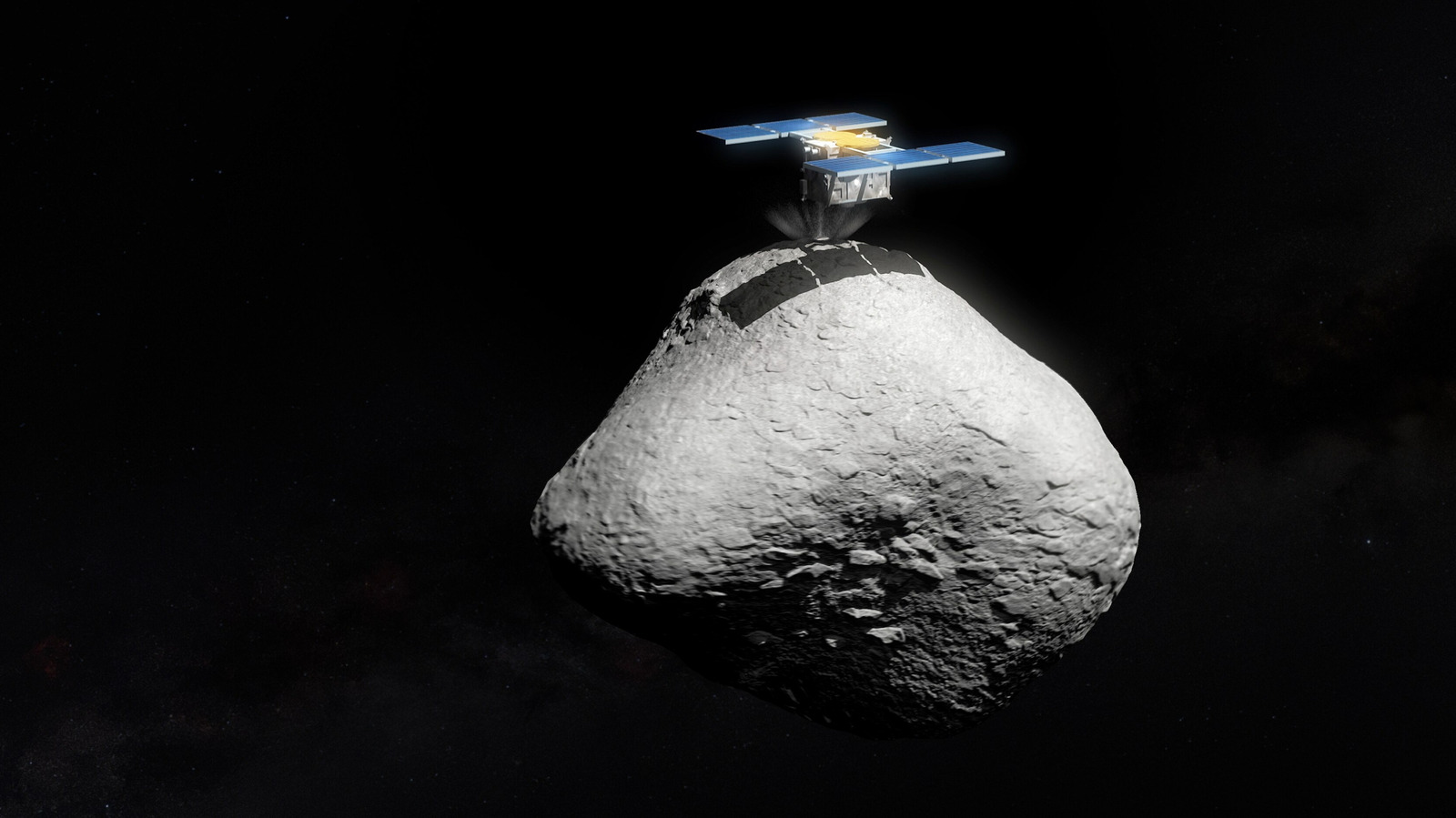
JAXA Cancels Hayabusa2 Visit to Mystery Object 1998 KY26
Spinning once every five minutes, the 36-foot object known as 1998 KY26 is accelerating through the solar system in a way that gravity alone cannot explain, leaving astronomers divided over its true identity.
The Tech TL;DR:
- Object 1998 KY26 measures roughly 36 feet across and exhibits an anomalous nongravitational acceleration between Earth and Mars.
- Japan’s space agency canceled a planned Hayabusa2 spacecraft mission to the object due to engine issues, redirecting the probe toward asteroid 2015 BM510 for a 2028 visit.
- Researchers and astrophysicists debate whether sunlight pressure, thermal radiation, or a lost Soviet space probe accounts for the strange velocity.
Japan Cancels Hayabusa2 Rendezvous Mission
On November 16, officials from the Japan Aerospace Exploration Agency announced that their Hayabusa2 spacecraft will no longer visit the rapidly rotating and mysteriously accelerating rock, as Scientific American reported. Operating well past its nominal lifetime in an extended mission, the probe cannot reach the target for an intended 2031 rendezvous due to problems with its engines. Instead, the agency rerouted the spacecraft to visit near-Earth asteroid 2015 BM510 in 2028.

Discovered in 1998 by astronomer Tom Gehrels of the University of Arizona, the object initially prompted estimates three times its current size, per the BBC’s Sky at Night Magazine cited by Jalopnik. Telescope data eventually revealed a smaller diameter of approximately 36 feet.
Earth’s Moon reflects about 12 percent of the sunlight it receives, but 1998 KY26 is a very shiny object with a reflectivity that is much higher than that of typical asteroids, according to Avi Loeb.
Sublimation and Radiation Pressure Offer Physical Explanations
Various hypotheses attempt to resolve the acceleration mystery without invoking artificial origins. Comets accelerate via sublimation, where ice turns directly to gas and shoots particles outward, creating a momentum push. However, 1998 KY26 lacks a visible tail. While fourteen dark comets are believed to exist, recent research demonstrated that 1998 KY26 has a temperature of minus 53 degrees Fahrenheit, which is too warm for ice to exist.
Alternative physical explanations focus on radiation pressure. Photons of light carry momentum, and solar radiation exerts pressure that can alter an object’s trajectory over time, a mechanism similar to how a solar sail propels a spacecraft, as noted by The Economic Times.
The Yarkovsky effect, driven by emitted heat from sunlight, provides another possible vector for thrust. NASA favors the explanation that solar forces push the object past where gravity alone would take it, though other scientists argue these effects do not generate enough force to explain the measured acceleration.
Debating the Lost Soviet Phobos 1 Hypothesis
Challenging natural explanations, Harvard astrophysicist and White House UAP Science Advisory Council chair Avi Loeb argued that the object’s high reflectivity and rapid five-minute rotation rate resemble artificial construction rather than a natural cluster of rocks held together by ice. Loeb suggested that 1998 KY26 might actually be Phobos 1, a Soviet spacecraft launched in 1988 toward Mars that was lost after a mistyped command deactivated crucial systems.

“[The] sunlight reflecting off these solar panels is pushing them, just like a sail on a boat,” Loeb explained in an interview detailed by The Economic Times.
Loeb and co-authors Adam Hibberd and Adam Crowl calculated that sunlight reflection off solar panels could account for the observed velocity changes. Under Theory Number 4, the probe allegedly reached its current orbit via two thruster burns on September 2, 1988, and May 19, 1996, driven by faulty circuitry. NASA rejects the artificial probe theory, and other astronomers maintain that standard solar radiation pressure on a smaller space rock fully explains the motion.
Mysterious space object accelerates toward Earth as scientists debatehttps://t.co/CoNleIBGp2
| Object Property | 1998 KY26 Measurement | Comparison Reference |
|---|---|---|
| Diameter | 36 feet (11 meters) | Initially estimated at three times larger |
| Albedo / Reflectivity | Approximately 50% | Earth’s Moon reflects 12%; typical asteroids reflect 5% |
| Surface Temperature | -53°F (-47°C) | Too warm for ice sublimation to occur |
| Rotation Period | Once every five minutes | Significantly faster than standard asteroid rotation norms |
While the canceled JAXA rendezvous removes an immediate opportunity for close-range imaging, researchers continue to analyze telescope data to refine radiation pressure models. The distinction between a heavily weathered dark comet, an unusual near-Earth asteroid altered by thermal forces, or an inert relic of early interplanetary exploration remains open as data collection proceeds.
The Japan Aerospace Exploration Agency, formed in 2003 by merging three predecessor organizations, operates Hayabusa2 well beyond its nominal lifetime. The probe previously deployed rovers on an asteroid surface and returned samples in a 2010 Hayabusa mission. JAXA is one of five space agencies participating in the International Space Station program and developed Kibō, the station’s largest module.
“It’s not done by NASA’s administrator saying conclusively that he knows the answer,” Loeb told The Economic Times on November 14.