
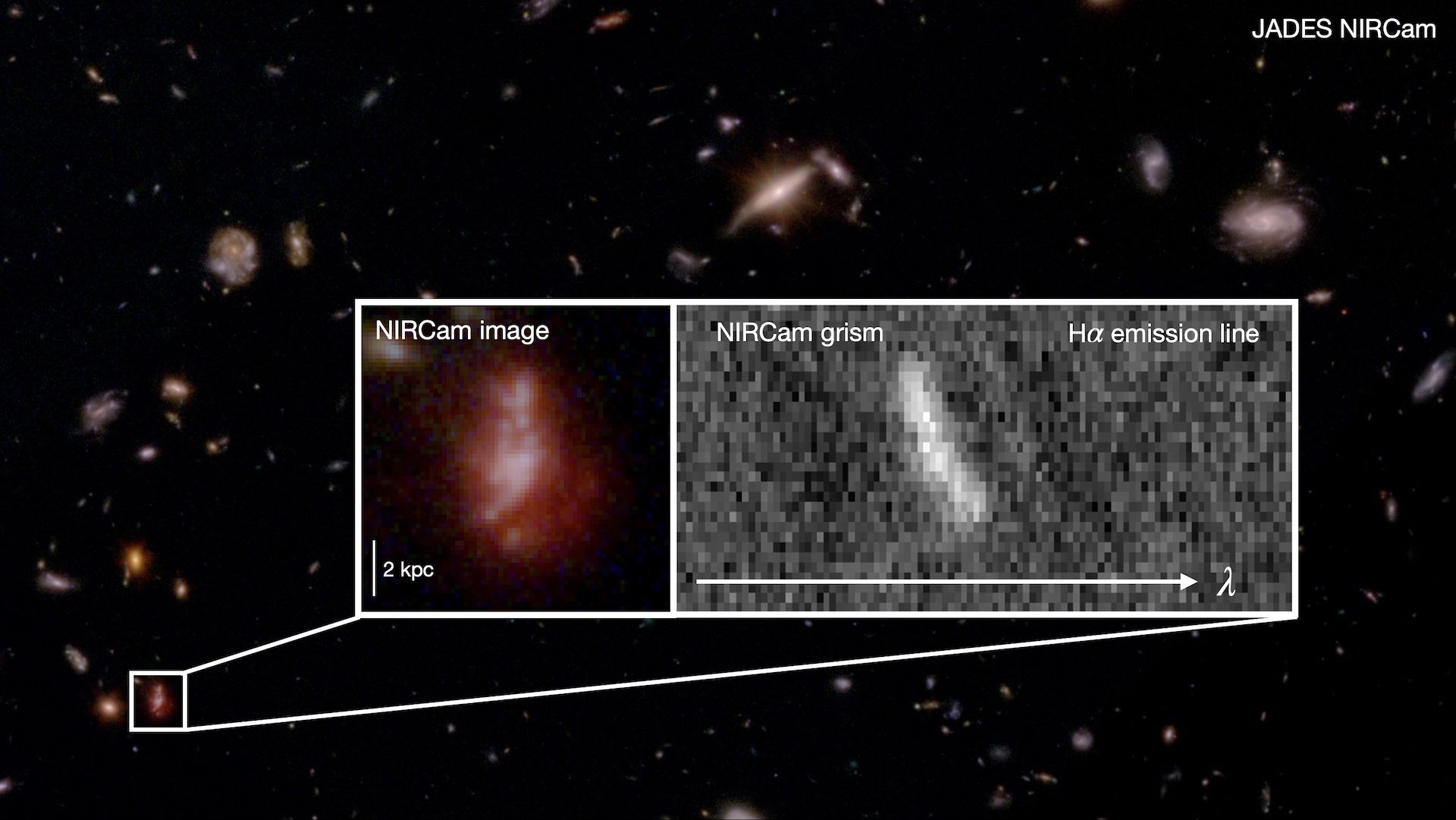
Webb Telescope Reveals Early Galaxies Grew Through Violent, Turbulent Phases
WASHINGTON – New observations from the James Webb Space Telescope (JWST) are challenging previous understandings of galaxy formation, revealing that early galaxies experienced a far more chaotic and turbulent youth than previously thought. A study led by Charlotte Danhaive has provided an unprecedented view of how galaxies evolved from their initial, unstable stages to the more mature structures observed today.
The research indicates that in the early universe, galaxies underwent periods of intense activity, characterized by bursts of star formation and large amounts of gas that disrupted the orderly rotation of galactic disks. “At early times,galaxies are undergoing a turbulent phase of assembly,where strong bursts of star formation and high amounts of gas disrupt the ordered motions of the gas disk,” Danhaive explained. “at later times, galaxies grow their mass and become more stable.”
Structures like our own Milky Way formed relatively recently, within the last few billion years, as star formation consumed available gas. The reduction in free-floating gas allowed galaxies to evolve more smoothly.
The findings were made possible by JWST’s unique capabilities. Positioned in a gravitationally stable location distant from Earth and the moon, the infrared telescope can observe deeper into space than any prior instrument, routinely identifying some of the earliest galaxies ever formed. The observatory, combined with advanced simulations, is helping scientists decipher the patterns of “bursty” star formation and the influence of gas on galactic disk structures.
“our work opens a window into the dynamics of early galaxy formation,” danhaive stated. The team’s next step involves analyzing gas inflows and outflows in individual galaxies, tracking chemical enrichment to understand how galaxies evolved. They anticipate that incoming gas will be less chemically enriched – or “pristine” – while outflowing gas will contain more components from stars within the galaxy. This analysis could explain variations in galactic rotation speeds.
“There is so much more to uncover with JWST’s amazing capabilities,and we look forward to exploring many more aspects of early galaxy formation,” Danhaive added.
