
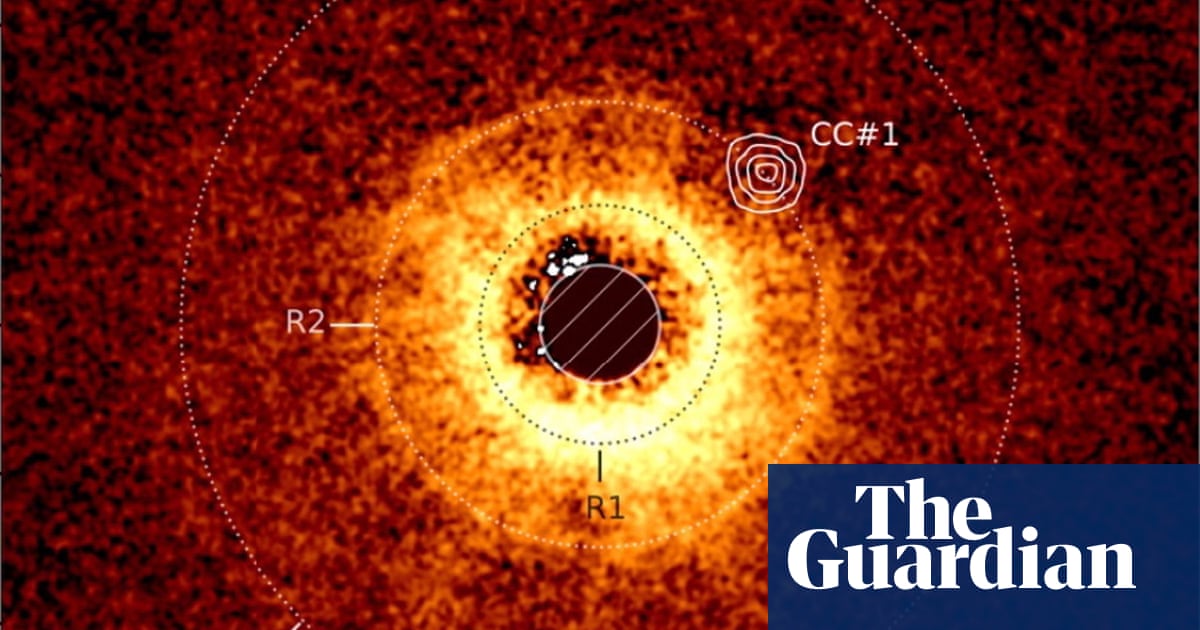
James webb Telescope captures First Direct Image of Exoplanet TWA 7b
Table of Contents
In a groundbreaking achievement, the James Webb Space Telescope (JWST) has directly imaged an exoplanet for the first time, capturing unprecedented views of TWA 7b, a gas giant with the mass of Saturn. Located approximately 110 light-years from Earth, this discovery provides invaluable insights into the formation and evolution of planetary systems .
Unveiling TWA 7b: A Young Gas Giant
TWA 7b orbits the star TWA 7, a relatively young star estimated to be onyl 6 million years old. This makes TWA 7b one of the youngest exoplanets ever observed, offering a unique prospect to study a planetary system in its infancy. The planet is positioned about 50 times as far from its star as Earth is from the sun, resulting in an orbital period of several hundred years.
Did You Know? The first exoplanet was discovered in 1992.Since then,nearly 6,000 more have been identified .
Direct Imaging Breakthrough
Directly imaging exoplanets is a significant challenge due to their faintness and proximity to their much brighter host stars. To overcome this hurdle, astronomers, led by Dr. Anne-Marie Lagrange at the Paris Observatory, utilized a specialized instrument on the JWST designed to mimic an eclipse, effectively blocking the star’s light and revealing the surrounding objects.
This technique allowed them to observe the TWA 7 system “pole on,” providing a clear view of the planetary disc. The images revealed three concentric rings of dust and debris, along with the exoplanet TWA 7b appearing as a distinct bright spot within one of the rings.
Significance of the Discovery
the direct observation of TWA 7b,a gas giant with a mass similar to Saturn,marks a significant milestone in exoplanet research. It is the least massive planet to be directly imaged to date. This achievement provides astronomers with a wealth of data to analyze, shedding light on the planet’s composition, atmosphere, and formation processes.
Pro Tip: Studying young exoplanets like TWA 7b helps scientists understand the early stages of planetary evolution.
Exoplanet TWA 7b: Key Facts
| Property | Value |
|---|---|
| Name | TWA 7b |
| Type | Gas Giant |
| Mass | Similar to Saturn |
| Distance from Earth | 110 light-years |
| Orbital Distance | 50 times Earth-Sun distance |
| Orbital Period | Several hundred years |
Future Research
The discovery of TWA 7b opens new avenues for exoplanet research. Future observations with the JWST and other advanced telescopes will focus on characterizing the planet’s atmosphere, searching for signs of water or other molecules, and further refining our understanding of its formation and evolution.
what other exoplanets do you think the James webb Telescope will discover? How will these discoveries change our understanding of the universe?
Exoplanet Exploration: A Historical Outlook
The search for planets beyond our solar system has captivated scientists and the public alike for centuries. While the first confirmed exoplanet discovery occurred in 1992, the possibility of other worlds orbiting distant stars has been a topic of speculation and scientific inquiry for much longer.
Early exoplanet detection methods relied on indirect techniques, such as observing the wobble of a star caused by the gravitational pull of an orbiting planet or detecting the slight dimming of a star’s light as a planet passes in front of it.These methods have been incredibly accomplished,leading to the discovery of thousands of exoplanets with diverse characteristics.
The James Webb Space Telescope represents a new era in exoplanet exploration, enabling direct imaging and detailed atmospheric studies of these distant worlds. As technology advances, our understanding of exoplanets and their potential for habitability will continue to grow.
Frequently Asked Questions About Exoplanets
What is an exoplanet?
An exoplanet is a planet that orbits a star outside of our solar system. Thousands of exoplanets have been discovered, offering diverse insights into planetary formation and potential habitability.
How did the James Webb Space Telescope discover TWA 7b?
The James Webb Space Telescope (JWST) directly imaged TWA 7b using a specialized instrument that masks the light from the host star, TWA 7, allowing the fainter exoplanet to be observed. This is a significant achievement, as most exoplanets are detected through indirect methods.
How far away is the exoplanet TWA 7b?
TWA 7b is located approximately 110 light-years away from Earth. This distance, while vast, is relatively close in astronomical terms, making it a prime target for detailed observation.
What is the significance of directly imaging an exoplanet?
Directly imaging an exoplanet allows scientists to study its properties, such as its atmosphere and composition, in much greater detail than indirect methods. This provides valuable information about the planet’s formation and evolution.
What are the implications of this exoplanet discovery?
The discovery of TWA 7b provides fresh insights into planetary systems in their early stages of development. Studying this young gas giant can definitely help scientists understand how planets form and evolve over time.
Share this exciting discovery with your friends and family! Subscribe to our newsletter for the latest updates on space exploration and scientific breakthroughs.
