Insolation Thresholds Trigger Abrupt Cold and Drought in East Asian Monsoon Climate
East Asian monsoon climates cross solar radiation thresholds to trigger abrupt, severe cold and dry events that can last for several thousand years.
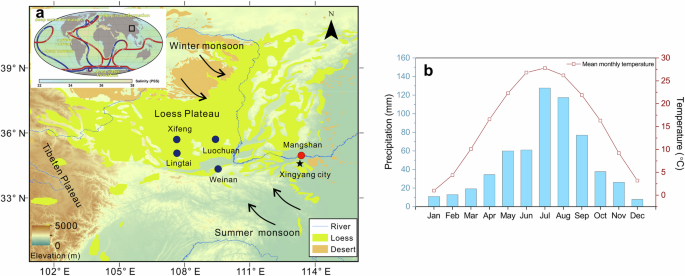
Geoscientists analyzing fossil membrane molecules within sediment sequences on the Chinese Loess Plateau mapped how continental conditions shifted over the past 250,000 years. The study, published in Communications Earth & Environment, demonstrates that temperature and precipitation generally track incoming solar radiation across astronomical timescales. However, researchers observed sharp deviations from this baseline pattern during glacial periods when regional solar radiation dipped below specific critical levels.
Conventional analytical methods struggle to separate ancient shifts in temperature from historical changes in precipitation. To overcome this obstacle, the researchers relied on a specialized laboratory technique that isolates subtle molecular variations in the cell membranes of soil bacteria.
Bacteria alter these membrane molecules in response to environmental shifts, and structural changes caused by temperature differ distinctly from those driven by precipitation. By examining these preserved organic compounds in sediment cores, the science team reconstructed past land temperatures and hydroclimate variability independently.
Data comparisons with climate models revealed that extreme cold and dry spells occurred when incoming solar radiation dropped past a predictable tipping point. Francien Peterse, a co-author of the study, noted the wider context of these shifts.
These abrupt changes in the monsoon climate occur mainly when CO₂ concentrations are low,
Peterse said, explaining that background climate states dictate how the land responds.
Lead author Hao Lu elaborated on the timing of these transitions during glacial cycles. We see that, over astronomical timescales, both temperature and precipitation track changes in incoming solar radiation, although precipitation sometimes responds only after a delay of a few thousand years,
Lu said. But we also found departures from this pattern: abrupt periods of extremely cold and dry conditions that can last for several thousand years.
The research team found that while falling insolation crossed a threshold to trigger these arid cold phases, the regional climate only recovered once incoming solar radiation climbed back above that critical boundary.