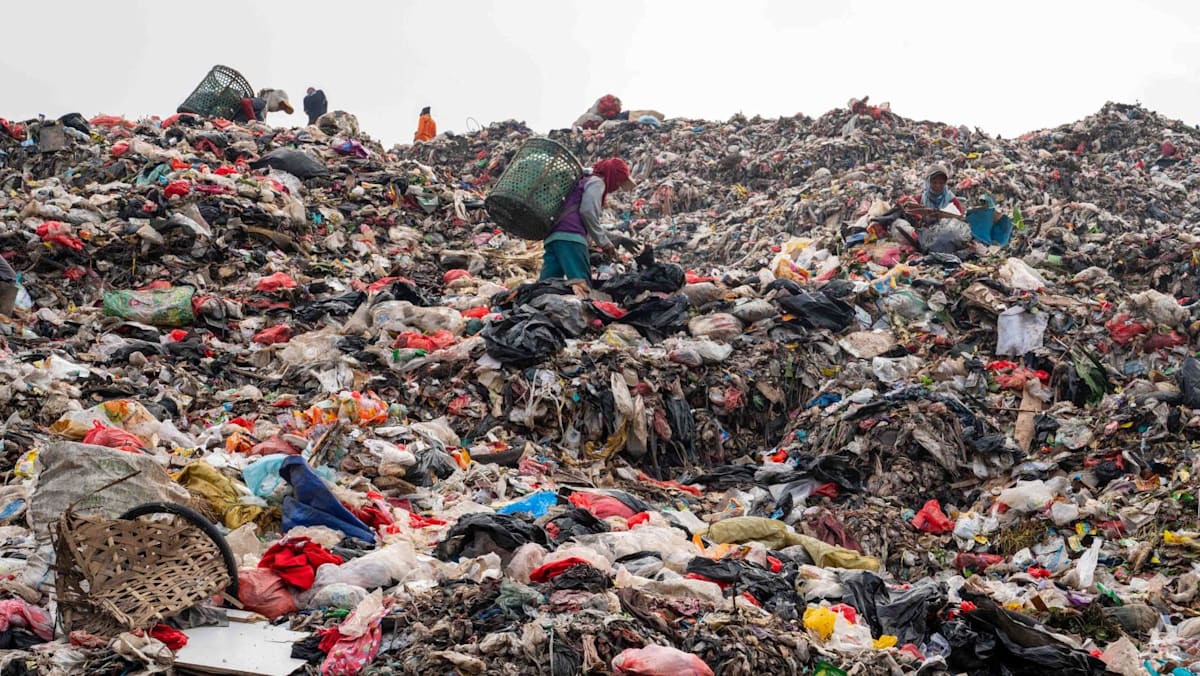
Indonesia’s Waste Crisis: Strategies to Tackle Jakarta’s Landfill Emergency
Indonesia is facing a critical environmental tipping point as its primary landfills reach maximum capacity. The nation’s waste crisis, centered in the Greater Jakarta area, has forced a pivot toward mandatory household sorting and international waste-to-energy models to avert a complete collapse of municipal sanitation infrastructure by late 2026.
The situation in Bantar Gebang—the massive landfill serving Jakarta—is no longer just an environmental concern; it is a structural failure of urban planning. With millions of tons of waste accumulating annually, the “ticking time bomb” metaphor used by local officials is an understatement. The soil and groundwater contamination risks are rising and the social cost of ignoring this crisis has reached a point where administrative mandates are no longer optional.
The Architecture of a Failing System
For decades, Indonesia relied on a “collect and dump” model. This linear approach ignored the reality of modern consumption patterns. As of June 2, 2026, the government has begun enforcing strict domestic waste sorting policies. While these regulations attempt to curb the volume of trash reaching landfills, they are essentially band-aids on a severed artery.
The problem is not just the volume; it is the composition. Organic waste, which accounts for more than half of the municipal solid waste stream, is currently sent to rot in anaerobic conditions, producing significant methane—a potent greenhouse gas. The shift toward a circular economy requires more than just sorting at the door; it requires a fundamental overhaul of how waste is processed and financed.
Businesses operating within the region are finding that the regulatory environment is shifting from “suggested compliance” to “mandatory operational changes.” Companies failing to adapt to new waste management protocols face significant legal exposure. Firms are increasingly turning to environmental compliance law firms to navigate the shifting landscape of municipal waste legislation and avoid heavy penalties.
Learning from the Danish Model
Jakarta’s interest in the Danish waste-to-energy strategy is a recognition that incineration—when managed with high-tech filtration—can reduce landfill volume by up to 90 percent. However, importing a European model into an Indonesian context is fraught with logistical hurdles, ranging from the high moisture content of tropical waste to the massive capital expenditure required for such facilities.

“The transition to waste-to-energy is not a silver bullet. Without a robust, enforced sorting system at the household level, the calorific value of our waste is too inconsistent for high-efficiency incineration. We are not just building plants; we are attempting to build a new culture of waste responsibility overnight.” — Dr. Aris Wahyudi, Senior Fellow at the Institute for Sustainable Urban Infrastructure
This transition creates a massive demand for specialized engineering and infrastructure development. The technical gap between current landfill management and modern, circular waste processing is where the next decade of investment will be directed. For municipalities and private developers, the complexity of these projects necessitates early engagement with civil and environmental engineering consultants to ensure that infrastructure projects meet both local standards and international environmental benchmarks.
The Economic Reality of Waste Management
The financial burden of this crisis is currently being offloaded onto the public sector, but this is unsustainable. The World Bank’s global assessment on solid waste management highlights that cities in developing economies must move toward “polluter pays” models to fund the next generation of infrastructure. Indonesia’s current environmental funding mechanisms are being scrutinized for their lack of transparency and efficiency.
| Category | Current Status (2026) | Projected Requirement |
|---|---|---|
| Landfill Capacity | Near 95% saturation | Need for 3 new regional hubs |
| Household Sorting | Mandatory (Inconsistent) | Universal enforcement/compliance |
| Waste-to-Energy | Pilot Phase | National grid integration |
The shift is not merely governmental. Small-to-medium enterprises (SMEs) are now being pressured to provide documentation on their waste output. As local ordinances become more granular, businesses must ensure their supply chains are transparent. Engaging with professional waste diversion and logistics providers is becoming a standard requirement for maintaining a valid operating license in major metropolitan areas.
The Path Forward: A Systemic Shift
The urgency of the situation cannot be overstated. By mid-2026, the reliance on traditional landfilling has reached a critical threshold. The government’s move to mandate household sorting is a necessary first step, but it is only the beginning of a much longer, more painful transition toward a circular economy.
We are witnessing the end of the era where waste could be ignored simply by moving it out of sight. The future of Indonesia’s urban centers depends on the ability to treat waste as a resource rather than a liability. This requires deep collaboration between policymakers, the private sector, and the public.
For those operating in the region, the “ticking time bomb” is an indicator of a market in flux. The companies that thrive will be those that integrate sustainability into their core operations today, rather than reacting to the inevitable environmental and regulatory crises of tomorrow. As the landfills close, the window for passive compliance closes with them. The question remains whether the infrastructure will be built fast enough to outpace the mounting piles of refuse, or if the system will buckle under the weight of its own inertia.