
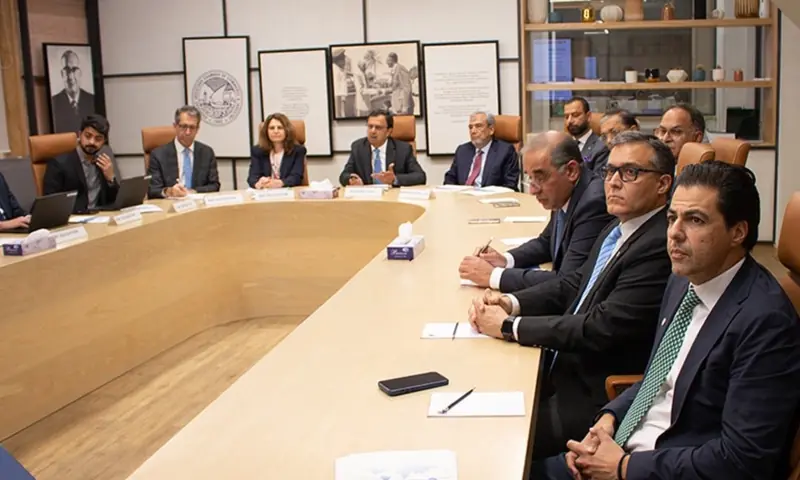
Karachi – An International Monetary Fund (IMF) mission, led by Iva Petrova, concluded meetings with Pakistan’s leading business organizations on Friday, February 28th, 2026, as part of its ongoing third review of the country’s $7 billion Extended Fund Facility (EFF). Discussions centered on the need to translate recent economic stabilization into sustainable investment, export growth, and job creation, according to statements released by the Pakistan Business Council (PBC) and the Overseas Investors Chamber of Commerce and Industry (OICCI).
The IMF team, which arrived in Pakistan on February 25th, is assessing the nation’s progress toward meeting key economic targets, including a primary fiscal surplus and controlled inflation, projected to remain between 5% and 7% [HRNW]. The review is critical for unlocking approximately $1.2 billion in funding – $1 billion from the EFF and $200 million from the $1.1 billion Resilience and Sustainability Facility (RSF) – expected by late April 2026 [Freepressjournal.in].
A delegation from the PBC, headed by Chairperson Dr. Zeelaf Munir, met with Petrova and IMF Resident Representative Mahir Binici. The PBC emphasized the necessity of structural reforms to restore private sector confidence, noting that the State Bank of Pakistan’s (SBP) current policy rate of 10.5% and a recorded primary surplus provide a foundation for such changes. The conversation focused on moving beyond stabilization to policies that stimulate investment, and employment.
Foreign investors, represented by the OICCI, pressed for the abolition of the “super tax” levied on income, dividends, and capital gains, arguing it disproportionately burdens compliant businesses and hinders export expansion. Dr. Zeelaf Munir called for a phased reduction of the corporate tax rate to 25% and a streamlining of advance and withholding tax regimes, which are currently considered de facto minimum taxes. The OICCI, led by President Yousaf Hussain, advocated for a centrally coordinated, medium-term National Economic Plan to transition to a sustained, export-led growth path.
Hussain argued that such a plan must integrate fiscal, trade, industrial, energy, and human capital policies, with clear milestones and enhanced coordination between federal and provincial governments to achieve national economic priorities. OICCI Secretary General M. Abdul Aleem highlighted Pakistan’s geo-economic potential, asserting that it remains largely untapped due to a lack of policy coherence and predictability [Propakistani.pk].
Finance Minister Muhammad Aurangzeb has expressed optimism regarding a staff-level agreement with the IMF, anticipating that discussions will also shape the contours of the upcoming Federal Budget 2026-27 and address systemic issues like circular debt and tax evasion [Freepressjournal.in]. Though, the IMF mission is expected to scrutinize revenue shortfalls at the Federal Board of Revenue (FBR) and the implementation of energy sector reforms [HRNW].
The IMF mission is scheduled to remain in Pakistan until March 11th, after which it will assess the findings and determine whether to recommend the release of the next tranche of funding. The outcome of the review remains uncertain, with Aurangzeb noting We see “too early to predict outcomes” despite describing the discussions as “meaningful” [Freepressjournal.in].
