
Laser Array Scaling Challenges Optical Performance
New Study Models Thermal Impact on Data Transmission
Advancements in data transmission rely on multi-wavelength light sources, but scaling laser arrays introduces critical thermal issues. A new study reveals how these challenges affect laser efficiency and overall reliability.
Understanding Laser Thermal Crosstalk
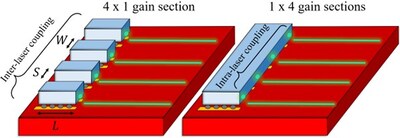
A recent investigation, published in the IEEE Journal of Selected Topics in Quantum Electronics, has developed and validated a thermo-optic laser model. The research, led by Dr. David Coenen and his team, explores the intricate relationship between laser array design and its thermal behavior. The study specifically examined configurations for transceivers requiring 64 distinct laser output channels.
The team analyzed key parameters to determine optimal designs for energy efficiency, reliability, and minimal footprint. Factors considered included the number of lasers per die, individual laser die dimensions, laser gain and output power, ambient temperature, thermal management techniques, and the integration of lasers (internal versus external).
The findings highlight a significant trade-off: smaller array areas lead to substantially increased thermal crosstalk and elevated temperatures, impacting performance. Conversely, extending laser length can boost light generation per gain section and reduce thermal resistance, though this must be balanced against potential optical losses from the longer gain path.
External Lasers Face Trade-offs
For external lasers, the need to compensate for fiber coupling losses presents difficulties, particularly at higher ambient temperatures. These lasers struggle more to achieve the necessary output power. However, external lasers offer the advantage of being thermally isolated from heat-generating components, such as those found in co-packaged optics for network switches.
The study’s conclusions provide valuable insights for designers, offering tools to assess the impact of various design choices on critical performance metrics. Further validation results are anticipated for presentation at the upcoming CLEO conference.
The research paper, “Thermal Scaling Analysis of Large Hybrid Laser Arrays for Co-Packaged Optics,” details these findings. According to industry reports, the global data center market is projected to reach $699.19 billion by 2030, underscoring the growing importance of efficient and reliable optical technologies (Grand View Research, 2024).
