ICJ Rules Myanmar Military Operations Against Rohingya Constitute Genocide
The International Court of Justice (ICJ) ruled on November 19 that Myanmar’s 2017 military operations against the Rohingya in Rakhine State constituted genocide, marking the first time the UN’s top court has held a state directly responsible under the 1948 Genocide Convention.
Judicial Findings on Myanmar’s Military Conduct
In a nine-to-six decision, the court determined that the Myanmar military’s “clearance operations” resulted in the destruction of nearly 400 villages, the killing of approximately 10,000 people, and systematic sexual violence against women and girls, according to DW.com. The ruling cited evidence of mass arson and the use of bulldozers to raze Rohingya settlements.
Myanmar is the first state ever found to have committed genocide by the Intl Court of Justice. Genocide must have consequences. The world must act decisively to isolate the military regime of Myanmar and deprive it of the means to continue its brutal attacks on Myanmar civilians.
The ICJ concluded that Myanmar failed to prevent or punish acts of genocide and actively obstructed investigations by blocking UN access and destroying evidence. The court’s mandate now requires the current military-backed government to initiate prosecutions against those responsible and provide reparations to survivors.
Refugee Responses in Cox’s Bazar
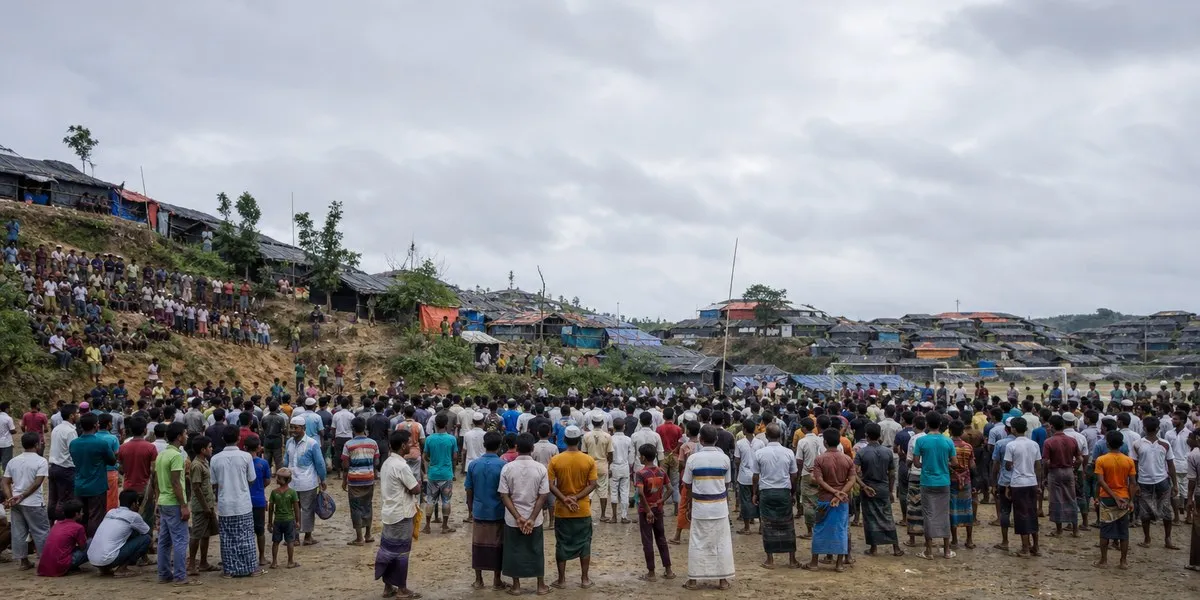
For the 1.2 million Rohingya refugees living in overcrowded camps in Bangladesh, the verdict represents a fragile milestone. “This is a victory, because it acknowledges the genocide and the suffering of the Rohingya people,” said Mohammad Rofik, a community leader in the camps, as reported by DW.com.
MULTIMEDIA: View photos and videos of the reading of the #ICJ Judgment in the case concerning Application of the Convention on the Prevention and Punishment of the Crime of Genocide (The #Gambia v. #Myanmar: 11 States intervening).https://t.co/oRTwbZIESg pic.twitter.com/y4LqB5ORfv
However, the practical reality of the ruling remains limited. While the ICJ’s judgments are legally binding, the court lacks an independent enforcement mechanism. Refugees in the camps continue to face daily risks from fire, infectious disease, and monsoon-triggered landslides, according to DW.com.
International and Regional Reactions
The ruling has triggered varied diplomatic responses. The United Nations Secretary-General António Guterres welcomed the decision as a necessary step toward accountability and reconciliation. Conversely, China has criticized the court’s intervention. Speaking on November 20, Chinese Foreign Ministry spokesperson Guo Jiakun argued that international judicial bodies should act with caution, stating that such rulings may complicate the dispute rather than resolve it, as noted by RFI.

The court’s composition reflected these divisions. Chinese judge Xue Hanqin voted in support of Myanmar, while two German judges, including an ad hoc judge appointed by Myanmar, also dissented. The case, originally initiated by The Gambia in 2019, has set a new legal precedent that observers suggest may influence other ongoing proceedings at the ICJ, including cases concerning the conflict in Gaza, according to reporting by the BBC.
Accountability and Future Implementation
The UN High Commissioner for Human Rights, Volker Türk, urged countries to stop the flow of military equipment to Myanmar and to support the preservation of evidence. He emphasized that no Rohingya should be returned to Myanmar until conditions are deemed safe and sustainable, as reported by DW.com.
LEARN MORE: The full text of the #ICJ Judgment in the case concerning Application of the Convention on the Prevention and Punishment of the Crime of Genocide (The #Gambia v. #Myanmar: 11 States intervening).https://t.co/IEAfHOc2Te pic.twitter.com/Ny8sCWLU9P
The United Kingdom, serving as the “pen holder” on Myanmar issues at the UN Security Council, has called for an emergency session to discuss the implementation of the ruling. “We must ensure the court’s ruling sends a clear message that no one can commit these heinous crimes with impunity,” the UK government said.
The International Court of Justice, seated in the Peace Palace in The Hague, is the only principal UN organ not located in New York City. Established in June 1945 by the UN Charter, it began work in April 1946 as the successor to the Permanent Court of International Justice.
Its 15 judges are elected for nine-year terms by the General Assembly and Security Council, with no two judges permitted to be nationals of the same country.
The court has granted Myanmar a two-year window to submit a report on the implementation of remedial measures and the establishment of compensation mechanisms. “The path to justice has begun, but we still have a long way to go,” Rofik told DW.com.
"Statement on the Judgment of the International Court of Justice on Myanmar" 19th November 2026 pic.twitter.com/eyxTLSfOyl
More on Myanmar
NEWS: @CIJ_ICJ determines Myanmar committed genocide against the Rohingya during the 2017 clearance operations in northern Rakhine State.@antonioguterres calls the judgement a demonstration of international justice.https://t.co/1RCbI9g5hb pic.twitter.com/E51EwzIIDf
2/3 The International Court of Justice delivered its judgment on the merits on 19 November. Brought by The Gambia in 2019, the case concerns Myanmar’s alleged violations of the Genocide Convention against the Rohingya.
📢 UPDATE: Remote participation is now available! Join the discussion on the International Court of Justice’s judgment in The Gambia v. Myanmar and its implications for the Rohingya community, accountability and international law. 📅 20 November | 14:00 CET pic.twitter.com/rdip1uoaS9