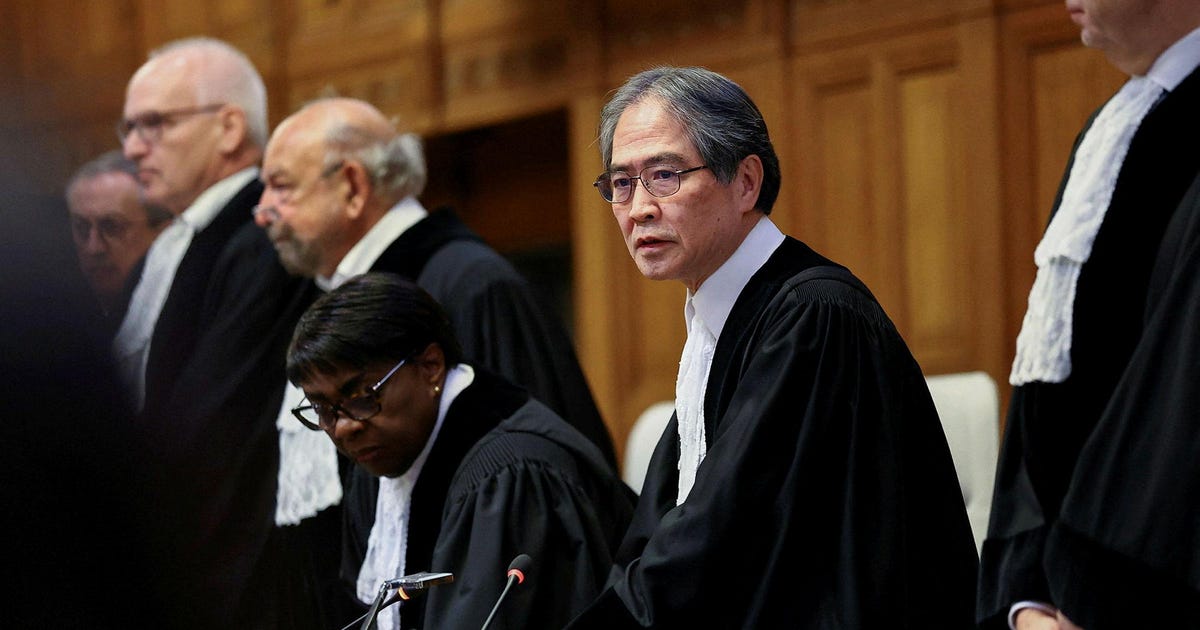
ICJ Rules Myanmar Committed Genocide Against Rohingya in Historic First Verdict
The International Court of Justice (ICJ) ruled on Thursday that Myanmar committed genocide against the Rohingya, marking the first time in the court’s 80-year history that it has held a state accountable for the crime.
The decision, reached by a vote of nine to six, concludes a case initiated in 2019 by The Gambia.
The court’s judgment confirmed that Myanmar’s security forces engaged in mass killings, widespread sexual violence, and the systematic destruction of villages in Rakhine state during 2017. Presiding judge Iwasawa Yuji stated during the reading of the decision that the scale and nature of the atrocities were “characteristic of an intent to destroy a substantial part of the group,” as reported by CNN.
“The Myanmar military tried to convince the world that we had lied,” said 58-year-old Monajat Alam, from Rathedaung Township. “Today, the truth has been recognized.” As the ICJ delivered its landmark genocide ruling, thousands of Rohingya in refugee camps in Bangladesh awaited…
General Assembly President Khalilur Rahman, who traveled to refugee camps in Bangladesh to address survivors, described the ruling as a historic acknowledgment of their suffering.
“Yesterday in The Hague, the highest court of the United Nations spoke. It spoke your name: Rohingya. Yes, Rohingya. Its decision was clear. What was done to you in 2017 was genocide,” Rahman told the crowd, according to UN News.
The @CIJ_ICJ has found #Myanmar responsible for genocide against the #Rohingya, in the case of The Gambia v. Myanmar. It is the first time in the court's history that a State has been held responsible under the Genocide Convention. https://t.co/QckKqbmo36 pic.twitter.com/E3JuQFZvyH
Requirements for Reparations and Reform
As part of its judgment, the ICJ ordered Myanmar to establish a program of restitution and compensation for the victims. The court mandated that Myanmar report back within two years on the specific steps taken to implement these reparations.
Rahman outlined four priorities for the international community following the verdict: justice through legal reform and the prosecution of those responsible, the safe and voluntary return of refugees, the provision of reparations, and the implementation of institutional safeguards to prevent future violence.
MULTIMEDIA: View photos and videos of the reading of the #ICJ Judgment in the case concerning Application of the Convention on the Prevention and Punishment of the Crime of Genocide (The #Gambia v. #Myanmar: 11 States intervening).https://t.co/oRTwbZIESg pic.twitter.com/y4LqB5ORfv
“Money cannot replace life. Money cannot replace loved ones that were lost,” Rahman said. He emphasized that while financial compensation is required, it must be accompanied by guarantees of safety and freedom of movement for those seeking to return to their homeland.
ICJ Ruling Changes International Jurisprudence Through Complex Legal Standards
The ruling changes international jurisprudence. While the ICJ has previously adjudicated disputes between states, this is the first instance in which the court has issued a finding of genocide against a sovereign state.

The decision was not unanimous, and the 11 separate opinions filed alongside the judgment highlight the complexity of the legal standard applied. According to EJIL: Talk!, the dissenting judges argued that the majority adopted a flexible approach to evidence, noting that the court’s findings blurred the distinction between genocide and other crimes against humanity, such as ethnic cleansing.
The dissenters maintained that the evidence presented did not meet the standard of the “only reasonable inference” required to prove genocidal intent.
Enforcing Court Orders Faces Practical and Diplomatic Challenges
The practical enforcement of the court’s orders remains a central challenge. Because the ICJ lacks its own police force, its rulings are typically transmitted to the UN Security Council for potential implementation through resolutions.
LEARN MORE: The full text of the #ICJ Judgment in the case concerning Application of the Convention on the Prevention and Punishment of the Crime of Genocide (The #Gambia v. #Myanmar: 11 States intervening).https://t.co/IEAfHOc2Te pic.twitter.com/Ny8sCWLU9P
UN human rights chief Volker Türk described the judgment as a historic examination of the “decades of discrimination and marginalization of the Rohingya,” according to CNN. However, many refugees remain in camps in Bangladesh, facing restricted movement and limited access to basic services.
The International Court of Justice serves as the principal judicial organ of the United Nations and is the only one of its six main branches not located in New York City. Established in 1945, the court operates from the Peace Palace in The Hague, Netherlands.
It is composed of 15 judges elected to nine-year terms, selected to represent the world’s principal legal systems. While its rulings are final and binding on the parties involved, the court possesses no formal enforcement mechanism, leaving the implementation of its decisions as a political matter for the UN Security Council.
The court’s ruling comes as international justice mechanisms face varying levels of scrutiny from global powers. While the ICJ has since permitted South Africa to bring a separate case against Israel regarding the war in Gaza, the long-term impact of the Myanmar judgment on future litigation is uncertain.
Earlier coverage: ICJ Rules Myanmar Military Operations Against Rohingya Constitute Genocide
More on Myanmar
NEWS: @CIJ_ICJ determines Myanmar committed genocide against the Rohingya during the 2017 clearance operations in northern Rakhine State.@antonioguterres calls the judgement a demonstration of international justice.https://t.co/1RCbI9g5hb pic.twitter.com/E51EwzIIDf
📢 UPDATE: Remote participation is now available! Join the discussion on the International Court of Justice’s judgment in The Gambia v. Myanmar and its implications for the Rohingya community, accountability and international law. 📅 20 November | 14:00 CET pic.twitter.com/rdip1uoaS9