
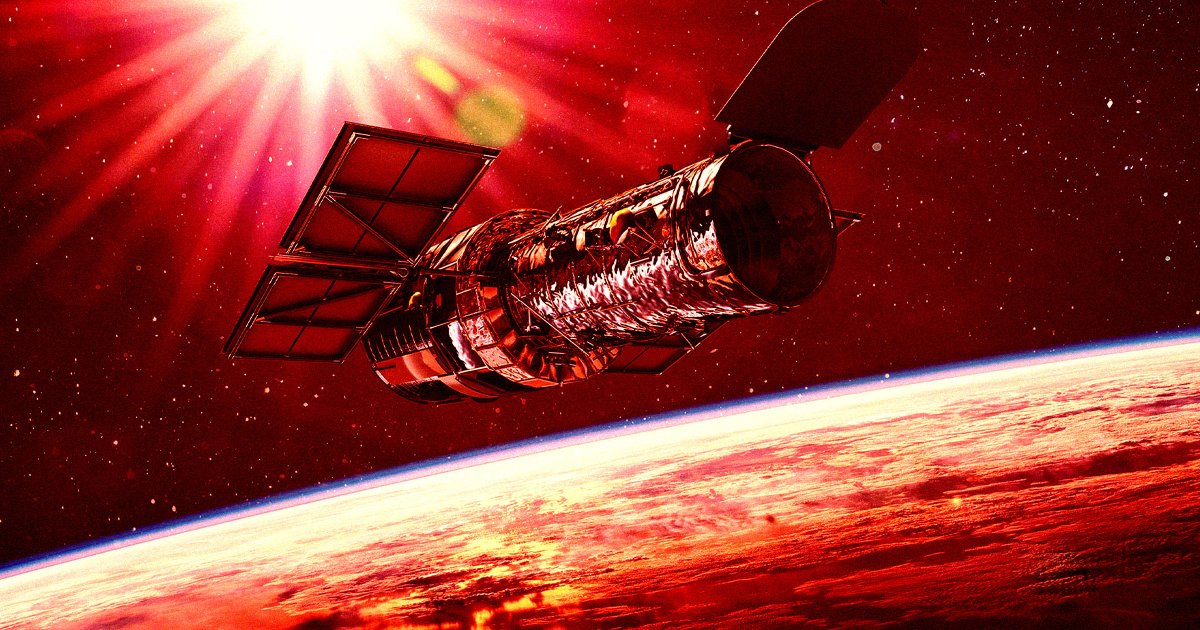
A newly released visualization of the Hubble Space Telescope’s orbit indicates the iconic observatory is losing altitude at an accelerating rate, potentially leading to its deorbit before 2030, according to Harvard astronomer Jonathan McDowell. The graph, posted on Bluesky, shows a significant decline in Hubble’s altitude – from approximately 330 miles in 2020 to around 300 miles in 2026 – a steeper drop than observed in previous decades.
NASA, but, maintains a more conservative estimate, stating on its website that Hubble is “not expected to re-enter Earth’s atmosphere until the mid 2030s at the earliest.” The agency attributes the decline to atmospheric drag, which gradually lowers the telescope’s orbit. NASA’s plan, as outlined on its website, involves either a controlled reentry into the South Pacific Ocean or a boost into a higher orbit, though the timing and feasibility of such a mission remain unclear.
Launched in 1990 aboard the Space Shuttle Discovery, Hubble was designed for in-orbit servicing. Five servicing missions were conducted between 1990 and 2009, allowing astronauts to repair and upgrade the telescope, extending its operational life. These missions are reflected in McDowell’s graph, which shows periodic increases in altitude corresponding to orbital boosts performed by the Space Shuttle.
With the retirement of the Space Shuttle program, however, servicing Hubble has become exceedingly difficult. A 2019 study highlighted that Hubble was intended to be retrieved by the Shuttle at the finish of its life, a scenario that became impossible with the program’s conclusion. The study predicted a potential atmospheric reentry as early as 2029, with 2033 as the most likely timeframe. A follow-up study published in November 2025 as well pointed to 2033 as the probable reentry year.
The future of Hubble has become a focal point since Jared Isaacman, the recently appointed NASA administrator, proposed a private mission to repair the telescope using a SpaceX Crew Dragon spacecraft. Isaacman initially floated the idea in 2022, offering to personally fund the mission. However, NASA previously expressed concerns about the risks associated with attempting repairs on the aging telescope with a spacecraft different from the Space Shuttle.
Hubble currently orbits at an altitude of approximately 326 miles (525 km), according to NASA. Its low-Earth orbit, below 1,200 miles (2,000 km), allows it to operate above the distorting effects of Earth’s atmosphere, providing exceptionally clear images of the cosmos. The telescope’s orbit has varied over the years, reaching as high as 360 miles (579 km), but requires periodic boosts to counteract atmospheric drag.
The Hubble Space Telescope is a joint project between NASA and the European Space Agency (ESA). It is equipped with a 2.4-meter primary mirror and a suite of instruments, including cameras and spectrographs, enabling observations across the infrared, visible, and ultraviolet spectrums.
