
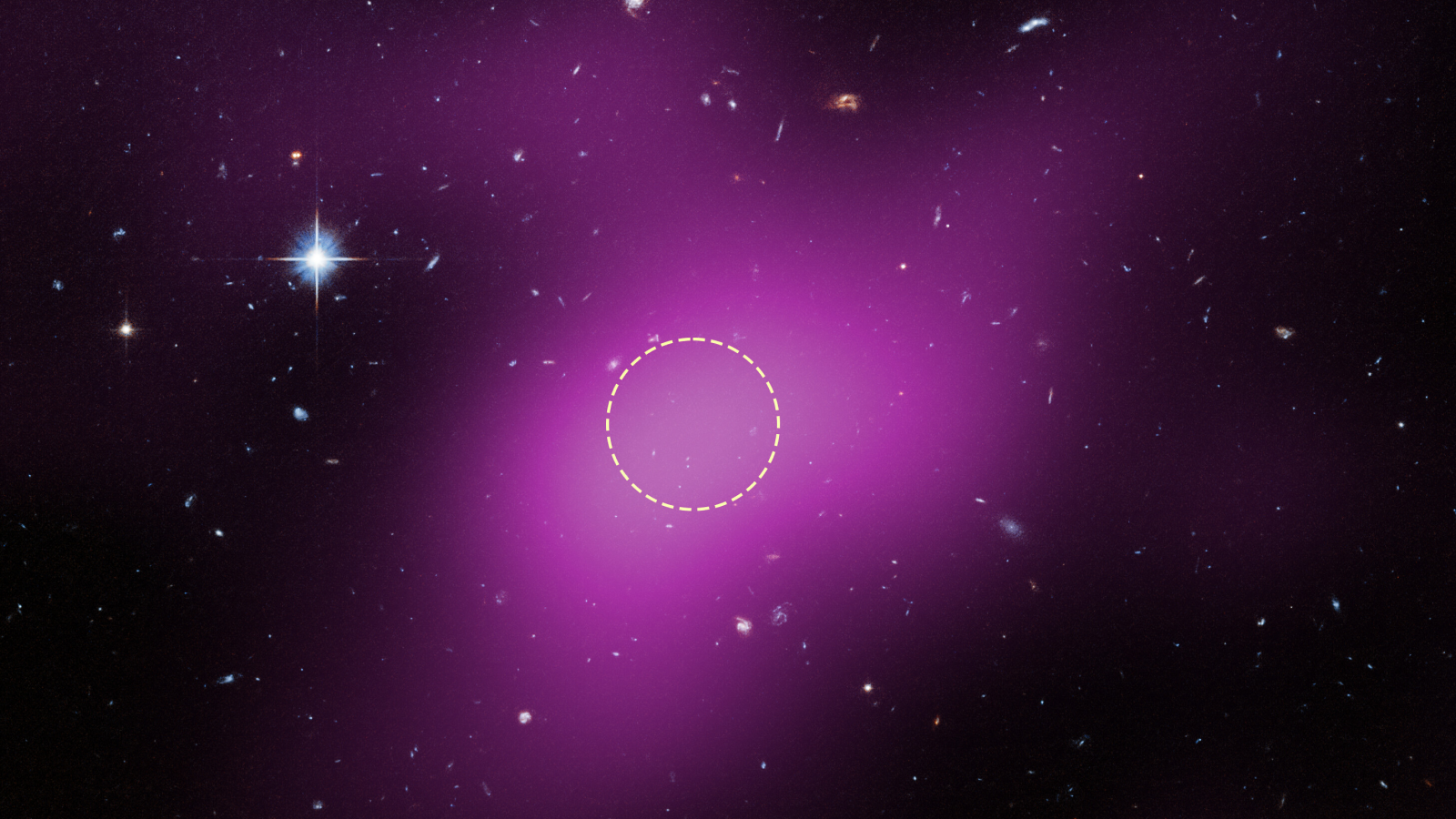
Astronomers have announced the discovery of a unique celestial object, dubbed cloud-9, using the Hubble Space Telescope. This newly identified entity is a starless, gas-rich cloud of dark matter that, remarkably, never quite evolved into a full-fledged galaxy. The findings, detailed in a study published in The Astrophysical Journal Letters, offer a crucial glimpse into the early universe and the processes of galaxy formation.
A Relic of the Early Universe
Located over 14 million light-years away near the spiral galaxy Messier 94 (M94), Cloud-9 represents a “failed galaxy” – a primordial building block that possessed the potential to become a galaxy but lacked the necessary mass to fully collapse. This discovery confirms a critical prediction of the Lambda cold dark matter model (ΛCDM), the prevailing cosmological framework describing the universe’s structure and evolution. The ΛCDM model posits that dark matter halos form first, and galaxies subsequently develop within them. Cloud-9 provides the first direct evidence of a gas-filled, starless dark matter halo on a subgalactic scale, supporting the idea that such structures are common but typically invisible due to their lack of stars 1.
Unveiling a Theoretical phantom
The initial detection of cloud-9 occurred three years ago using the Five-hundred-metre Aperture Spherical Telescope (FAST) in China. Subsequent observations with the Very Large Array in New Mexico initially failed to reveal the object’s true nature. It wasn’t until follow-up observations with Hubble’s Advanced Camera for Surveys that astronomers confirmed cloud-9 as a Reionization-Limited H I Cloud (RELHIC) – a “theoretical phantom object” composed of neutral hydrogen gas 2.
“This hydrogen detection was proof that Cloud-9 was not a typical dwarf galaxy, but something stranger,” explains Andrew Fox, an astronomer at the Space Telescope Science Institute (STScI). The presence of hydrogen gas is crucial,as it indicates that Cloud-9 has retained the raw material for star formation,yet,for reasons still being investigated,star formation hasn’t occurred.
The Critical Mass Threshold and Dark Matter’s Role
The analysis of Cloud-9’s gas content reveals that it contains approximately one million times the mass of our Sun. Though, this mass is insufficient to gravitationally bind the cloud without the presence of a significant dark matter component. Researchers estimate that Cloud-9’s dark matter halo weighs around five billion solar masses 3. This mass is remarkably close to the theoretical threshold at wich a dark matter halo can retain gas and prevent it from collapsing into stars.
“To survive as a dark, gas-rich cloud into the present-day, a system must meet two stringent, and statistically rare, criteria,” explains Alejandro Benitez-Llambay, an astrophysicist at the University of Milano-bicocca. “First,its dark matter halo must have an atypically slow assembly history… Second,the system must remain sufficiently isolated.”
Implications for Cosmology and future Research
Cloud-9’s discovery has notable implications for our understanding of the universe. It provides strong support for the ΛCDM model and suggests that the universe might potentially be teeming with similar, low-mass dark matter halos that remain devoid of stars. These halos, previously only theorized, are now directly observed, offering a new window into the “dark universe.”
The cloud is also in thermal equilibrium with the cosmic ultraviolet (UV) background, a pervasive energy field that inhibits star formation. This further explains why Cloud-9 remains starless. However, researchers don’t rule out the possibility that Cloud-9 could eventually accumulate enough mass to ignite star formation, though the exact mechanisms remain speculative.
Future research will focus on identifying other similar objects. However, finding them will be challenging, as these clouds are faint and easily obscured by brighter celestial sources. They are also susceptible to a process called ram pressure stripping, which can remove their gas as they move through intergalactic space.
Key Takeaways:
- Cloud-9 is a newly discovered “failed galaxy” – a starless, gas-rich dark matter halo.
- Its discovery supports the ΛCDM model of cosmology and the existence of low-mass dark matter halos.
- Cloud-9’s mass is close to the critical threshold for galaxy formation, explaining why it hasn’t collapsed into a galaxy.
- The object’s survival is due to a slow assembly history and relative isolation.
- Future research will aim to find more of these elusive objects to better understand the early universe.
Cloud-9 serves as a powerful reminder that the visible universe – the stars and galaxies we observe – represents only a small fraction of the cosmos. the vast majority of the universe is composed of dark matter and dark energy,and objects like Cloud-9 are helping us unravel the mysteries of this hidden realm.
