
Hubble Glimpses a Galactic Explosion’s Aftermath
Astronomers are using the Hubble Space Telescope to examine the remnants of a stellar explosion in the galaxy IC 758. This distant galaxy, located 60 million light-years away, offers insights into the violent deaths of massive stars and their impact on the cosmos.
A Peaceful Galaxy, a Violent Past
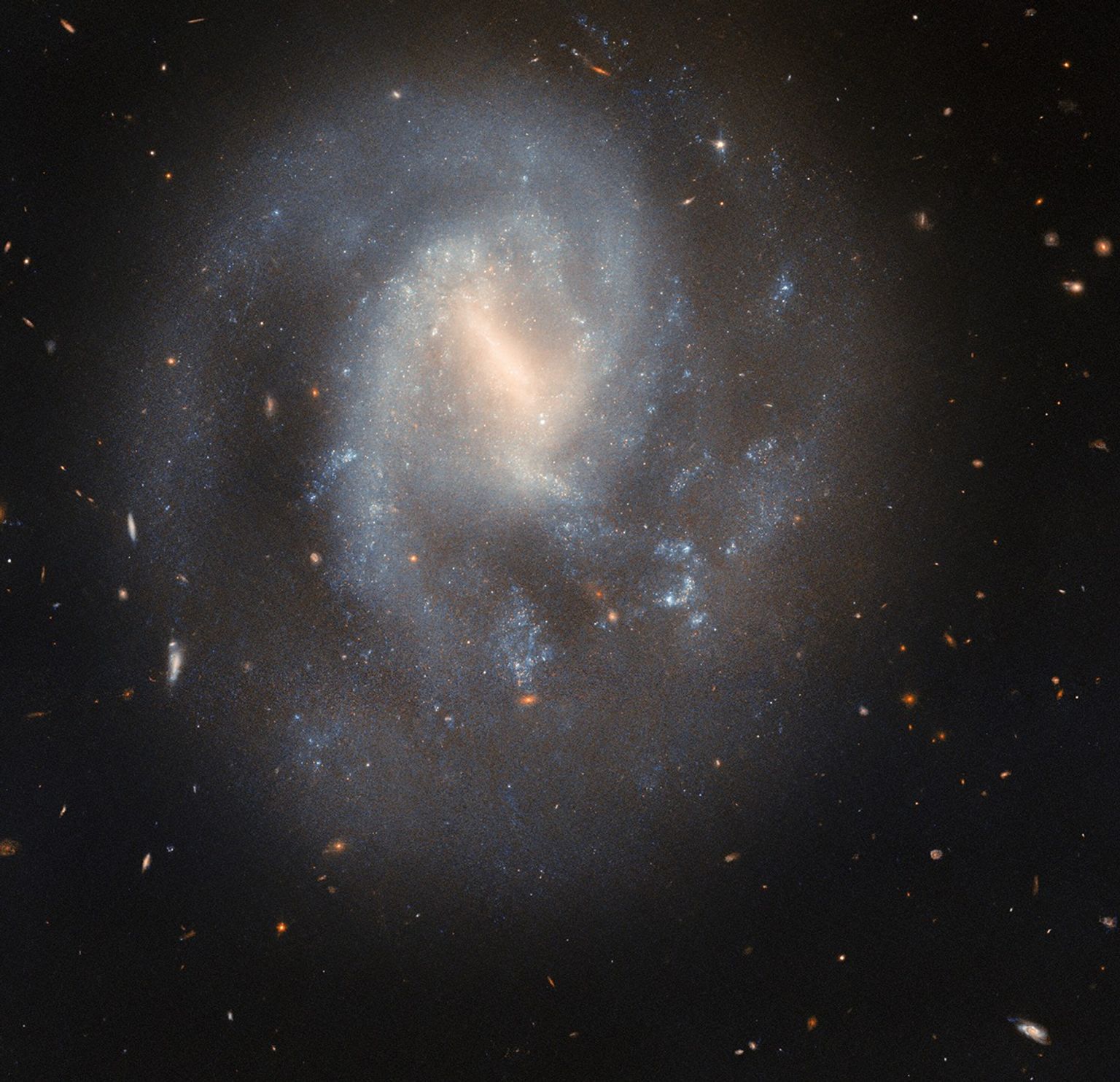
The Hubble Space Telescope captured an image of IC 758 in 2023. The galaxy appears serene, with its blue spiral arms gracefully curving around a hazy center. Yet, this peaceful facade conceals a cataclysmic event from 1999: the supernova SN 1999bg. This explosion marked the end of a star far larger than the Sun.
Researchers aim to use Hubble observations to measure the mass of stars near SN 1999bg. These findings should allow them to estimate the mass of the star that triggered the supernova. They will also examine whether the star had a companion, hoping to learn more about its life and death.
“A supernova represents more than just the demise of a single star – it’s also a powerful force that can shape its neighborhood.”
—Text Credit: ESA/Hubble
Supernovae like SN 1999bg are cosmic events that have a profound effect. They can trigger or halt star formation by compressing or dispersing interstellar gas clouds. Such events also enrich the interstellar medium with heavy elements, the building blocks for new stars. Globally, supernovae occur at a rate of roughly one every 50 years in our galaxy (Space.com, 2024).
Exploring the Aftermath
The image from the Hubble Space Telescope, a joint project of NASA and the European Space Agency, shows the barred spiral galaxy IC 758. This galaxy, found within the constellation Ursa Major, offers valuable data to astronomers.
The ongoing research employing data from the Hubble Space Telescope offers an opportunity to learn more about the life cycle of stars. This knowledge provides essential understanding of the evolution of galaxies.
