How Space Agencies Plan to Sustain Human Life on the Moon and Mars
Establishing sustainable human outposts on the Moon and Mars requires moving beyond Earth-dependent supply chains toward local resource utilization, according to research published by Mondosanità.
Sustaining long-term missions demands the on-site production of water, oxygen, and food, a challenge currently being addressed by space agencies in the United States, China, Russia, and Europe.
The Moon’s south pole remains the primary target for NASA due to the presence of water ice. This ice serves as a vital precursor for breathable oxygen and hydrogen fuel. However, successfully extracting and processing these resources in an environment devoid of an atmosphere—where radiation, temperature extremes, and abrasive lunar dust threaten both equipment and human life—remains unproven at scale.
Engineers are currently evaluating the use of natural lunar lava tubes as potential shelters. These subterranean cavities could provide the thermal stability and shielding necessary for human habitation. Meanwhile, China’s Chang’e program is focusing on the development of construction materials using lunar regolith. The upcoming Chang’e-8 mission, scheduled for 2029, aims to test these materials and evaluate the viability of a closed-loop ecosystem.
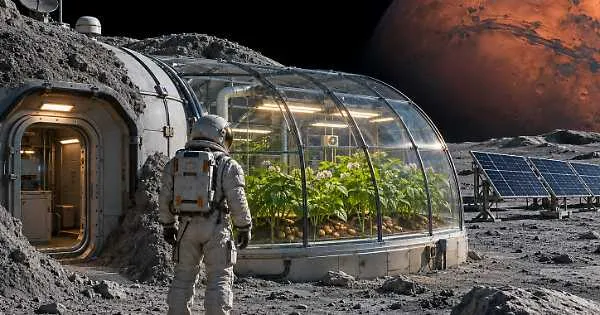
Agriculture remains a major obstacle for survival beyond Earth. A study published on November 19, 2026, in npj Microgravity by researchers at Oregon State University demonstrated that potatoes can grow in simulated lunar regolith when enriched with organic matter, according to Mondosanità. By adding 30% vermicompost to the regolith, the study achieved plant life cycles and tuber production comparable to terrestrial soil.
The experiment confirms that raw regolith is insufficient for farming. Successful lunar agriculture will require a sophisticated infrastructure to manage water, light, and nutrient recycling within protected, pressurized greenhouses.
Mars presents a more complex logistical environment than the Moon. The planet’s distance from Earth necessitates autonomous systems capable of long-term operation without immediate assistance. NASA’s MOXIE experiment, deployed on the Perseverance rover, successfully proved that oxygen can be extracted from the thin, carbon-dioxide-rich Martian atmosphere, producing 122 grams of oxygen during its testing phase.
Future exploration is set to expand in 2028 with the European Space Agency’s ExoMars mission. The Rosalind Franklin rover is designed to drill up to two meters into the Martian subsurface to search for signs of past life and analyze materials shielded from surface radiation.
Scientific discussion regarding the large-scale warming of Mars has shifted from traditional terraforming to the use of artificial nanoparticles. While models suggest that releasing engineered particles into the atmosphere could raise the global temperature by over 30 degrees Celsius, the feasibility remains speculative. Current research indicates that existing CO2 reserves are insufficient to create the necessary atmospheric pressure for human habitation.
Even if global warming were achieved, the environment would remain hostile due to low pressure and radiation exposure. The focus remains on developing high-reliability, pressurized, and shielded habitats.
NASA was established on July 29, 1958, succeeding the National Advisory Committee for Aeronautics to give the U.S. space program a distinct civilian orientation focused on peaceful applications. The agency absorbed 8,000 employees, three major research laboratories, and the Army Ballistic Missile Agency led by Wernher von Braun, consolidating the nation’s civil space efforts under one roof.
It has since led every major American human spaceflight program, from Project Mercury and the Apollo Moon landings to the Space Shuttle and the International Space Station, and now directs the multinational Artemis program targeting the lunar south pole.
The transition from robotic exploration to permanent settlement depends on the ability to integrate disparate technologies into a single, functional life-support system.