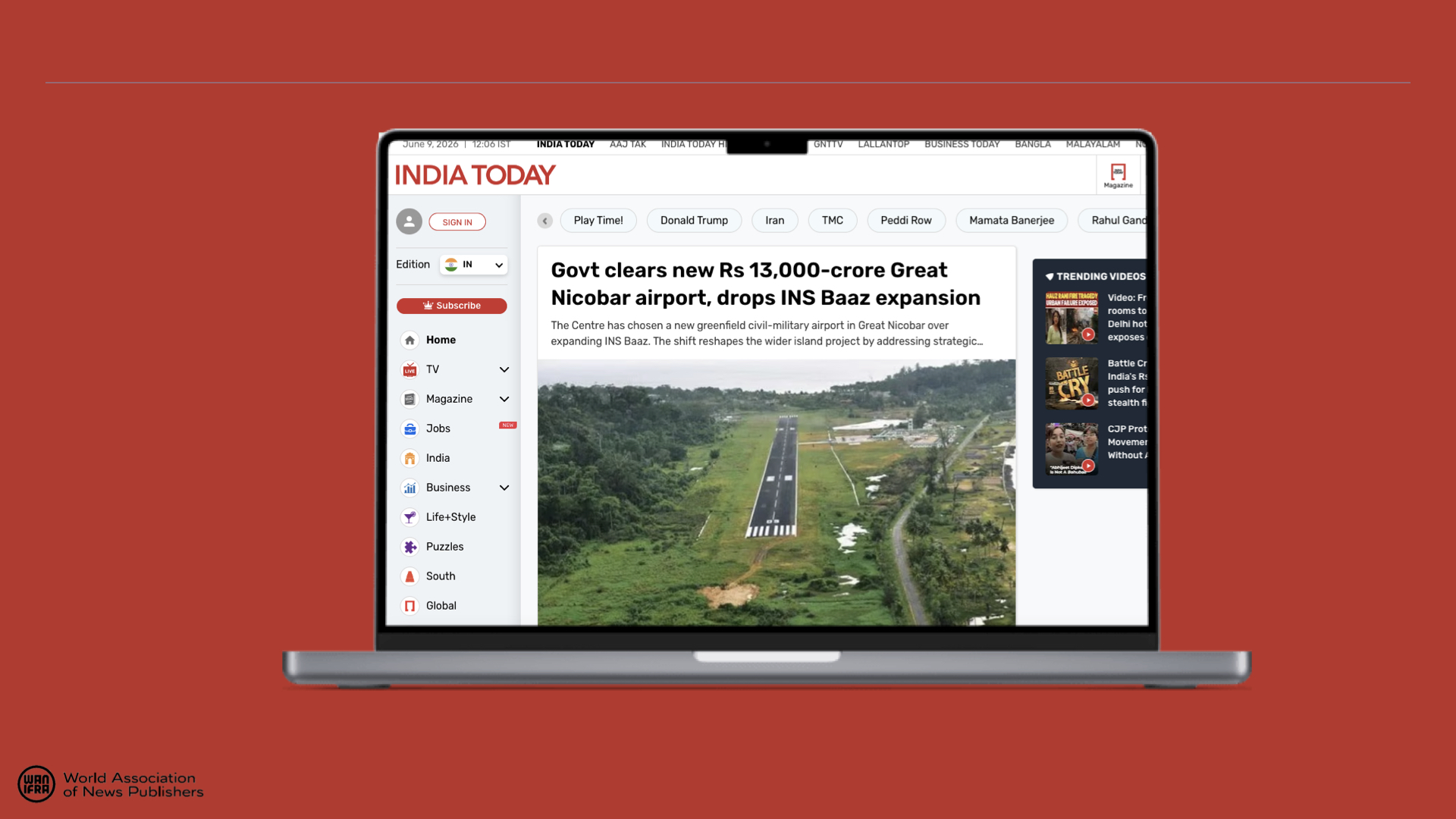
How India Today’s AI-Powered Audience Prediction Tool Audipulse Redefines Editorial Decision-Making
India Today, one of India’s largest multimedia news organizations, has completed a 15-day pilot of Audipulse, an AI-powered audience prediction engine that analyzes engagement data to forecast which stories, formats, and publishing times will perform best the following day. The experiment, developed in-house with on-premises GPU infrastructure, achieved 64% prediction accuracy—12 percentage points higher than human editors’ baseline of 52%. The project, supported by WAN-IFRA’s 2025 Newsroom AI Catalyst program, marks a pivotal test of whether AI can move beyond reactive analytics to proactive editorial guidance in an era where news consumption is increasingly dictated by algorithms.
Why This Experiment Matters: The Race to Outsmart Algorithms
Newsrooms globally are grappling with a fundamental shift: audiences no longer actively seek out sources. Instead, they consume whatever algorithms—primarily those of Google, Facebook, and YouTube—push their way. In this environment, understanding audience expectations isn’t just about measuring past performance; it’s about predicting what will keep readers loyal before the algorithm does.
Bal Krishna, who leads India Today’s Fact Check team and oversaw the Audipulse project, frames the challenge bluntly: “In today’s digital space, where people don’t choose their news source, knowing what your audience expects is critical to retaining them.” The experiment was designed to answer a core question: Can AI turn raw engagement data into actionable editorial decisions before a story is published?
How Audipulse Works: From Data to Predictive Signals
Audipulse operates by combining two key inputs: real-time analytics and draft content. Using data from Chartbeat and Google Analytics, the system ingests metrics like clicks, engagement duration, story topics, and format types (text, video, interactive). It then cross-references these with draft headlines and publishing schedules to generate predictive signals.

The model doesn’t just analyze what worked yesterday—it forecasts tomorrow’s performance. During the pilot, it recommended optimal publishing times and content formats, which editors could accept, reject, or refine. The system also retrains continuously by comparing predicted outcomes with actual engagement data, creating a feedback loop.
The 11% Boost: Cricket, Elections, and the Limits of Pure Data
One of the pilot’s most striking findings was that raw engagement data alone wasn’t enough. When the team incorporated contextual taxonomies—categories like elections, cricket, and Bollywood—the prediction accuracy improved by 11 percentage points, reaching 64%. This suggests that audience behavior isn’t purely data-driven; it’s deeply tied to cultural and temporal contexts.
“The biggest concern was that while data-driven approaches excel at predicting trends, they struggle to capture the deeper context of stories and topics,” Krishna said. The experiment highlighted a critical tension: AI can identify patterns, but it can’t yet fully grasp why those patterns exist—or how they might shift in real time.
Editorial Skepticism and the Path Forward
Early in the pilot, editorial teams were cautious about relying on AI recommendations. Krishna noted that skepticism only dissolved when side-by-side comparisons showed the AI’s predictions outperforming human intuition. This mirrors broader industry challenges: publishers must balance trust in data with the nuanced judgment of experienced editors.

Looking ahead, India Today plans to expand Audipulse’s capabilities. Future phases include:
- Extending predictions to video thumbnails and push alerts.
- Building an explainability layer to show the factors behind each prediction.
- Conducting a 30-day A/B test to further validate the model’s reliability.
The Broader Implications: Can AI Replace Editorial Intuition?
India Today’s experiment isn’t just about improving engagement metrics—it’s about redefining the role of editors in an algorithmic news ecosystem. As WAN-IFRA’s 2025 Newsroom AI Catalyst program notes, publishers are increasingly turning to AI to “anticipate audience needs before they become visible in the data.” But the question remains: Can predictive systems ever fully replace the human element of journalism?
For now, the answer appears to be no. Krishna emphasized that while AI excels at identifying trends, it requires continuous human oversight to refine outputs and adapt to unforeseen context. “To overcome this, it needs more data, monitoring, and dedicated resources,” he said.
Regional Impact: How This Affects Indian Newsrooms and Beyond
India’s news media landscape is uniquely shaped by its diverse audience segments—from urban professionals consuming business news to rural populations following cricket and regional politics. India Today’s pilot offers a case study in how AI can be tailored to these nuances. However, the experiment also raises questions about data privacy and infrastructure. By deploying Audipulse on-premises with local GPU servers, India Today avoided sending sensitive engagement data to external cloud environments—a critical consideration for publishers in regions with strict data sovereignty laws.
“In jurisdictions like India, where data localization is a growing concern, on-premises AI solutions provide both security and compliance advantages,” said Dr. Ananya Roy, a media law expert at the National Academy of Legal Studies and Research (NALSAR). “But the real test will be whether smaller publishers can replicate this without heavy investment in infrastructure.”
What Happens Next: The Future of Predictive Journalism
India Today’s Audipulse is far from the only experiment in predictive newsroom tools. Global players like The New York Times and BBC have also explored AI-driven content recommendations, though with different approaches. The key difference in India Today’s model is its focus on prediction before publication, rather than post-hoc optimization.

For publishers, the implications are clear: the ability to forecast audience behavior could reshape editorial workflows, but it also introduces new risks. Over-reliance on predictive models might lead to homogenization of content—or worse, the exclusion of stories that don’t fit algorithmic patterns but are critically important.
Solutions in the Directory: Who Can Help Publishers Navigate This Shift?
As newsrooms adopt AI-driven prediction tools, several challenges emerge:
- Data Privacy Compliance: Publishers in regions with strict data laws (e.g., India’s Digital Personal Data Protection Act) will need legal expertise to ensure on-premises AI solutions meet regulatory standards. [Data Privacy Law Firms]
- Infrastructure Scaling: Smaller newsrooms may lack the GPU resources to deploy similar systems. Cloud-based AI partnerships or hardware providers could bridge this gap. [AI Infrastructure Consultants]
- Editorial Training: Teams must adapt to working alongside predictive tools without losing their editorial judgment. Media training firms specializing in AI integration can provide this bridge. [Journalism AI Training Programs]
The Kicker: Prediction Isn’t the Future—It’s the Present
India Today’s Audipulse pilot didn’t solve the problem of algorithmic news consumption. But it proved that prediction is possible—and that the gap between data and editorial decision-making can be narrowed. The real question now isn’t whether AI can predict audience behavior. It’s whether newsrooms are ready to act on those predictions before the algorithms do.
For publishers navigating this shift, the time to prepare is now. The tools exist. The data is available. What’s needed is the willingness to rethink editorial workflows—before the next wave of algorithmic disruption arrives.
“The newsroom of the future won’t be defined by what we publish, but by how well we anticipate what our audience needs before they even know they need it.” —Bal Krishna, India Today