How AI Surveillance and Algorithmic Management Are Transforming Fast-Food Workplaces
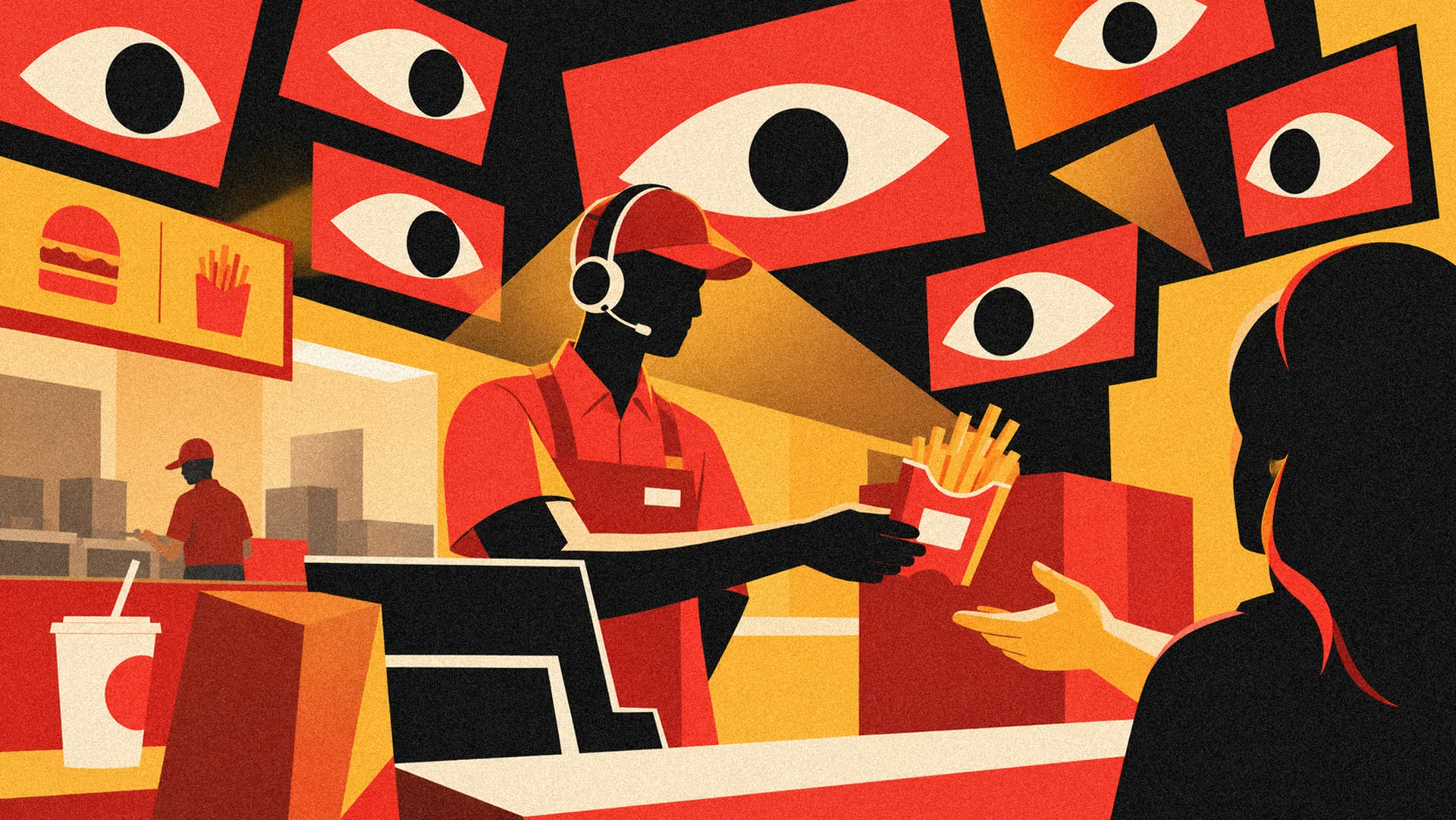
Fast-food chains are increasingly deploying AI-powered monitoring systems that track, score, and discipline employees based on real-time behavior, ranging from driving habits to the tone of voice used with customers.
According to Capital & Main, workers are often subjected to these surveillance tools without their consent or prior awareness, as their pay and career advancement become tied to algorithmic assessments.
At a Domino’s in North Texas, delivery drivers are required to install an app from Drivosity that tracks their routes and assigns a score from 0 to 100 based on metrics such as speed, braking, and cornering. Drivers are expected to maintain a score above 85; falling below that threshold results in formal reprimands and, eventually, a lockout from the company’s system.
“Drivosity can effectively fire people,” said Corrin Kearney, a driver at the location. Kearney said that the technology often fails to account for real-world variables, such as the need for sudden braking to avoid a collision or rapid acceleration to safely merge onto a highway.
As a driver captain, Kearney has to write up other drivers, despite the app failing to recognize the nuance of real-world situations. “It’s infuriating,” Kearney said. “The AI can tell you haven’t driven well enough and you get fired,” Kearney added.
The company’s promotional materials suggest that franchise owners can “gamify” these metrics by creating leaderboards to encourage competition among staff.

Similar surveillance is appearing in drive-thru operations. In February, Burger King announced the rollout of an OpenAI-powered assistant named Patty to approximately 500 U.S. restaurants, with plans for a full national implementation by the end of 2026.
Dante Vasquez, a worker at a Burger King in Niagara Falls, New York, described how the system monitors drive-thru conversations, scoring employees on friendliness and upselling. The process began with an AI voice in the headset, followed by the activation of monitoring features. Managers and other staff could click on a transaction to hear a recording and review AI-generated transcripts.
Managers watched these scores closely, reminding the crew to stay above a 70% friendliness target. Vasquez reported that managers utilize these scores to determine staff schedules, leading him to adopt a rigid speaking style to satisfy the AI’s requirements.
He became so proficient that customers began asking if he was a bot, and his co-workers nicknamed him “Gemini.” “The system wants me to talk like a robot, so I’m trying,” Vasquez said.

According to a statement from Burger King, the monitoring features were intended “to celebrate great examples of friendly service” and allow managers to coach their team. The company also stated it has since disabled both features “for further improvements.” Burger King would not specify when the features were disabled, though workers reported the monitoring was active through August of this year.
Researchers warn that these practices treat the workforce as a testing ground for unproven software. “They basically use their population of workers as guinea pigs,” said Alexandra Mateescu, a researcher at the nonprofit Data & Society.
Regarding potential regulation, legal expert Tobin-Miyaji noted in an email that an emotion-scoring ban would likely cover a tool like Patty, but warned that “No Robo Bosses” legislation could be satisfied by “cursory” human oversight, leaving workers “constantly surveilled and quantified.”
Tobin-Miyaji added that unions could in theory negotiate stricter protections than legislation might afford. Both Domino’s and Drivosity did not respond to requests for comment regarding these systems, as reported by Fast Company.