Himes Warns Europe: Pay for Your Own Defense
Europe expected relief from the outcome of the midterm elections.
What its officials heard instead, from one of the incoming committee chairs, was a promise of continuity: Americans will keep pressing Europeans to pay for their own defense.
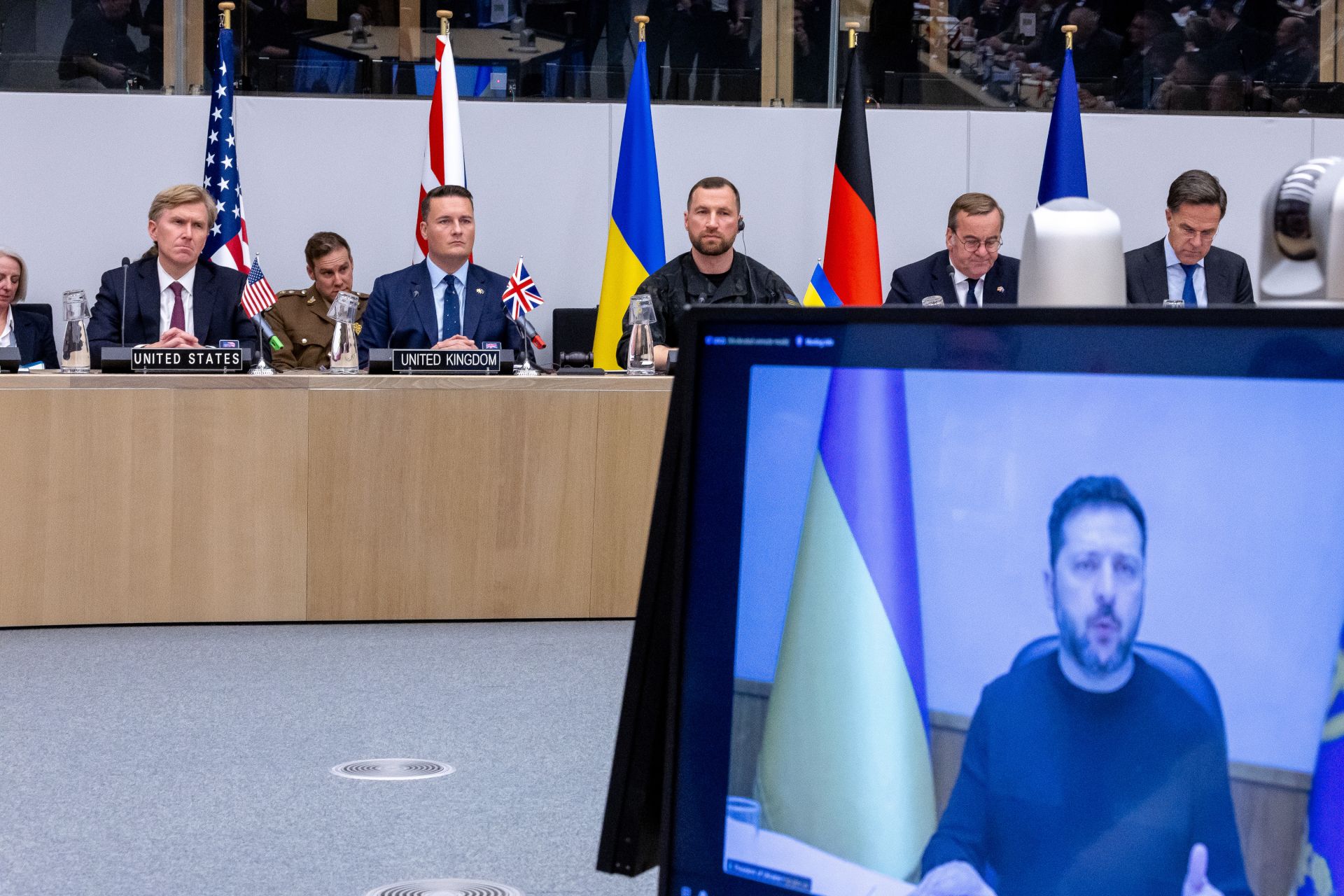
The message came from Rep. Jim Himes of Connecticut, the Democrat in line to chair the House Permanent Select Committee on Intelligence. Speaking at the Warsaw Security Forum on Oct. 13, New Lines Magazine reported, Himes drew a line between what changes with an election and what does not.
“Superficially, everything is different,” he said. “There will be no threatening of Denmark. There will be no attacking Canada. All of the ludicrous, circus-like activities of the current president that serve no real purpose, in fact are counterproductive, are gone.”
Then came the part the Warsaw audience did not want. “The truth is that the American people have realized, and Trump capitalized on this, that we paid a very large cost for the defense umbrella over a generation. And so there will be a continuation on the part of Americans to keep pushing the Europeans to assume more of a role,” Himes said.
That continuity is the story. New Lines Magazine reported that Europeans viewed the midterm results with satisfaction, a rebuke of an unpopular lame-duck president. But the structural pressure — the transfer of Europe’s defense burden from Washington to Brussels, Berlin, Warsaw and the rest — predates this president and, by the incoming chairman’s own account, will outlast him.
Burdens Shared, Then Shifted
Burden-sharing, the advertised ethic of the Trump administration’s NATO policy, has in practice worked as burden transfer, New Lines Magazine found. Canada and the European allies now pay the United States for nearly all American military equipment sent to Ukraine through NATO’s Prioritized Ukraine Requirements List program — and, in return, face tariffs on almost everything else they buy.
| Measure | Figure | Source and frame |
|---|---|---|
| EU defense spending, 2020 | $257.84 billion | New Lines Magazine, EU-wide total |
| EU defense spending, 2025 | $419.82 billion | Roughly 63% increase; two-thirds from Germany, the Netherlands and Poland |
| Unreceived U.S. commitments to Ukraine | $16 billion | Zelenskyy, Ukrainian broadcaster, Nov. 5 |
| PAC-3 MSE consignment | 500 missiles, $2.1 billion | First delivery 2030 at the earliest |
| Frozen Russian assets in the EU | about $230 billion | Cited by New Lines Magazine in U.S.-Russia bargaining |
| Starlink vs. IRIS² satellites | about 11,500 vs. 348 by 2030 | SpaceX constellation vs. EU program |
Warsaw Hears the Terms
Nothing in the midterm result changes the underlying arithmetic, and European officials know it. João Cravinho, the former Portuguese foreign minister, put the new consensus bluntly. “The countries of Central and Eastern Europe, Scandinavia and the Baltic states now realize that reliance on the United States for our defenses is untenable,” Cravinho told New Lines Magazine. “That simple sentence would not be at all consensual a few years ago.”
The disagreement now is over speed, not direction. “Still there is a divide between those who want to move fast in developing autonomous reaction capacity and those who remain terrified that by doing so they will be giving the wrong signals to the U.S., and allow the U.S. to pull out or encourage the U.S. to pull out,” Cravinho said.
Washington has noticed the drift, and pushed back. Andrew Puzder, the U.S. ambassador to the EU, warned of “devastating” retaliation if the bloc moves to limit SpaceX’s access to the European mobile satellite band.
The warning landed even as Helsinki and Kyiv were signing around the problem: on Oct. 22, Nokia together with the Finnish satellite manufacturer ICEYE concluded a letter of intent with Ukraine’s Defense Ministry aimed at expanding European satellite systems as a substitute.
“We already have the satellite cooperation where the French and German companies are involved, the IRIS² cooperation. But then, the Americans are unhappy again that we’re doing exactly what they wanted us to do and taking our security into our own hands,” said Ville Niinistö, a Finnish member of the European Parliament, in an interview with New Lines Magazine.
Bargaining With What It Cannot Sell
On the war itself, the administration is negotiating with assets it does not own. Envoy Steve Witkoff and Jared Kushner are reportedly offering the Kremlin the prospect of reactivating dormant or destroyed Russian energy pipelines through Europe, via Ukraine, as an inducement to end the war of conquest it started, now in its fifth year — while treating roughly $230 billion in EU-frozen Russian assets as bargaining chips.
Kushner described the plan as built on “practical arrangements that address the security concerns of all sides,” including “an enduring framework for long-term European security and stability.”
Michael Carpenter, who served as the U.S. ambassador to the Organization for Security and Co-operation between 2021 and 2024, has no faith in the broker. “If you don’t understand how Russia ripped apart the European security architecture of the last 35 years, you won’t succeed at building a new one,” Carpenter told New Lines Magazine. “It’s like trying to operate on a patient without understanding anatomy.”
The Eisenhower Clock Still Runs
None of this is new. Gen. Dwight Eisenhower, NATO’s first Supreme Allied Commander Europe, wrote in 1951 that if all American troops stationed in Europe for national defence purposes had not been returned to the United States within a decade, “this whole project will have failed.” The troop presence peaked at 475,000 in the late 1950s, fell for three decades, rose to nearly 350,000 in the late 1980s, and never went home.
The complacency that followed is now paying itself out in budgets. EU defense spending rose roughly 63% between 2020 and 2025, from $257.84 billion to $419.82 billion, with Germany, the Netherlands and Poland accounting for about two-thirds of the total, most of it in equipment and research rather than personnel.
“For too long, we loved the status quo arrangement because it allowed us to drink our Aperol spritzes on the beach while America did the dirty work of protecting us from the Russians. We got used to it, like an addiction. Now we’re back to first principles, the Eisenhower plan,” said Teun Janssen, an assistant to Dutch MEP Reinier van Lanschot, in an interview with New Lines Magazine.
The medium-term wave will change the tone in Washington. It will not change the invoice. “If in 10 years, all American troops stationed in Europe for national defence purposes have not been returned to the United States, then this whole project will have failed,” Eisenhower wrote in 1951.