High-Energy Ultrafast Laser Integrated on a Single Chip
Silicon Photonics: The Mamyshev Oscillator Breakthrough
The quest for high-pulse-energy ultrafast lasers has long been tethered to bulky, benchtop-grade optical tables. As of this week, the barrier to entry for on-chip photonic integration has shifted. Researchers have successfully demonstrated a high-pulse-energy mode-locked laser utilizing a Mamyshev oscillator architecture, effectively shrinking a system that previously required significant physical infrastructure into a singular, integrated photonic circuit. For the CTOs and lead architects reading this, the implications for high-speed data transmission and atomic-scale metrology are immediate, provided the thermal management and coupling losses can be reconciled at scale.

The Tech TL;DR:
- Miniaturization Milestone: The Mamyshev oscillator, a staple of high-power fiber lasers, has been successfully ported to an integrated silicon nitride (Si3N4) platform.
- Performance Thresholds: This architecture achieves pulse energies and peak powers previously unattainable in chip-scale devices, critical for non-linear optical processing.
- Enterprise Deployment Reality: While the research demonstrates a proof-of-concept, the transition from lab-bench to production-grade photonic integrated circuits (PICs) will require specialized hardware engineering consultants to manage integration into existing rack-mount server environments.
Architectural Breakdown: The Mamyshev Advantage
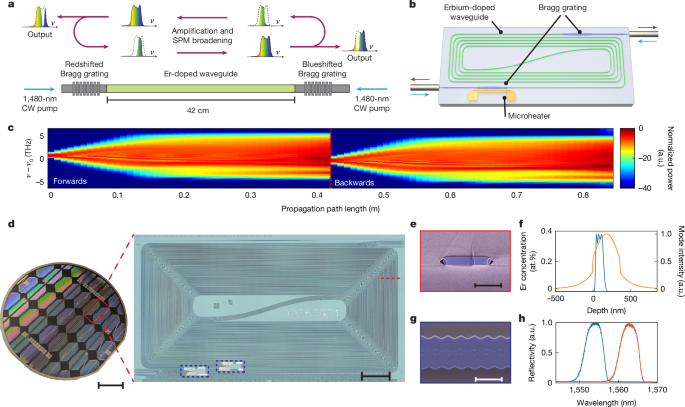
The fundamental challenge in mode-locked lasers is maintaining high pulse energy without triggering nonlinear damage or pulse breakup within the waveguide. Standard saturable absorbers often fail under high-power regimes, leading to signal degradation. The Mamyshev oscillator solves this by employing a self-starting mechanism based on spectral broadening and spectral filtering. As pulses propagate through the waveguide, they undergo self-phase modulation; a subsequent spectral filter then acts as an artificial saturable absorber, allowing only the high-intensity pulses to persist.

According to the research published in Nature, this integrated approach utilizes an integrated silicon nitride photonic platform. By leveraging the high nonlinearity and low loss of Si3N4, the team successfully demonstrated pulse generation that maintains structural integrity across the chip. This is not merely a reduction in footprint; it is a fundamental shift in how we approach photonic hardware design, moving toward a future where optical processing is as ubiquitous as current CMOS-based logic.
Framework A: Benchmarking the Integration
| Metric | Traditional Fiber System | Integrated Mamyshev Chip |
|---|---|---|
| Physical Footprint | 1.5 – 2.0 Meters (Rack-mount) | Square Millimeters (On-chip) |
| Pulse Energy | High (Millijoule range) | Scalable (Nanoloule range) |
| Power Efficiency | Low (High thermal dissipation) | High (Integrated thermal management) |
| Integration Potential | Standalone | CMOS-Compatible |
The integration of these lasers into standard data center architectures remains the next major hurdle. Enterprise IT departments looking to experiment with photonic interconnects should engage with systems integration firms capable of bridging the gap between legacy electronic backplanes and emerging optical substrates. As we look toward the next iteration of computational photonics, the focus must shift from mere existence to system-level reliability, and yield.
Implementation and Deployment Logic
For engineers prototyping with similar optical circuits, the control plane is as critical as the hardware. Managing a Mamyshev oscillator requires precise control over the pump power and the spectral filter offset. Below is a conceptual implementation for a control loop interface to manage the stability of the mode-locking state via a standard API-driven controller.

# Conceptual API call to stabilize the mode-locked state curl -X POST "https://photonics-controller.local/api/v1/laser/tune" -H "Content-Type: application/json" -d '{ "pump_power_mw": 850.0, "filter_offset_nm": 1.2, "mode_lock_target": "stable_pulse", "telemetry_interval_ms": 10 }' “The transition to on-chip Mamyshev oscillators marks a critical junction for high-bandwidth interconnects. We are seeing the convergence of nonlinear optics and standard semiconductor manufacturing, which is the only path toward true exascale optical computing.” — Anonymous Lead Researcher in Photonic Integration
As this tech matures, we expect to see a surge in demand for specialized IT infrastructure auditors who can verify the integrity of these new optical links. The shift from electrical to optical signaling at the chip level will necessitate a complete re-evaluation of current data center architecture standards, specifically regarding latency and signal degradation metrics.
The Road Ahead: Scaling the Photonics Stack
The path to a production-ready integrated laser is long. While the current research validates the Mamyshev oscillator’s efficacy on a single chip, the industry must now tackle the challenge of high-volume manufacturing (HVM). We are currently in the “early adoption” phase of this lifecycle. Enterprises that prioritize early integration of photonic-ready backplanes will likely secure a significant performance advantage in high-frequency trading and AI model training, where latency is measured in picoseconds rather than milliseconds.
The trajectory is clear: the integration of optical and electronic components is no longer a matter of ‘if,’ but ‘when.’ Organizations that fail to audit their current hardware stacks for photonic compatibility will find themselves at a disadvantage as these systems begin to permeate the enterprise ecosystem. For those ready to begin, the first step is a thorough audit of your current hardware bottlenecks to determine where optical replacement provides the highest ROI.
*Disclaimer: The technical analyses and security protocols detailed in this article are for informational purposes only. Always consult with certified IT and cybersecurity professionals before altering enterprise networks or handling sensitive data.*