
Hera Images Reveal Dimorphos Crater Size and Chaotic Changes After NASA DART Impact
The first images of the asteroid hit by NASA show a crater as big as a stadium and hundreds of rocks now orbiting it, the European Space Agency announced on Wednesday four years after the impact.
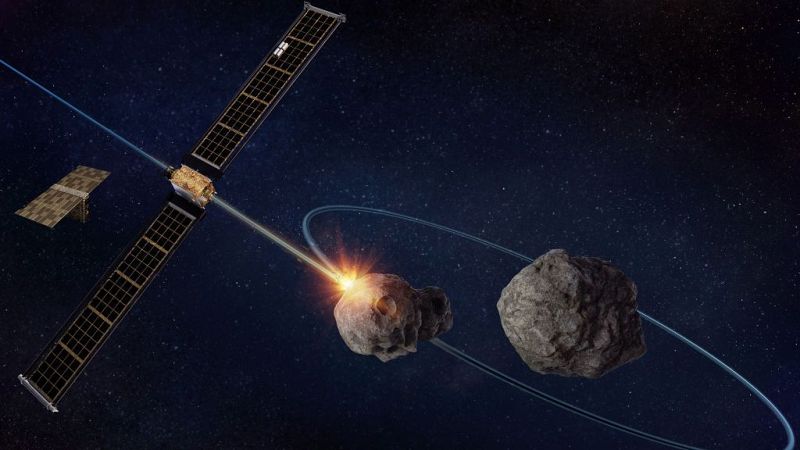
The NASA mission, known as DART, deliberately crashed into Dimorphos, a small moon orbiting the larger asteroid Didymos, in September 2022. The goal was to test a kinetic impactor, a technique for deflecting an asteroid that might threaten Earth. The impact successfully shortened Dimorphos’s orbit around Didymos by 33 minutes. This diminutive luna orbits at a kilometer from Didymos, a body of 730 meters situated currently at 193.5 million kilometers from Earth.
BIG NEWS! We have a whole new look at Dimorphos, the first asteroid humans have ever moved 👀☄️ @ESA_Hera mission has captured Dimorphos completing a full orbit around its larger companion, Didymos. Look closely and you will see the impact site come into view, and Dimorphos… pic.twitter.com/jWsuwz3H98
ESA’s Hera mission, launched in October 2024, has now arrived at the binary asteroid system to study the aftermath. The spacecraft, the size of a small car, is flying between 25 and 30 kilometers away from the asteroids, moving at an average speed of just 12 centimeters per second to allow for detailed observations.
Impact Exceeds Expectations
The images reveal a scene far more complex than scientists initially predicted.
“The crater is very large and seems to have some strange structures inside it”, says Julia de León, a participant in the mission and a researcher at the Instituto de Astrofísica de Canarias (IAC). “The crater is almost as large as the body itself,” said Patrick Michel, the Hera mission principal investigator and director of research at CNRS/Observatoire de la Côte d’Azur, according to WIRED. “And, as a crater lover, I can also say it is beautiful.”
Scientists had debated whether the impact would create a crater, alter the asteroid’s shape, or leave it unchanged. “The scientists debated if Dimorphos had suffered an impact crater, if it had changed shape, or if it had remained the same,” Michel told WIRED. “To our surprise, the answer turns out to be all three things at once!”
The initial predictions for the crater’s size were much smaller. “Our initial predictions pointed to a crater of about 10 meters in diameter”, has explained Ian Carnelli, director of the Hera mission, during the presentation of the images in the Museum of Natural History of Berlin. “We thought it would be a 10-meter diameter crater when we started the adventure,” Ian Carnelli, the Hera mission director, told El Confidencial.
Chaotic New Environment
The impact has fundamentally changed Dimorphos. Its once-rounded face is now flattened and covered by a massive crater, and the asteroid is rotating chaotically.
“It is now the most chaotically rotating object in the solar system,” explained Michael Kueppers, a mission scientist from ESA, as quoted by El Confidencial. “The impact caused a disaster”, said Patrick Michel, the Hera mission principal investigator at the Observatoire de la Côte d’Azur in Nice, France.
A third major surprise is the discovery of hundreds of previously unknown rocks, several meters in size, now orbiting the Didymos-Dimorphos system. “It’s amazing,” said Julia de León, a researcher at the Instituto de Astrofísica de Canarias (IAC) and a participant in the mission. “Of course, we were prepared to see material orbiting the system after such an impact, but this exceeds our best expectations.”
The existence of these floating rocks poses a challenge for the Hera spacecraft. “This behavior is immensely complicating the navigation of the probe in the vicinity of the system,” noted El Ciudadano.
Next Steps for the Mission
Hera will continue studying the system until June 2027. The mission’s primary goal now is to determine the exact mass of Dimorphos. This measurement is crucial for validating computer models used to plan planetary defense missions. “The first time I saw the images I said ‘wow!'”, declares to the AFP Patrick Michel, researcher of the mission.”
“Calculating the exact mass of Dimorphos will be the definitive step to know how to precisely deflect any asteroid that threatens Earth in the future,” El País reported. “If we ever detect a space rock on a collision course with our planet, we need to know how much energy to apply to deflect it sufficiently,” explained Simon Green, a Hera team scientist.
“That ESA has advanced several months the start of ‘Hera’s’ autonomous operations is a sign of enormous confidence in the GNC system and in the work of the team that has developed it”, has pointed out Mariella Graziano, director of strategy of the flight segment of GMV.
In January 2027, Hera will deploy two small CubeSats—Juventas, led by Luxembourg, and Milani, from Italy. Juventas will attempt to land on Dimorphos to study its interior with a radar, while Milani will analyze the surface and surrounding dust. This will be the first time three robotic probes have studied an asteroid together.
“Today, for the first time in history, humanity is checking how to prevent such an event from happening again,” the ESA said in a press release. The images were presented today at an event at the Natural Sciences Museum of Berlin, in Germany.