
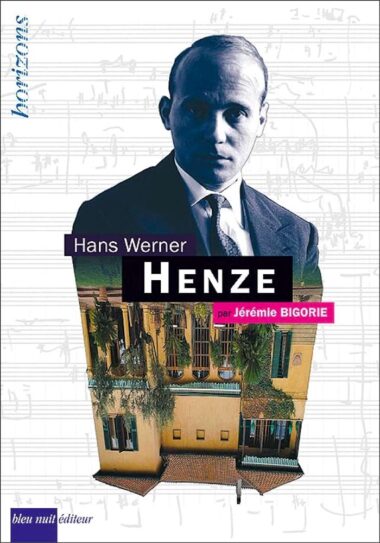
A second French-language biography of German composer Hans Werner Henze (1926-2012), penned by Jérémie Bigorie, has been released just months after the publication of a first biography by Philippe Torrens. Henze, a figure largely distanced from the French musical scene, would have celebrated his 100th birthday in 2026.
Known for his affinity for lyric opera – a catalog exceeding twenty works at a time when contemporaries largely turned away from the form – Henze exiled himself from Germany in 1953, initially settling on the Italian island of Ischia before acquiring the estate of La Leprara in Marino. There, he lived a life of relative privilege that contrasted with his stated leftist political commitments. Bigorie, a musicologist and critic for Diapason magazine, explores the composer’s multifaceted personality, centering his analysis on Henze’s compositional goal: “I would like to write music that could become a language,” as the composer reportedly expressed.
The book dedicates a chapter, titled “Médusante volte-face” (Medusa’s Turn), to 1968, the year of the revised oratorio The Raft of the Medusa, dedicated to Che Guevara. The work’s initial scandal propelled it to success and marked a turning point towards the composer’s political radicalization. Henze aimed to create “music usable in the political struggle.” This embodies his concept of “Musica impura” (impure music) – a term borrowed from Pablo Neruda – where artistic engagement is actively expressed. According to Bigorie, Henze believed his music should serve socialism.
Bigorie details Henze’s “experimental surges,” including a period in Cuba that proved both utopian and deeply challenging, leading to periods of severe depression. The book, structured in eighteen chapters and including a synoptic table, navigates the composer’s extensive catalog of approximately 150 works within the constraints of its 170-page format. Thirteen compositions, primarily operas but also including other forms, receive detailed descriptions, beginning with Boulevard Solitude (Hannover, 1952), his breakthrough work staged with designs by Jean-Pierre Ponnelle, and extending to The Bassarids (1966), which Henze considered his most crucial lyrical work. Other works discussed include Voices (1973), a song cycle based on politically engaged poets, and Elogium Musicum (2008), a choral work dedicated to his life partner, Fausto Moroni, who died in 2007.
Bigorie addresses the complex question of serialism in Henze’s work, noting that what distinguishes him from more strictly observant serial composers isn’t the complexity of his combinatorial tools, but rather his “hospitality,” his ability to integrate foreign elements into his musical microcosm. This heterogeneity, serving the cause of expression, defines Henze’s style and drew criticism from more radical avant-garde circles. While remaining close to Luigi Nono, and even joining the Italian Communist Party, and later reconciling with Helmut Lachenmann, Henze’s rupture with Pierre Boulez proved irreparable, described by Bigorie as representing “two antithetical figures.”
Bigorie’s biography, informed by rigorous musicological research, offers a sympathetic portrayal of a major figure in contemporary music. The book is supplemented with musical examples and links to YouTube recordings of lesser-known Henze works. It also features photographs from the Hans Werner Henze Foundation in Nuremberg.
