Graphene FET Sensor with Post-SELEX Aptamer Library Quantifies Anti-Aging Protein Klotho in Human Serum
Researchers in Austria and Germany have built a graphene field-effect transistor sensor that quantifies the hormone-like anti-aging protein klotho in human serum, work published as a preprint on Research Square on August 25 and reported by Nature.
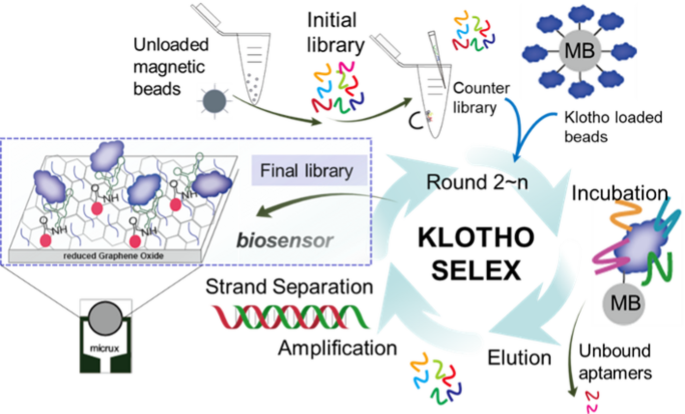
The team used nine rounds of FluMag-SELEX to generate a focused polyclonal aptamer library against α-Klotho, then wired it into a transistor readout that detects the protein label-free.
The problem the sensor addresses is long-standing. Soluble α-Klotho, the predominant circulating form of the protein, is difficult to detect in plasma, the authors write in the preprint. Existing measurement relies on sandwich ELISA kits, and reference ranges for healthy adults aged 18 to 85 have only recently been established through ELISA-based studies, work cited in the Research Square paper.
Why it matters commercially: low serum Klotho has been associated with all-cause mortality, diabetes and Alzheimer’s disease in studies the preprint cites, including mouse work showing Klotho overexpression improves amyloid-β clearance. A fast, label-free quantification method could turn a research biomarker into a clinically routine one — and that is where diagnostic developers, contract biosensor manufacturing firms and clinical-lab service providers enter the picture.
The selection process started from a commercial oligonucleotide library of roughly 6 × 10¹³ individual ssDNA molecules, per the methods section. The target was recombinant human α-Klotho (MedChemExpress, Cat. No. HY-P700011), expressed in CHO cells, covering the extracellular domain E34–S981 with both KL1 and KL2 domains and a C-terminal 10xHis tag. The manufacturer lists the protein at approximately 110–130 kDa under reducing SDS-PAGE with purity of at least 95%, with biological activity confirmed through NIH-3T3 proliferation (EC40 < 1 µg/mL) and FGF23 binding (EC50 = 0.64–1.25 µg/mL), according to the paper.
Immobilization used Dynabeads M-280 tosyl-activated beads from Thermo Fisher, with Klotho covalently coupled through primary amino groups. Counter-selection against unloaded beads, escalating BSA and tRNA blocking, and emulsion PCR amplification with Lambda exonuclease regeneration drove the enrichment across rounds one through nine. Input dropped from 100 pmol in round one to 0.1 pmol by rounds seven through nine.
qPCR tracked the enrichment, with amplification efficiency calculated from a calibration curve spanning 0.005–5 pg/µL. Fluorescence binding assays on rounds 3, 5, 7 and 9 confirmed the pool was tightening around the target rather than the beads. The authors report the final round-9 library showed high affinity, expressed as an apparent dissociation constant because the pool is heterogeneous.
The specificity result is the one that matters for the clinic. In the Aptamer-Linked Fluorescence Assay, the aptamer pool distinguished α-Klotho from β-Klotho and other homologous proteins in human serum, the preprint states. That discrimination has been the sticking point for Klotho assays, since β-Klotho shares structural features and confounds antibody-based detection.
Integration into the gFET delivered what the paper calls label-free, specific and fast quantification with high sensitivity in complex biological matrices. Graphene field-effect transistors convert binding events on the graphene surface into electrical signal changes, so no fluorescent or enzymatic tag is required — a workflow advantage over ELISA, which needs incubation, washing and colorimetric reading steps.
KL1 is the functional heart of the target. The authors identify it as the key domain mediating most of Klotho’s enzymatic and signaling activity, including modulation of fibroblast growth factor pathways and glycan processing. The aptamer library recognizes α-Klotho and its KL1 domain, which positions the sensor to track the biologically active species rather than total protein.
The commercial path runs through partnerships. Aptamer-based diagnostics have been displacing antibodies in lateral flow and electrochemical formats for years, a shift documented in the Biosensors & Bioelectronics literature the preprint cites. For diagnostic firms evaluating the platform, the practical questions are manufacturing scale-up of the aptamer pool, regulatory clearance for a serum-based assay, and reimbursement codes — territory where diagnostic regulatory consultancies and in-vitro-diagnostic market-access specialists typically earn their fees.
What the preprint does not yet show is clinical validation data. The study demonstrates analytical performance in spiked and complex matrices; it does not report patient-outcome correlations or comparison against a cleared ELISA in a clinical cohort. The work is a preprint, posted August 25, and has not completed peer review.
The SELEX methodology itself is off-the-shelf. FluMag-SELEX was described in 2005 in Analytical and Bioanalytical Chemistry, and the underlying aptamer concept dates to the 1990 papers by Ellington and Szostak in Nature and Tuerk and Gold in Science, both cited in the preprint. The novelty here is the combination: a focused polyclonal library against a hard-to-catch circulating protein, paired with a transistor readout sensitive enough for serum.
Klotho was first identified in 1997, when Kuro-o and colleagues showed mutation of the mouse klotho gene produces a syndrome resembling aging, published in Nature. Nearly three decades later, the measurement bottleneck remains the constraint on translating that biology into routine diagnostics.
For the diagnostics industry, the next milestone to watch is peer-reviewed publication and any partnership announcement around the gFET platform. The paper’s abstract closes by describing the integration as achieving label-free, specific and fast quantification — the claim that, if it survives review and clinical validation, would determine whether Klotho testing moves from specialty labs into standard clinical panels.