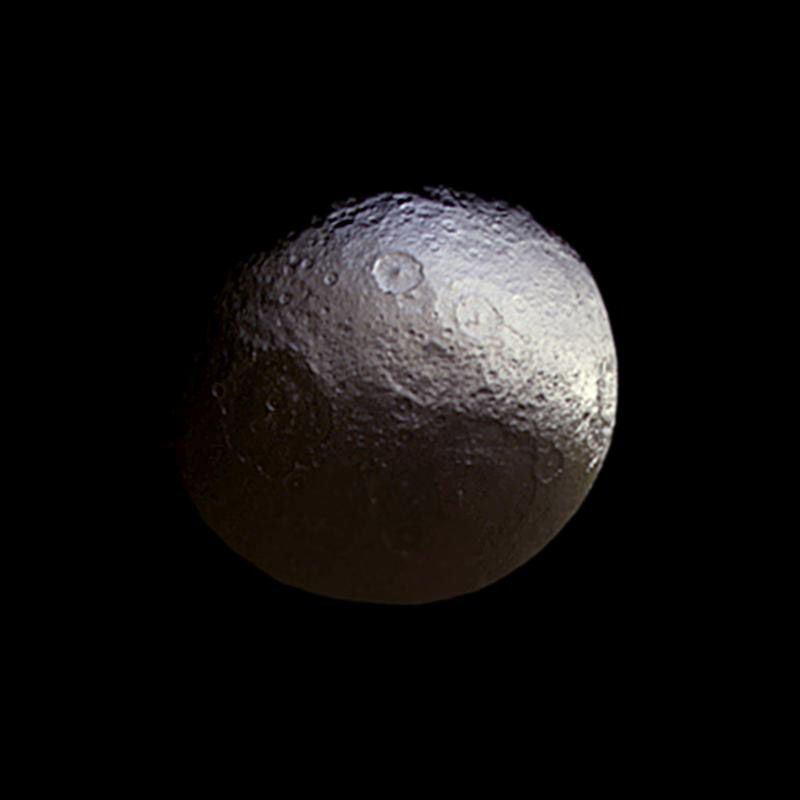
Giovanni Cassini Discovers Iapetus the Yin-Yang Moon of Saturn
Giovanni Cassini discovers Saturn moon Iapetus in 1671
On October 25, 1671, Italian astronomer Giovanni Cassini discovered a new moon orbiting Saturn, marking the second lunar body ever found around the ringed planet, Space reported. It was reported that the discovery marked the first of four moons Cassini would ultimately find at Saturn. Dutch astronomer Christiaan Huygens had previously discovered Saturn’s largest moon, Titan, approximately six years earlier.
When Cassini first observed Iapetus, it appeared as a tiny speck positioned on the west side of Saturn. Based on orbital calculations, he anticipated seeing the moon again on the east side of the planet 39 days later, but the object was missing from view. Upon its eventual reappearance on the west side, Cassini deduced that the moon possessed two distinct surface hemispheres—one significantly darker than the other—which rendered it nearly invisible to Earth-based telescopes when the dark side faced inward.
Saturn's moon Iapetus captured on this day in 2007 during Cassini spacecraft’s flyby pic.twitter.com/e0IXDc8pdA
Spacecraft imagery reveals yin-yang hemispheres
More than 300 years following the initial telescopic observation, NASA dispatched a spacecraft named Cassini to study the Saturnian system. The spacecraft captured detailed photographs of Iapetus, revealing a stark two-tone surface coloration that inspired its enduring nickname: the yin-yang moon.
According to computer simulations cited in the Space report, researchers concluded that Saturn’s inner moons and planetary rings are relatively young, while more distant bodies like Titan and Iapetus formed independently. The research indicates that Saturn’s earlier collection of moons experienced orbital disturbances driven by an orbital resonance linked to the planet’s motion around the sun. These disrupted trajectories eventually resulted in orbital crossings and high-speed collisions among neighboring objects, generating the debris field from which the current configuration of rings and moons coalesced. The discovery of Iapetus, with its yin-yang bright and dark hemispheres, has added to our understanding of how moons form, and researchers noted Using the computer simulations, the researchers concluded … the inner moons of Saturn and its gorgeous rings are all relatively young. The more distant moons Titan and Iapetus would not have been formed at the same time
and further stated Our best guess is that Saturn had a similar collection of moons before, but their orbits were disturbed by a special kind of orbital resonance involving Saturn’s motion around the sun. Eventually, the orbits of neighboring moons crossed, and these objects collided. From this rubble, the present set of moons and rings formed
.

Historical context of early space exploration milestones
Just one day prior to the anniversary of the Iapetus discovery, on October 24, 1946, a V-2 rocket captured the first photographs of Earth from space, according to historical archives detailed by Space.
Following the identification of Iapetus, Giovanni Cassini continued his systematic survey of the Saturnian system, subsequently discovering the moons Rhea, Tethys, and Dione.
Saturn’s Two-Faced Moon: Why Iapetus Is Painted in Two ColorsIn 1671, Giovanni Domenico Cassini noticed something odd about a newly found moon of Saturn: it was sometimes easy to see and sometimes almost vanished. He inferred, correctly, that Iapetus always keeps the same face… pic.twitter.com/wtkPhVWFMm
One face collects dust. The other keeps the ice.Iapetus is 1,471 km across and locked to Saturn. One spin is one orbit: 79 Earth days. Giovanni Cassini saw the trick in 1671. He could find the moon on one side of Saturn and lost it on the other. The leading hemisphere is dark.… pic.twitter.com/Q5tjsmfWDD