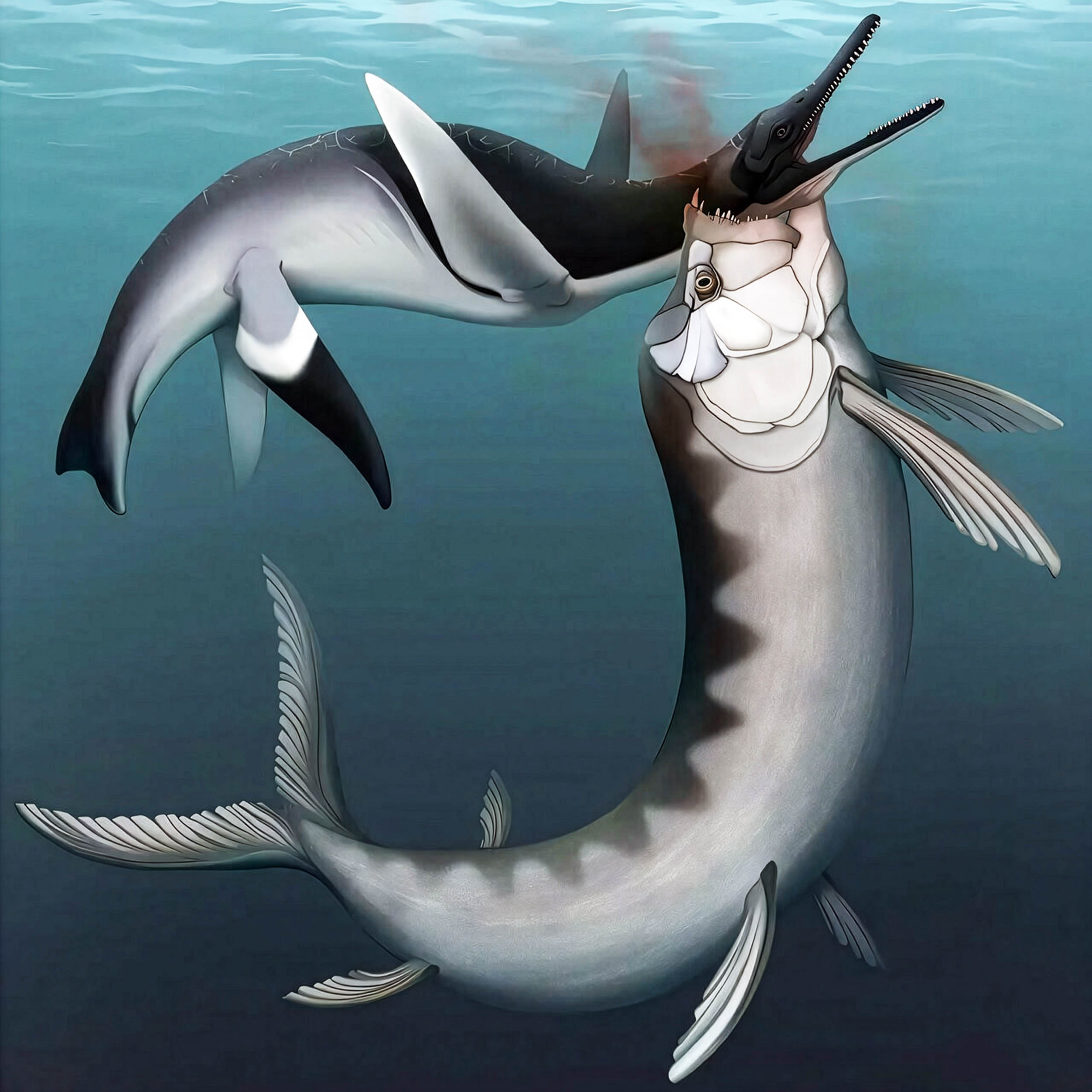
A four-meter-long marine reptile fossil discovered in Alabama preserves direct evidence of a fatal attack by a giant prehistoric fish, researchers announced Friday. A tooth from Xiphactinus, a predatory bony fish, remains lodged in the neck vertebra of a Polycotylus plesiosaur, offering a rare glimpse into the violent interactions between apex predators in the Cretaceous seas.
The discovery, made in the Mooreville Chalk of Alabama, reveals a clear physical link between attacker and victim, according to Stephanie Drumheller at the University of Tennessee, Knoxville (UT Knoxville). The tooth was broken at both ends and showed no signs of healing, indicating the injury occurred at or near the time of the plesiosaur’s death.
“We sometimes secure these fixed ideas in our heads about who the top predator in any given environment is and who might rest a rung or two down on the food chain,” Drumheller said in a press release. “This fossil is a great reminder that nature is rarely that cut, and dry.”
Researchers used computed tomography (CT) scanning to examine the bone without damaging the fossil. UT Knoxville undergraduates Miles Mayhall and Emma Stalker digitally separated the tooth and created a three-dimensional model, revealing its unique curve and confirming its origin. The shape of the tooth narrowed the possibilities to one giant bony fish known to inhabit those waters.
Polycotylus, like other plesiosaurs, possessed a long neck that provided reach but also exposed vulnerable soft tissues essential for breathing and circulation. F. Robin O’Keefe, a professor of biological sciences at Marshall University, noted that a bite to the neck could easily sever the airway and major blood vessels, leading to rapid death.
While the tooth provides definitive evidence of the attack, the motive remains unclear. Xiphactinus typically swallowed smaller prey whole, making a bite to the neck an unusual tactic. This suggests the attack may not have been a straightforward hunting attempt, but rather a clash between the two predators or a bite delivered after the plesiosaur was already dead.
The quick descent of the carcass into anoxic, low-oxygen waters likely contributed to the exceptional preservation of the fossil, preventing scavenging and decay that would have scattered the bones. Alabama’s Mooreville Chalk has previously yielded fossils with bite marks from sharks, marine reptiles, and other large fish, indicating a highly competitive ecosystem.
Interestingly, Xiphactinus is known for being found with the remains of other fish inside its body. A famous specimen at the Sternberg Museum contains a smaller fish preserved within the gut of a larger Xiphactinus. This feeding behavior makes the attack on the plesiosaur’s neck even more puzzling, as it was a risky maneuver that yielded little potential food.
The discovery challenges traditional views of ancient food webs, which often portray predator-prey relationships as neatly defined. This fossil suggests that even top predators could become targets, and that competition or chance encounters could lead to violent clashes. The study, published in the Journal of Vertebrate Paleontology, raises the possibility that similar interactions may have been more common than previously thought, and that further research into bite-mark fossils could reveal a hidden pattern of violence in Alabama’s ancient seas.
Leave a Reply