
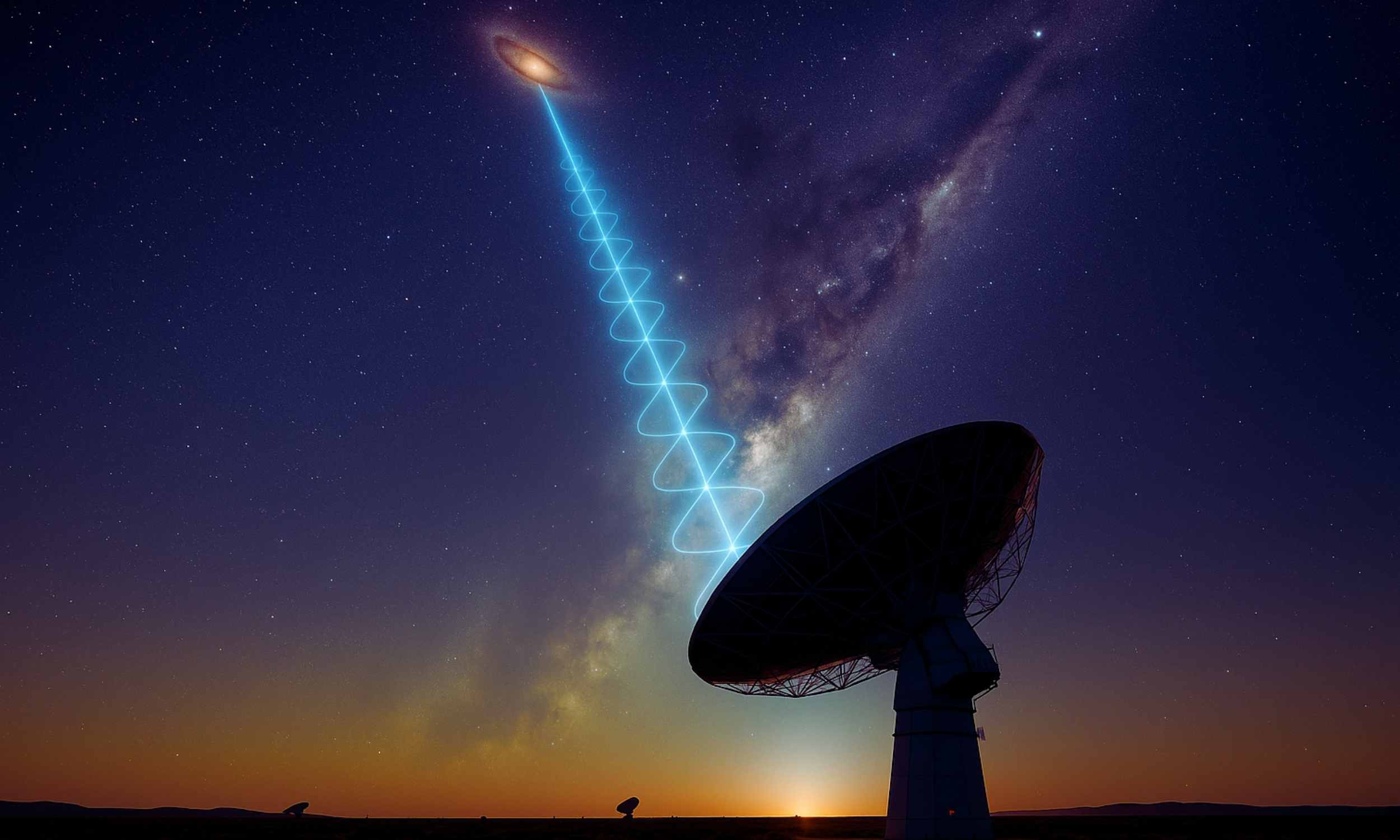
Intense Radio Burst Reveals Clues to Fast Radio Burst Origins
Astronomers have observed an exceptionally active fast radio burst (FRB) source, designated FRB 20240619D, emitting hundreds of bursts within a short timeframe. This event is providing valuable data for understanding teh nature of these mysterious cosmic signals.
The burst activity was initially detected by the Canadian Hydrogen Intensity Mapping Experiment (CHIME), prompting a coordinated observational campaign. Researchers utilized radio telescopes to track the source, and simultaneously, the MeerLICHT telescope was employed to search for any accompanying optical flashes.
“We find no optical counterpart of FRB 20240619D in the MeerLICHT optical observations,” reported Tian, a member of the research team.This observation places stringent upper limits on the possibility of a bright optical signal coinciding wiht the radio bursts. Autonomous research programs are also refining optical searches, achieving increasingly sensitive limits on fluence ratios in other repeating FRB sources, further constraining the potential for optical counterparts.
The intense activity of FRB 20240619D offers a unique opportunity to investigate the origins of FRBs. the debate continues regarding whether repeating FRBs, like this one, and non-repeating FRBs originate from the same type of astrophysical object. Current theories propose mechanisms such as starquakes in highly magnetized neutron stars or interactions within binary systems involving compact objects.
FRB 20240619D shares characteristics with previously observed repeaters, including FRB 20121102A and FRB 20201124A, which also exhibited bursts at rates of hundreds per hour. Comparing the timing,polarization,and frequency behavior of these sources could reveal a common underlying mechanism.
The detailed data gathered during this well-documented campaign allows researchers to perform several key analyses. These include testing the relationship between burst counts and radio fluence, precisely measuring dispersion measure and rotation measure, and comparing activity across different frequencies without significant delays.
Furthermore, FRBs can be used to map the distribution of ionized gas in the universe. As the signals travel across vast cosmic distances, they interact with this gas, allowing astronomers to trace the cosmic web and locate “missing baryons” – a significant component of the universe’s matter content.
The findings have been published in Monthly Notices of the Royal Astronomical society.
