
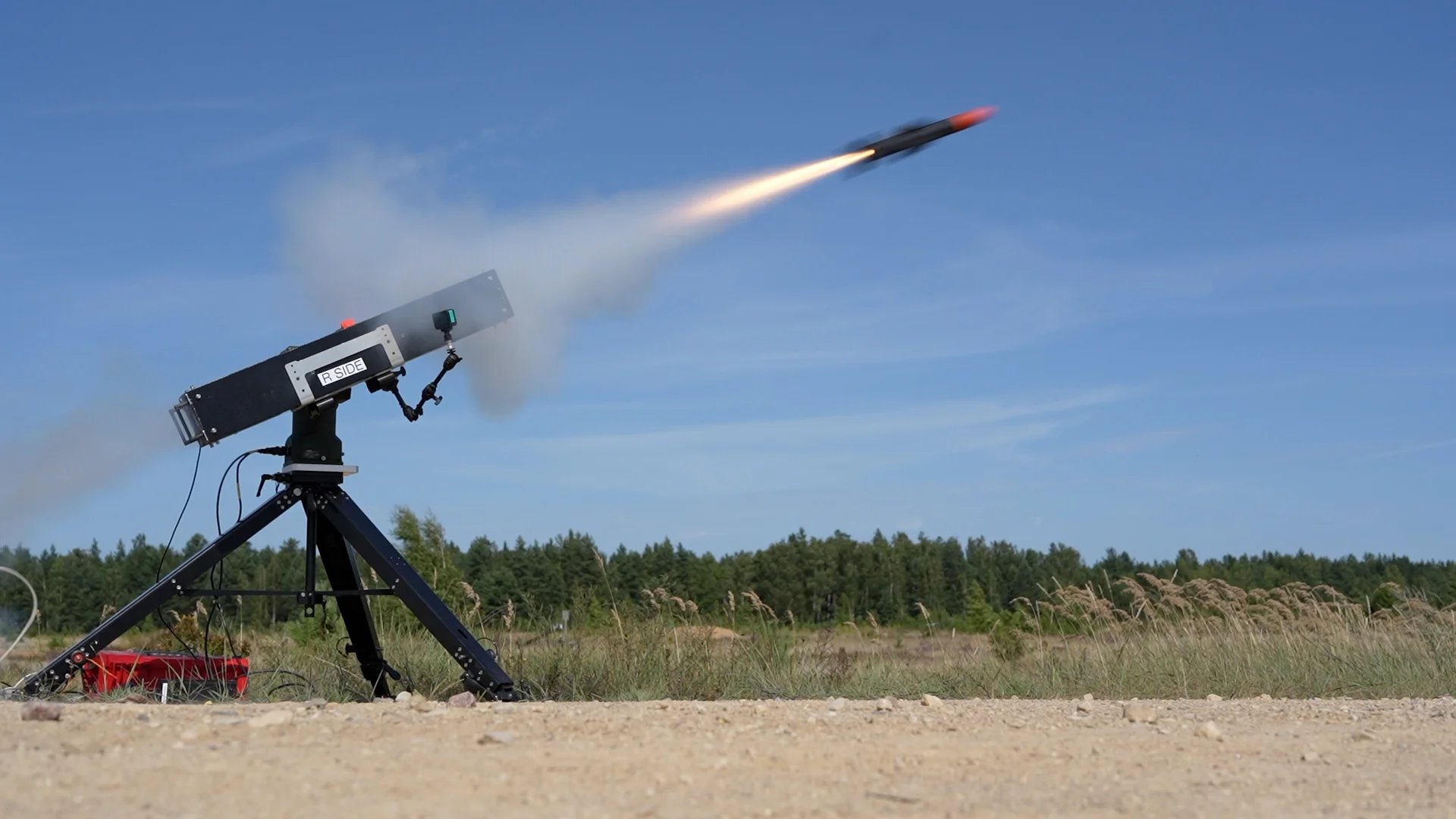
Estonian defence technology startup Frankenburg Technologies secured €30 million in modern funding to rapidly scale production of its Mark I interceptor missile, designed to counter the proliferation of low-cost attack drones.
The investment round was led by Plural, an operator-led investment platform, with significant participation from SmartCap, a fund backed by the Estonian state, bringing the company’s total funding to €40 million. Frankenburg intends to establish two mass production facilities within the European Union, aiming for a capacity of over 100 missiles per day at each site.
Founded in 2024 by Taavi Madiberk and Marko Virkebau, Frankenburg Technologies was established in response to the increasing ineffectiveness of traditional, expensive defence systems against the growing threat of readily available drones. Madiberk has stated his ambition is to bring a “SpaceX-style shift” to the defence missile industry.
The Mark I missile, which underwent a live-fire test on December 12, 2025, is designed as a low-cost interceptor to address the economic imbalance created by using expensive missiles to defeat significantly cheaper drones. The missile has a launch weight of under 2 kg, a length of 660 mm and a 60 mm diameter, and is capable of reaching targets at ranges up to 2 km and altitudes of 1,500 metres. It utilizes a solid-fuel rocket motor and a 0.5 kg high explosive-fragmentation warhead with a proximity fuse and self-destruct capability. The missile employs an electro-optic seeker for guidance, operating in both day and low-light conditions, and relies on data from ground-based sensors for initial target acquisition.
Frankenburg’s CEO, Kusti Salm, a former permanent secretary of Estonia’s defence ministry, has described the Mark 1 missile as the world’s smallest guided missile. The company is focusing on neutralizing threats such as long-range attack drones like the Shahed, as well as reconnaissance drones like the Orlan, Zala, and Supercam, commonly used by Russian forces in Ukraine, and loitering munitions.
In a separate development, British aerospace company BAE Systems signed a memorandum of understanding with Frankenburg Technologies to explore collaboration on counter-drone technologies. The initial focus of the agreement will be on accelerating the development of warheads for Frankenburg’s mass-producible missile systems.
Frankenburg Technologies currently operates in eight countries, including Estonia, Latvia, Germany, the UK, and Ukraine, where its systems are being developed with operational feedback.
