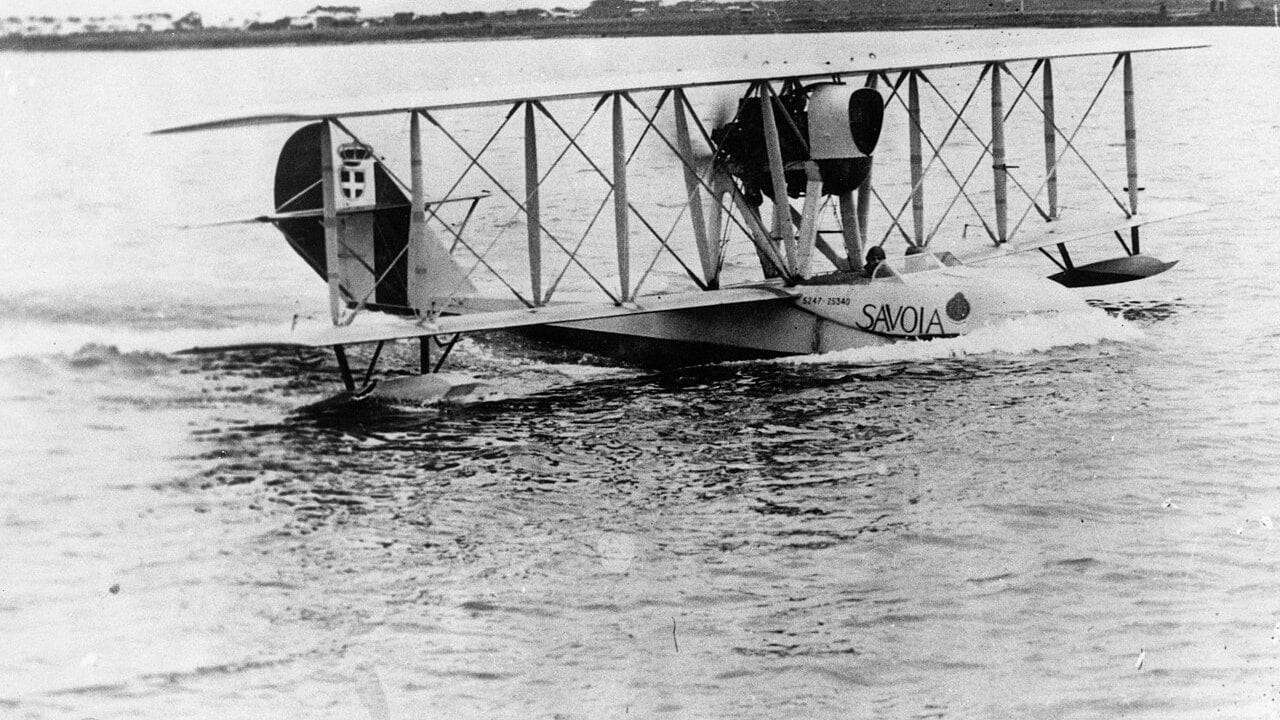
Francesco de Pinedo Completes Record 55,000-Kilometre Flying Boat Tour of Three Continents
Francesco de Pinedo touched down on the Tiber in Rome on November 7, 1925, completing a 55,000-kilometre aerial tour of three continents.
Thousands of spectators lined the riverbanks to watch the battered biplane flying boat settle onto the water. Benito Mussolini and cabinet members greeted the pilot alongside his father.
The journey took a little over 200 days with one mechanic, Ernesto Campanelli, and almost no ground support. The British aviation weekly Flight called it the most extensive aerial tour on record.
De Pinedo was born in Naples on February 16, 1890, into an old patrician family. He entered the Naval Academy at Livorno in 1908, served in Libya during the Italo-Turkish War, and flew reconnaissance missions for the navy in the First World War.
When the Regia Aeronautica became an independent service in 1923, he transferred to it. He believed seaplanes, which could land on any harbor, river, or lake, offered the key to long-distance travel.
His aircraft was a standard production SIAI S.16ter flying boat powered by a Lorraine-Dietrich engine of around 400 horsepower. It lacked wheels, meaning every stop had to be on water. He named the aircraft Gennariello.
The flight began in late April 1925, with Flight dating the departure to April 21 and Italian sources dating it to April 20 from Sesto Calende. The pair carried a minimum of equipment without prepared fuel dumps or support teams.
“[O]ne of the most remarkable aerial achievements of recent times, inasmuch as he was accompanied only by his mechanic Ernesto Campanelli, carried but a minimum of equipment, and relied throughout the entire journey on just the ordinary facilities existing at the various points of call,” Flight stated.
Their outbound route crossed Brindisi, Leros, Baghdad, Bushire, Chabar, Karachi, Bombay, Cocanada, Calcutta, Akyab, Rangoon, Tavoy, Mergui, Phuket, Penang, and Singapore. They reached Australia at Broome on May 31, then followed the coast to Melbourne on June 10, 1925.
After staying about five weeks in Melbourne and three weeks in Sydney, they flew up the Queensland coast and crossed to Merauke in Dutch New Guinea. They traveled through Dobo, Amboina, Menado, and Manila, reaching Kasumigaura near Tokyo on September 26, 1925.
The flying boat underwent a complete overhaul and received a new engine in Tokyo. It was the only engine change of the entire journey.
On October 17, the aviators started for home. The homeward journey of roughly 24,000 kilometres took just 22 days.
Francesco de Pinedo, a veteran officer of the Regia Marina who transferred to the Regia Aeronautica in 1923, undertook this arduous expedition to demonstrate the practical superiority of seaplanes for global travel.
Having served as a senior staff officer, he grew disillusioned with desk work and sought to prove that natural waterways, rather than costly airports, provided the ideal infrastructure for long-distance aviation. By leveraging his technical expertise, he aimed to establish Italy’s leadership in pioneering intercontinental flight paths.
The record-breaking journey also served as a direct critique of previous aerial attempts. Francesco de Pinedo, serving as a lieutenant colonel in the Regia Aeronautica, specifically chose a flying boat to surpass the 1920 Rome-to-Tokyo flight conducted by other Italian aviators.
“What may be described as the most extensive aerial tour on record has just been brought to a successful conclusion by the arrival in Rome, on November 7, of the Marquis de Pinedo and his mechanic Campanelli,” Flight reported.