
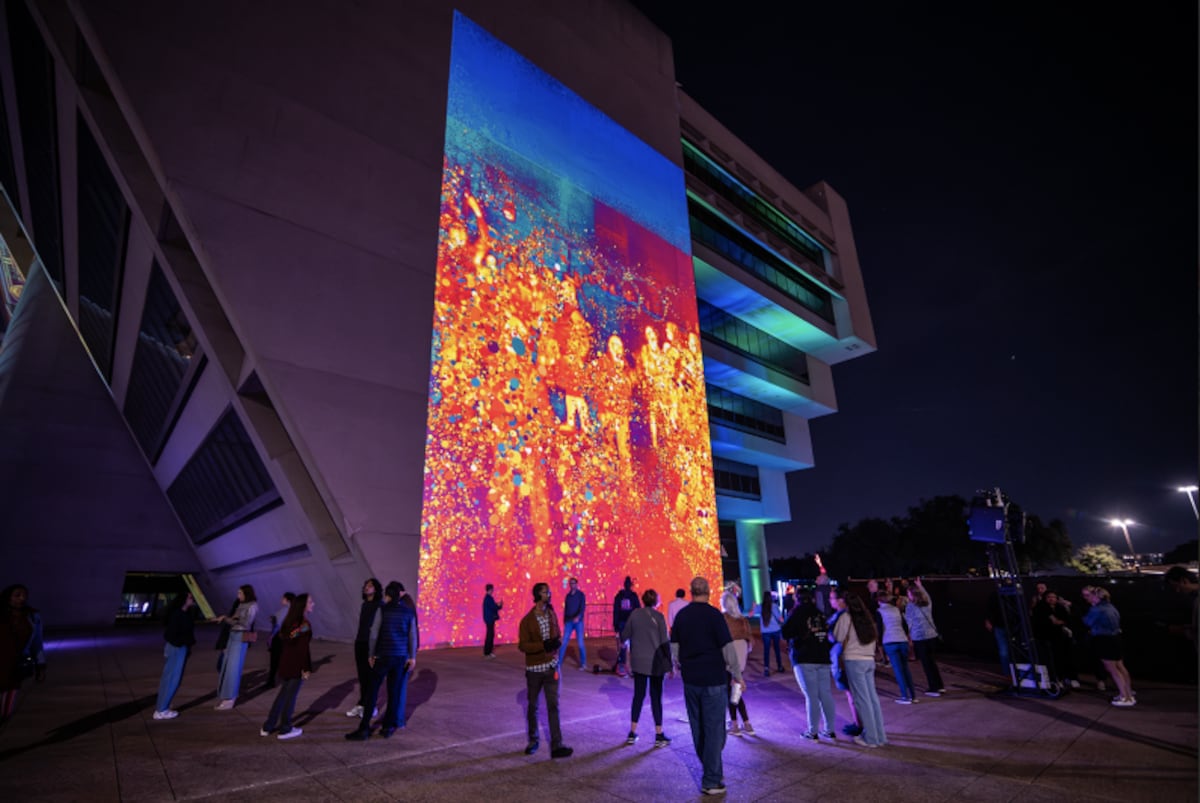
A Mexican artist is preparing to transform the historic Beti Jai fronton in Madrid into a canvas for an interactive art installation that explores themes of surveillance and community. Rafael Lozano-Hemmer’s “Deriva térmica” (Thermal Drift) will utilize thermal cameras to capture the heat signatures of visitors, projecting them onto the fronton’s 600-square-meter game wall as part of the LuzMadrid festival, running March 12-14.
The project draws inspiration from Michel Foucault’s 1975 book, Vigilar y castigar (Discipline and Punish), which examined the relationship between power, knowledge, and control. Foucault, as noted in the Spanish publication El País, argued that the Enlightenment brought not only freedom but also fresh forms of repression, exemplified by the “panopticon”—a prison design allowing for constant surveillance without the prisoners knowing if they are being watched.
Lozano-Hemmer, speaking to ICON Design, described his perform as an attempt to subvert the disciplinary function of the panopticon. “The piece doesn’t intend to impose discipline, but quite the opposite, to generate a sense of union between those who participate in it,” he said. He hopes the installation will foster a sense of community, countering the isolating effects of constant digital connection. “These works interrupt the narrative we have daily about who we are.”
The Beti Jai, originally built in 1894 for the Basque ball game Jai Alai, presents a unique architectural setting. Its tiered seating, reminiscent of a panopticon, adds another layer of meaning to the installation. The building has undergone numerous transformations throughout its history, serving as an aeronautical testing center, a sports venue, and even a makeshift garage, narrowly avoiding demolition in favor of luxury development. It was declared a Cultural Heritage Site in 2011 and underwent restoration, winning a National Restoration and Conservation Award in 2025.
“Deriva térmica” has been exhibited in cities including Kansas City and Abu Dhabi, but this will be its first presentation on the scale of the Beti Jai’s front wall. The installation employs infrared cameras—technology commonly used in military and security contexts—to detect and visualize body heat. Lozano-Hemmer intends this juxtaposition to provoke reflection on the implications of surveillance technologies. “Politically it is a way of underlining and making visible these systems of control,” he stated. He noted the potential for the work to resonate in Spain, where he observed a resurgence of extremist ideologies during his two decades living in the country.
The artist intends to display a notice informing participants that their thermal images will be captured and displayed, acknowledging the inherent surveillance aspect of the work. Lozano-Hemmer aims to create a disorienting experience, hoping to unsettle those who embrace technology while offering a sense of connection to those who view it with suspicion. “I want those who think technology is fun to have a sinister experience, and those who see it as something sinister to have a connection with other people,” he explained.
Lozano-Hemmer’s work often engages with themes of control and visibility, recalling his 1992 video installation, “Tensión superficial” (Surface Tension), which featured a large eye that tracked viewers’ movements. He recently inaugurated “Jardín inconcluso” (Unfinished Garden), a major exhibition at the Museo de Arte Moderno in Mexico City, returning him to his home country after years based in Canada. He expressed concern over the recent violence in Mexico following the death of drug lord Nemesio Oseguera, “El Mencho,” and the challenges of discerning truth amidst the rapid spread of information and misinformation.
The Madrid City Council’s Department of Culture, Tourism and Sport has stated there are currently no plans to alter the Beti Jai’s current use as a public space and monument, despite ongoing debate regarding a potential roof structure and the future of the building’s use. Lozano-Hemmer expressed his hope that the fronton will continue to be used for its original purpose—the game of pelota—alongside its role as a cultural venue.
