Fossilized Mastodons in Texas Cave Uncover Hidden 100,000-Year-Old Warm Period
Paleontologists diving in a flooded Texas cave have uncovered over 1,000 Ice Age fossils—including mammoths, saber-toothed cats and giant ground sloths—challenging long-held assumptions about Central Texas’s prehistoric climate. The discovery in Comal County’s Bender’s Cave, dated to roughly 100,000 years ago, reveals a previously unknown warm period when megafauna thrived in what is now arid terrain. The find forces scientists to rethink regional ecosystems and could reshape conservation policies for Texas’s cave systems.
The Lost World Beneath the Water
For decades, Texas’s Edwards Plateau was considered a backwater for Ice Age research. The conventional wisdom held that its limestone karst landscape—now home to drought-prone hills and sparse forests—was too inhospitable for megafauna during glacial periods. That narrative collapsed in March 2023, when University of Texas at Austin paleontologist John Moretti and caver John Young descended into Bender’s Cave, a privately owned groundwater conduit near San Antonio. Equipped with snorkeling gear, they navigated an underground stream where fossilized bones littered the streambed like modern river rocks.
“We thought we knew so much. These fossils really kind of start to shake that idea.”
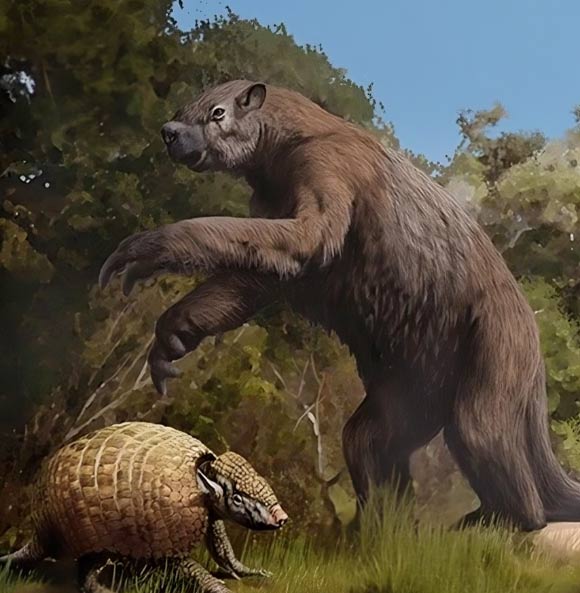
The team’s eight expeditions yielded roughly 1,000 specimens, including teeth from Columbian mammoths, limb bones from Smilodon (saber-toothed cats), and vertebrae from Glyptodon-sized armadillo relatives. Among the most startling finds were fossils of Megatherium (giant ground sloths) and Pampatherium (pampathere), animals whose presence in Central Texas had never been documented. The cave’s sediment layers suggest these creatures lived during a relatively warm interglacial period around 100,000 years ago—a time when global temperatures fluctuated dramatically.
Why This Discovery Forces a Reckoning
The implications extend far beyond academia. Texas’s cave systems are a hotspot for paleontological research, but the Bender’s Cave findings expose critical gaps in our understanding of regional climate resilience. If megafauna thrived here during past warm periods, what does that mean for today’s climate vulnerability assessments? The Edwards Aquifer, which supplies drinking water to 2 million people in San Antonio and Austin, is already under stress from drought, and urbanization. This discovery suggests the aquifer’s ancient recharge cycles may have been far more dynamic than previously modeled.
Locally, the find could trigger a surge in heritage tourism. Comal County, already home to attractions like the Gruene Hall, may see a boom in “Ice Age trail” development—if municipal leaders act swiftly to protect the site. “This isn’t just about fossils,” says Comal County Judge Sarah Ramirez. “It’s about telling a story that connects our past to our future. We’re talking to the Texas Historical Commission about designating Bender’s Cave as a state paleontological preserve.”
“This discovery isn’t just academic—it’s a wake-up call for how we manage our water and land. If You can’t predict how ecosystems survived past climate shifts, how can we prepare for the next one?”
The Legal and Economic Landmine
Private land ownership complicates conservation efforts. Bender’s Cave sits on property zoned for agricultural use, raising questions about whether fossil-hunting expeditions could be restricted—or even banned. Texas law grants landowners broad rights to subterranean resources, but the Antiquities Code (Tex. Nat. Res. Code § 71.001) protects fossils on state land. With no clear precedent for private cave systems, landowners and researchers are now in uncharted territory.
For businesses, the stakes are high. Environmental law firms specializing in Texas land-use disputes are already fielding calls from paleontologists and property owners. “The first case over fossil rights in a private cave is inevitable,” warns Attorney Marcus Chen of Chen & Associates. “We’re advising clients to document every expedition now, before disputes arise.” Meanwhile, geotechnical consultants are being hired to assess whether cave collapses—triggered by fossil extraction—could threaten nearby residential wells.
What This Means for Science and Beyond
The fossils’ age aligns with the Last Interglacial Period (125,000–115,000 years ago), a time when sea levels were 6–9 meters higher than today. If Central Texas supported temperate forests then, it suggests the region’s carbon sequestration potential during past warm phases was vastly underestimated. This could have profound implications for Texas’s greenhouse gas reduction strategies, particularly in the Edwards Plateau, where reforestation is a key climate mitigation tool.

For the scientific community, the discovery is a call to action. The Vertebrate Paleontology Lab at UT Austin is leading a multi-institutional effort to date the fossils more precisely using uranium-lead dating. Meanwhile, the Texas Parks and Wildlife Department is reviewing whether to classify Bender’s Cave as a “significant paleontological site,” which would trigger federal protections under the Archaeological Resources Protection Act.
The Bigger Picture: A Caveat for the Future
This isn’t just about the past—it’s a warning for the present. The megafauna that once roamed Central Texas didn’t vanish overnight; they succumbed to a cascade of environmental stresses. Today, Texas faces its own existential shifts: record-low aquifer levels, expanding urban sprawl into karst terrain, and increasingly volatile rainfall patterns. The Bender’s Cave fossils remind us that ecosystems, once disrupted, rarely recover in linear ways.
For those navigating this new reality, the path forward is clear. Civil engineers specializing in karst terrain will be critical to assessing cave stability as fossil recovery accelerates. Land-use attorneys will help property owners balance commercial interests with preservation needs. And heritage consultants can turn this discovery into a sustainable economic driver—if local governments act before developers do.
The cave doesn’t just hold bones. It holds a mirror. And what it reflects isn’t just history—it’s a roadmap for survival.