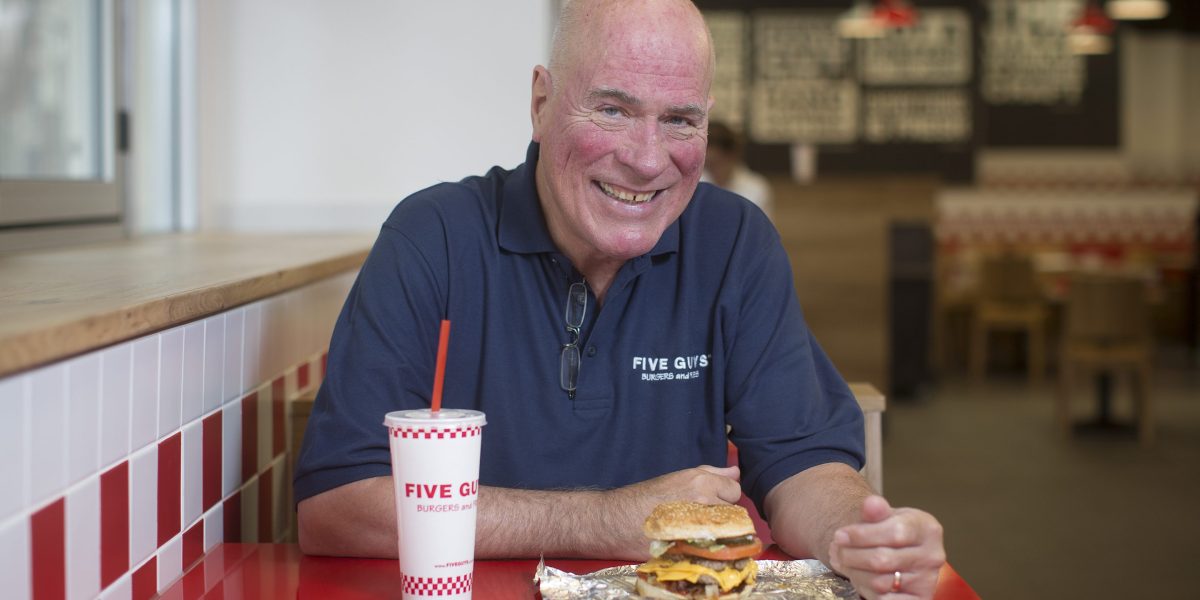
Five Guys Founder Jerry Murrell Pays $1.5 Million Bonus After 40th Birthday Promotion Collapse
Five Guys founder Jerry Murrell distributed $1.5 million in employee bonuses following a logistical collapse during a 40th-anniversary BOGO promotion. The move mitigated operational risk and preserved brand equity, highlighting the agility of private family-owned QSR models against the rigidity of public conglomerates.
When a promotional engine misfires in the Quick Service Restaurant (QSR) sector, the immediate fiscal impact is rarely just the cost of the food. We see the erosion of unit-level economics and the degradation of labor efficiency. Jerry Murrell’s decision to liquidate $1.5 million in cash bonuses was not merely an act of contrition; it was a calculated hedge against systemic brand damage. In an industry where labor constitutes roughly 30% to 35% of prime costs, flooding the payroll with unexpected liquidity serves as a shock absorber for workforce retention during high-stress operational volatility.
The “40th Birthday” promotion, intended to drive same-store sales growth, instead triggered a supply chain bottleneck that overwhelmed front-of-house capacity. For public companies, such an event typically triggers a cascade of earnings call revisions and investor relations crises. Five Guys, operating as a private entity, bypassed the shareholder scrutiny to address the human capital crisis directly. This distinction is critical. Publicly traded peers like McDonald’s or Yum! Brands often rely on standardized crisis playbooks managed by external agencies. Murrell’s approach suggests that in family-run conglomerates, the cost of reputational repair often outweighs the immediate P&L hit of an unbudgeted expense.
The Fiscal Weight of Operational Failure
Consider the math. Five Guys generates an estimated system-wide sales volume exceeding $2.5 billion annually. A $1.5 million payout represents approximately 0.06% of that top-line figure. In the context of EBITDA margins for mature QSR chains, which often hover between 15% and 20%, this expenditure is negligible. However, the alternative cost—losing trained crew members who quit due to burnout—is far steeper. Recruiting and training novel staff in a tight labor market can cost upwards of $3,000 per unit when factoring in lost productivity and onboarding.
When operational workflows fracture under unexpected demand, the immediate remedy often lies beyond internal HR capabilities. Brands facing similar volume spikes frequently engage specialized workforce optimization consultants to restructure labor scheduling algorithms and prevent future bottlenecks. The inability to forecast demand elasticity remains a persistent vulnerability in the sector, particularly for chains relying on legacy POS systems that lack real-time inventory integration.
“In the QSR landscape, agility is the primary asset of private firms. Public companies are often paralyzed by quarterly guidance fears, whereas family offices can deploy capital instantly to preserve long-term brand equity.” — Senior Analyst, Consumer Staples Division, Global Investment Research
Murrell’s candid admission that he “screwed up” the forecasting underscores a common disconnect between corporate strategy and unit-level execution. The promotion drove a 130% increase in traffic, a variance that standard demand planning models failed to capture. This volatility exposes the fragility of just-in-time inventory models when consumer behavior shifts abruptly. To mitigate such exposure, enterprise-level franchises increasingly partner with supply chain resilience firms capable of stress-testing inventory buffers against viral marketing events.
Private Equity vs. The Family Office Model
The broader market context reveals a divergence in capital allocation strategies. While private equity-backed chains like Wingstop or Domino’s focus heavily on digital integration and franchisee optimization to boost multiples, family-owned entities like Five Guys prioritize operational continuity and culture. Murrell’s joke about skipping a fur coat for employee bonuses signals a governance structure where reputation risk is managed personally by the C-suite, rather than outsourced to a PR firm.
Yet, even private giants face scaling limits. As Five Guys eyes international expansion and digital ordering integration, the complexity of their supply chain will mirror that of public competitors. The “do-over” promotion in March indicates a willingness to iterate, but it also highlights the necessitate for robust data analytics. Without sophisticated predictive modeling, promotional calendars remain a gamble. This is where the gap between family intuition and institutional data science widens. Bridging this gap often requires strategic management consulting to implement enterprise resource planning (ERP) systems that align marketing spend with operational capacity.
Industry data from the National Restaurant Association suggests that 60% of independent operators lack the capital reserves to absorb unexpected operational shocks. Five Guys’ ability to write a $1.5 million check on the spot is a luxury of scale, but the lesson applies universally: liquidity is the ultimate crisis manager. For mid-market firms lacking such deep pockets, the alternative is rigorous scenario planning and hedging strategies often facilitated by financial risk management specialists.
The Valuation of Trust
Murrell’s payout was an investment in the intangible asset of trust. In a sector plagued by high turnover and commoditized products, crew morale directly correlates with speed of service and order accuracy. The $1,000 per store bonus acts as a retention anchor, stabilizing the workforce for the next fiscal quarter. This human capital stabilization is arguably more valuable than the temporary sales lift from the BOGO offer.
As the QSR sector moves toward 2027, the divergence between public and private operational philosophies will sharpen. Public chains will lean on automation and AI to reduce labor variance. Private families will likely double down on culture and agility. For investors and operators alike, the lesson from Five Guys is clear: when the model breaks, the fastest path to recovery is often direct capital injection into the workforce, bypassing the bureaucracy of crisis committees.
The market rewards those who can pivot without hesitation. Whether through internal capital reserves or external B2B partnerships, the ability to absorb operational shock defines the next cycle of winners in the global food service directory.