
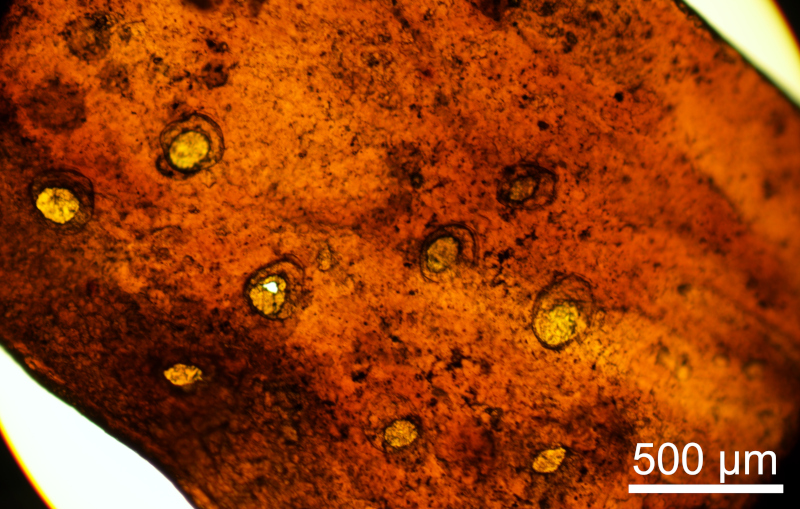
Ancient Fossil Reveals Earliest Evidence of Lichens, Rewriting Understanding of Life’s Transition to Land
RIO VERDE DE MATO GROSSO, BRAZIL – A groundbreaking revelation in a Brazilian quarry has yielded the oldest known fossil evidence of lichens, pushing back the timeline for these crucial organisms and offering new insights into how life first colonized land. The 480-million-year-old fossil, named Spongiophyton, suggests lichens weren’t simply surviving in harsh conditions, but actively shaping the early terrestrial habitat, paving the way for complex ecosystems like forests and fields. The research, published today in Science Advances, combines customary paleontological methods with advanced nanoscale imaging techniques.
The fossil was unearthed in 2021 by Bruno Becker-Kerber while completing his master’s degree at the University of São Paulo (IGc-USP), alongside his father, Gilmar Kerber, a paleontology enthusiast and retired Ibama official now pursuing a doctorate at the Federal University of Mato Grosso do Sul (UFMS). “Each fossil is a window into the past.This one, in particular, showed a new vision about how life conquered the earth’s environment,” said Gilmar Kerber.
Becker-Kerber, currently a postdoctoral researcher at Harvard University, meticulously packaged the sample in sterilized aluminum foil to prevent contamination, allowing for sensitive molecular biomarker analysis. Detailed examination at the National Synchrotron Light Laboratory (LNLS) at CNPEM revealed a complex network of fungi and algae, confirming the fossil’s lichen nature.
“The measurements guided us to key regions of the fossils and we were able to obtain nanometer-scale images that revealed the complex networks of fungi and algae that define the Spongiophyton like a real lichen,” explained Nathaly Archilha, a researcher at LNLS.
The discovery places the emergence of lichens in the cold regions of the ancient supercontinent Gondwana, encompassing present-day South America and Africa. Researchers believe these early lichens played a vital role in weathering rock, creating biomass, and ultimately transforming the planet’s surface – a role even more significant then previously understood.
“We still observe today how lichens altered rocky substrates, dissolving rocks, in addition to producing biomass used by plants and animals. This role would be even greater during that period, having enabled the emergence of the complex ecosystems we have today,” concluded Becker-Kerber.
The article, the rise of lichens during the colonization of terrestrial environments, is available at: https://www.science.org/doi/10.1126/sciadv.adw7879.
