First In-Flight Robotized TCD Assesses Cerebrovascular Reactivity and Posterior Circulation in Short-Duration Spaceflight
A single astronaut on a short-duration mission produced the first in-flight estimates of cerebrovascular CO2 reactivity and posterior circulation hemodynamics using a robotized transcranial Doppler ultrasound system, researchers reported in Nature.
Robotized probe proves feasible for middle cerebral artery
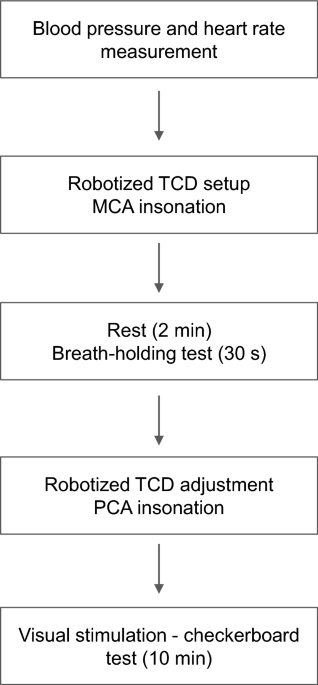
The crew operated the device proficiently, yielding high-quality recordings of the middle cerebral artery during every measurement session, Nature reported. Insonation of the posterior cerebral artery proved more challenging and time-consuming, with some recordings failing predefined quality criteria. The study authors wrote that successful posterior assessment in microgravity may require methodological refinement or remote-guided support from a neurosonology expert.
Systemic hemodynamics shift in microgravity
Both systolic and diastolic blood pressure were lower during and after spaceflight compared with pre-flight values, consistent with supine positioning on Earth. Heart rate showed a marked initial decrease after launch followed by a gradual increase during the flight phase, reflecting autonomic adjustments to increased stroke volume and subsequent plasma volume reduction, the study noted.
Anterior circulation resistance indices decline early and post-flight
Resting pulsatility and resistance indices in the middle cerebral artery decreased slightly but consistently during the first two weeks of spaceflight, with a transient rise on flight day 15, Nature reported. Post-flight, resistance indices were lower than pre-flight or in-flight values, most prominently on return day 5. The authors cautioned these waveform-derived indices are sensitive to distal vascular tone but are not direct measures of cerebrovascular resistance.
Hemispheric asymmetry emerges only in flight
Pulsatility and resistance indices were higher on the left than the right middle cerebral artery exclusively during the in-flight phase, a lateralization not previously reported in human spaceflight, according to the study. Pre-flight parameters did not differ between hemispheres. Structural asymmetries or differential susceptibility to fluid shifts may contribute, though relevance in this participant remains speculative.
Breath-holding test estimates CO2 reactivity
The breath-holding index showed a modest overall decrease in flight, with a transient pronounced reduction between flight days 7 and 12, Nature reported. Post-flight values were moderately lower than pre-flight, and the marked reduction on return day 5 coincided with decreases in pulsatility and resistance indices.
The authors noted the breath-hold maneuver’s hypercapnic stimulus may not have been identical across sessions, and intrathoracic pressure dynamics differed in microgravity, attenuating an initial flow velocity decrease seen on Earth.
Posterior circulation shows divergent pattern
Posterior cerebral artery resistance indices increased slightly to moderately during flight and at the first post-flight measurement, contrasting with the middle cerebral artery’s decreasing trend, the study found. Ground-based analogue studies have demonstrated heterogeneous anterior-posterior cerebrovascular responses, potentially due to differences in sympathetic innervation and autoregulatory characteristics between the two circulations.
Nature published the peer-reviewed study reporting the first in-flight estimates of cerebrovascular CO2 reactivity and posterior circulation hemodynamics in a single astronaut on a short-duration mission. The journal accepted the research article detailing data from a robotized transcranial Doppler ultrasound system operated during spaceflight.
Nature’s peer-review process evaluated the study’s methodology, including the feasibility of in-flight transcranial Doppler recordings and the interpretation of breath-holding index changes in microgravity, before publication. The journal’s editorial standards for technical readability and scientific rigor applied to this novel space medicine dataset, which the authors noted was limited by its single-case design.
Single-case design limits generalization
Temporal patterns across consecutive measurements and clustering of changes around return day 5 may be consistent with physiological adaptation, though random variability and other factors cannot be excluded, the authors wrote. They emphasized the potential value of repeated post-flight assessments when characterizing cerebral hemodynamics after return to Earth.