First Galactic Microblazar Candidate Discovered by International Team
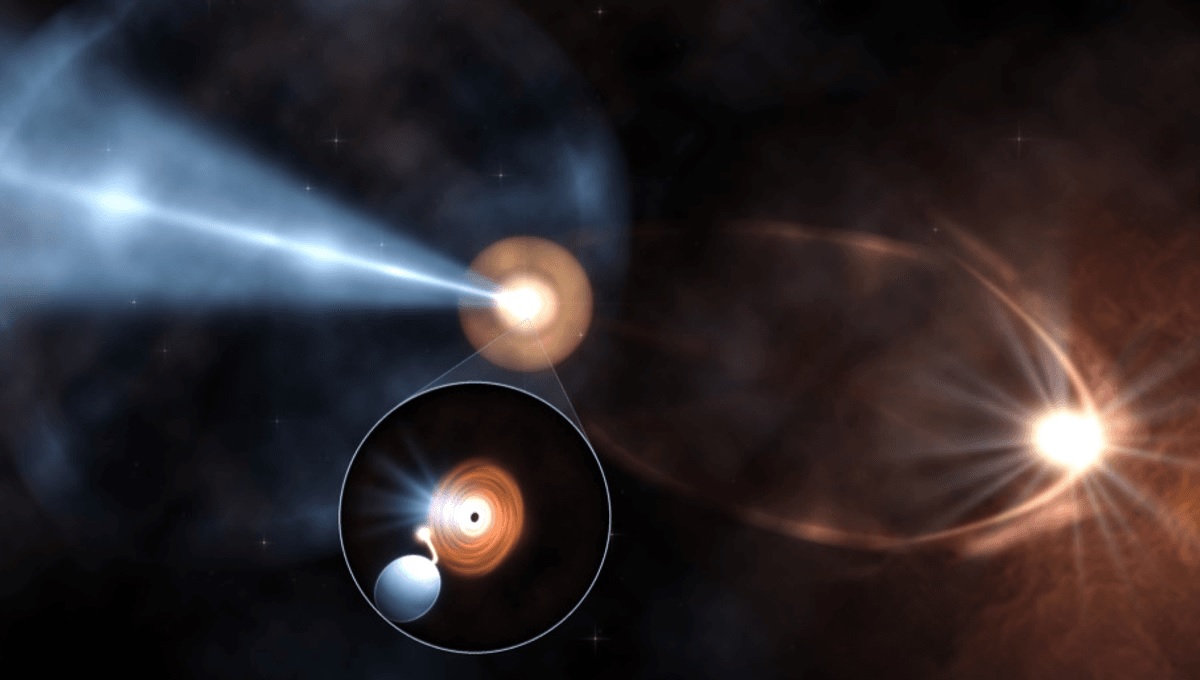
An international team of astrophysicists has identified IRAS 18293−0941 as a candidate galactic microquasar located approximately 12,000 light-years from Earth in the Milky Way, roughly 100 quadrillion kilometers away. The discovery provides a candidate for a rare class of stellar systems predicted by astronomical models roughly three decades ago.
International Collaboration and Theoretical Modeling
The research effort was led by Josep Martí and Pedro Luque Escamilla of the University of Jaén, with core theoretical contributions from the National University of La Plata. Their work reconstructed the physical scenario of the system, demonstrating how data gathered by multiple telescopes could be explained cohesively following three years of collaborative research.
Additional contributions to the data analysis came from researchers Jorge Combi and Federico García, who processed and interpreted X-ray emissions originating from the core regions of the system. European researchers gathered multi-wavelength observational data across the electromagnetic spectrum, while the Argentine team analyzed the physical processes driving high-energy emissions in an extreme environment.

Physical Structure of IRAS 18293−0941
A microquasar is a binary star system comprising a massive star and a compact object such as a black hole, which interact gravitationally while launching dual opposing relativistic jets of matter. In this system, one of the relativistic jets points almost directly toward Earth along the line of sight. The central binary components complete an orbital period every 11.38 days, while the compact object accretes material stripped from its stellar companion.
Dense clouds of gas and interstellar dust obscure the system, blocking visible light and limiting conventional optical observations. According to the UNLP physical model, stellar winds from the hot massive star collide with material streaming near the black hole, generating a substantial portion of the detected electromagnetic radiation alongside the opposing particle jets.