
Early Aerial Refueling: The unsung Story Explored
SAN DIEGO – May 9, 2024 – The story of early aviation often overlooks a crucial innovation: aerial refueling. On June 27, 1923, the first successful instance of air-to-air refueling took place, extending the range of aircraft and pushing the boundaries of flight endurance. This groundbreaking feat, driven by the need to overcome fuel limitations, paved the way for modern aviation. For a closer look, read on.
Pioneering the Skies: The Unsung Story of early Aerial Refueling
While the Wright brothers are often celebrated as the fathers of flight, the narrative of early aviation is far richer and more complex. From Gustave Whitehead’s alleged 1901 flight to Alberto Santos-Dumont’s later achievements, numerous individuals contributed to making powered flight a reality.
Fueling the Dream: The Dawn of Air-to-Air Refueling
The limitations of early aircraft were stark: range and endurance were directly tied to fuel capacity. The concept of refueling in mid-air might seem like a modern marvel, but its origins trace back to the pioneering spirit of the 1920s.
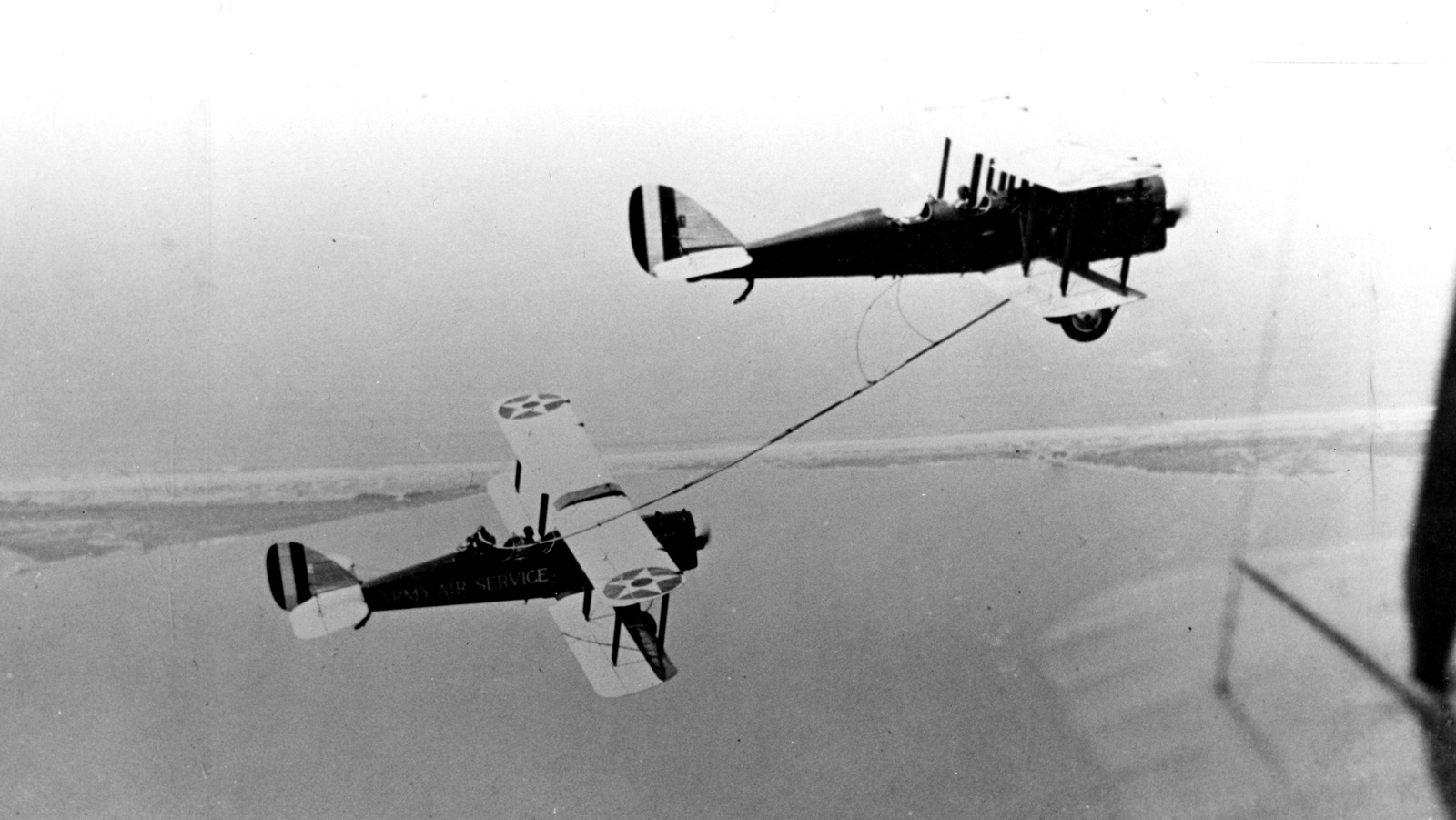
This groundbreaking event,involving a pair of De Havilland DH-4B biplanes,is considered one of the top ten moments in aviation history that changed flight forever.
The Record-Breaking Flight That Sparked Innovation
The impetus for aerial refueling arose from the desire to push the boundaries of flight endurance. On Oct. 5, 1922, Lieutenants John A. Macready and Oakley G. Kelly achieved a remarkable feat, flying a Fokker T-2 over San Diego, California, for 35 hours, 18 minutes, and 30 seconds. Their record-setting flight, though, was cut short by fuel exhaustion.
The De Havilland DH-4: A Workhorse with a Fiery Reputation
The De Havilland DH-4 biplane,a British design,played a crucial role in World War I,serving the U.S. Army Air Service in various capacities, including bombing, observation, and artillery spotting. Interestingly,it was built by the Aeroplane Division of General Motors,the Dayton-Wright company,and the Standard Aircraft Corporation.
By its retirement in 1932, over 60 variations of the DH-4 existed. Despite its reliability, the aircraft had a notorious fuel system problem, earning it the grim nickname The Flaming Coffin.
The irony of using this particular plane for such a risky refueling operation is not lost on aviation historians.
The First Successful In-Flight Refueling
Following Lts. Macready and Kelly’s record-setting flight, the team at San Diego’s Rockwell Field embarked on a mission to overcome the fuel limitation. on June 27, 1923, Lts. Virgil Hine and frank W. Seifert achieved a historic milestone: the first successful aircraft-to-aircraft in-flight refueling.
Using a gravity-feed system, gasoline was transferred through a 50-foot hose from their DH-4B to another DH-4B flown beneath them by Lts. Lowell H. Smith and John P. Richter.
Pushing the Limits: Record Attempts and Demonstrations
The day after the successful refueling,Smith and Richter attempted to break Macready and Kelly’s endurance record. However, a gas valve malfunction forced an early landing. Undeterred, in August 1923, they flew for 37 hours and 15 minutes, setting 16 new world records for distance, speed, and duration.
In October, they further demonstrated the reliability of the system by flying 1,250 miles nonstop from the Canadian border to Mexico, refueling midair three times. This flight proved that aerial refueling was a viable option for extending an aircraft’s flight range.
FAQ: Aerial Refueling
- Q: When was the first air-to-air refueling?
A: June 27, 1923. - Q: What planes were used in the first refueling?
A: Two De Havilland DH-4B biplanes. - Q: Why was aerial refueling developed?
A: To extend the range and endurance of aircraft.
