
Filipino Boxing Pioneer Pancho Villa Celebrated in New Book and Smithsonian Exhibit
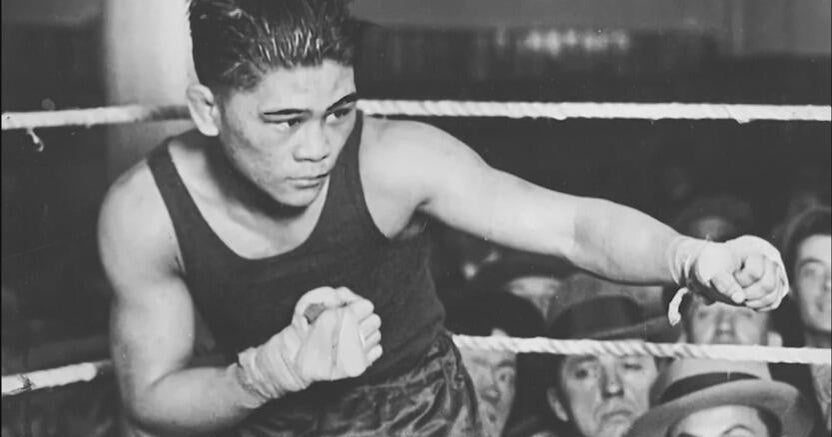
A new book, “Pancho Villa: World Champion, 1923,” co-authored by Bay Area artist Rene Aquilizan and Dr. Bernard Remollino, an associate professor of Asian American and Pacific American History at San Joaquin Delta College, is bringing renewed attention to the legacy of Filipino boxing legend Francisco “Pancho Villa” Guilledo. The book, released this summer, chronicles the life and career of the flyweight champion who broke barriers in the 1920s.
Villa revolutionized the sport, according to Aquilizan. “He kind of changed the boxing game,” he said. “He introduced speed and power at the same time. Little guys should not be knocking out other fighters.”
Villa’s record included 90 wins, eight losses, four draws, and two no-contests, with 22 knockouts. However, his defining moment came in June 1923, when he defeated Welsh-born Jimmy Wilde in New york City to become the first filipino to win a World Flyweight Title.
Beyond his athletic achievements, Villa’s success held significant cultural weight. “And they really respected him in the height of, like, racism back in 1920s,” Aquilizan explained. “this Asian guy, this brown guy came and showed the world that we matter, we are somebody.”
Dr. Remollino’s initial encounter with Aquilizan’s extensive collection of Villa memorabilia sparked the collaboration. “I was geeking out,I was really excited,I think my palms started getting sweaty,” Remollino recalled.”Here was tangible evidence this Pancho villa actually moved through these spaces in the 1920s.”
The pair felt a strong sense of purpose in sharing Villa’s story. “It felt like we were driven by something greater than us,” Remollino said. “We can think of Pancho Villa and the winning of the flyweight championship in 1923 as a watershed moment in the history of sport,in the history of boxing,and Filipino American history,and that speaks of the cultural importance,and it speaks to the social impact that that was having.”
villa’s victory paved the way for future Filipino boxing stars like Gabriel “Flash” Elorde, Ceferino Garcia, small Montana, and Manny Pacquiao. Aquilizan believes Villa’s impact is foundational.”I think [Pancho Villa] is greater than Manny Pacquiao, but Manny Pacquiao to me is probably the greatest fighter, but Pancho Villa opened that door so Manny can come in there,” he stated. ”The first one is always the hardest one.” Remollino added, “If we are looking at the long past thread of how Filipinos show up in the popular imagination of viable fighter, Pancho Villa really ignited the imaginations.”
Tragically, Villa’s career was cut short. Following a July 4, 1925, loss to Jimmy McLarnin by decision at the Oakland Oaks ballpark in Emeryville – after having a tooth pulled – he developed a serious infection and passed away ten days later at the age of 24.
The book is a labor of love, driven by a desire to preserve and share Filipino heritage. “We have to take care of our stories,” Aquilizan emphasized. “I have to make sure the community gets to see what I have, and that I’m not just hoarding these images. I want to share it with my people.”
Aquilizan’s collection will soon reach a wider audience, as the Smithsonian in Washington D.C. will feature a significant portion of it in an upcoming exhibit on the Filipino American experience,opening in November.
