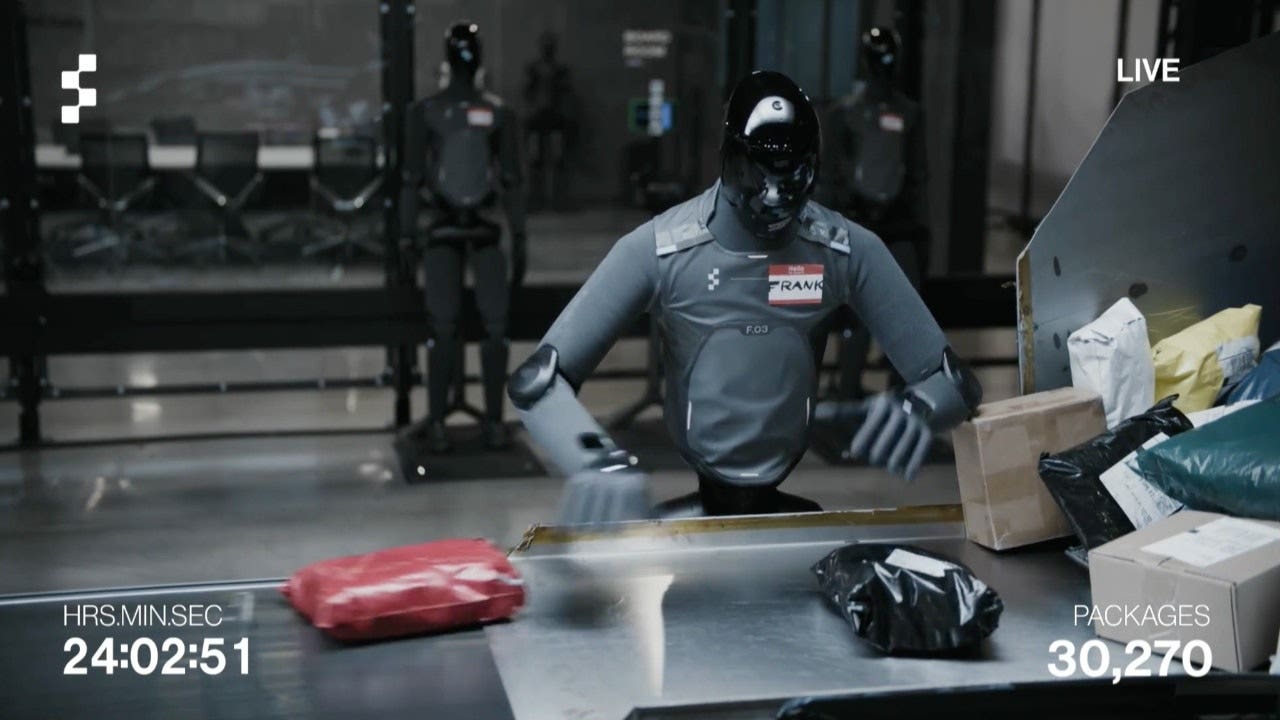
Figure AI Humanoid Robots Complete 24-Hour Continuous Package Sorting Test
Autonomous Throughput: Evaluating the Helix-02 Humanoid Runtime
The recent demonstration of humanoid robotics achieving 24 hours of continuous autonomous operation marks a departure from the intermittent, supervised testing cycles that have historically defined the sector. By transitioning from an eight-hour proof-of-concept to a multi-day, zero-failure production run, Figure AI has shifted the conversation from hardware viability to systemic reliability. For engineers focused on systems integration and industrial automation, the core question is no longer whether these units can manipulate objects, but whether their inference architecture can sustain low-latency decision-making under stress.

The Tech TL;DR:
- Continuous Runtime: Figure AI’s Helix-02 system maintained autonomous package sorting for over 24 hours without system failure, processing over 28,000 units.
- Inference at the Edge: The robots utilize onboard camera-to-pixel reasoning, achieving human-parity throughput of approximately 3 seconds per package.
- Operational Reliability: The shift from a controlled eight-hour demo to a multi-day operation suggests high stability in the underlying AI reasoning stack, though real-world deployment requires integration with existing IT infrastructure management protocols.
The Helix-02 Architecture: Hardware and Inference Benchmarks
At the center of this performance is the Helix-02 AI system. Unlike traditional robotics that rely on pre-programmed kinematic loops, these units are processing camera inputs to perform real-time reasoning. To maintain human-speed throughput, the system must minimize the compute-to-actuation pipeline. While the company has not released specific TOPS (Tera Operations Per Second) or thermal throttling data, the ability to maintain 3-second cycle times suggests a highly optimized neural network architecture, likely utilizing pruned models to reduce latency.
For enterprise CTOs, the challenge remains in the cloud-to-edge orchestration. Scaling these units requires robust containerization—often managed via Kubernetes clusters—to ensure that firmware updates and model weights remain consistent across a fleet. Relying on an autonomous agent that processes “directly from camera pixels” implies an heavy reliance on onboard NPU (Neural Processing Unit) efficiency, which historically creates significant thermal management challenges.
# Example: Monitoring Inference Latency for Edge Robotics # Pseudo-code for tracking API request-response cycle in autonomous agents import time def monitor_inference_latency(robot_id): start_time = time.perf_counter() # Trigger vision-reasoning model process_package_barcode(robot_id) latency = time.perf_counter() - start_time if latency > 0.5: # Threshold for human-parity performance log_performance_alert(f"Latency spike detected on {robot_id}: {latency}s") return latency The Infrastructure Triage: Scaling Beyond the Lab
Deploying humanoid robotics at scale is not merely a robotics problem; This proves a networking and security problem. Corporations attempting to integrate these systems into logistics hubs must account for the increased attack surface. Every autonomous node represents an endpoint that requires rigorous penetration testing and SOC 2 compliance validation. If the robot is reasoning locally, how is the model updated? If it is fetching weights from a central server, how is that data pipeline encrypted?
“The leap from 8 to 24 hours of autonomous operation is significant, but the real hurdle for enterprise adoption is not the runtime—it’s the fleet management layer. We need to see how these systems handle edge-case exceptions, network partitions, and the inevitable hardware degradation that occurs in a non-lab environment.” — Lead Robotics Architect, Infrastructure Research Group.
As organizations move toward automating physical workflows, they must engage with specialized Managed Service Providers (MSPs) that understand the intersection of IoT and enterprise-grade security. Managing the software lifecycle of a humanoid robot is functionally similar to managing a fleet of remote servers; it requires robust CI/CD pipelines and the ability to roll back firmware versions instantly if a regression is detected.
Framework: Hardware/Spec Comparison
| Metric | Traditional Automation | Helix-02 Humanoid |
|---|---|---|
| Flexibility | Low (Hardcoded) | High (AI Reasoning) |
| Deployment Time | Weeks (Mechanical) | Days (Model Training) |
| Throughput | High (Fixed) | Human Parity (Dynamic) |
| Failure Recovery | Manual Intervention | Autonomous Logic |
Conclusion: The Path to Industrial Normalization
The 24-hour milestone serves as a proof of concept for reliability, but the industry is still in the “early adopter” phase of humanoid deployment. The transition from “livestreamed demo” to “enterprise utility” depends on the maturity of the software stack. As these robots begin to handle more complex tasks, the necessity for standardized API documentation and open-source interoperability will become paramount. Firms looking to integrate this technology should focus on building a resilient, air-gapped internal network to isolate these endpoints from the broader corporate intranet until the security posture of the individual robot OS is fully vetted.

*Disclaimer: The technical analyses and security protocols detailed in this article are for informational purposes only. Always consult with certified IT and cybersecurity professionals before altering enterprise networks or handling sensitive data.*