
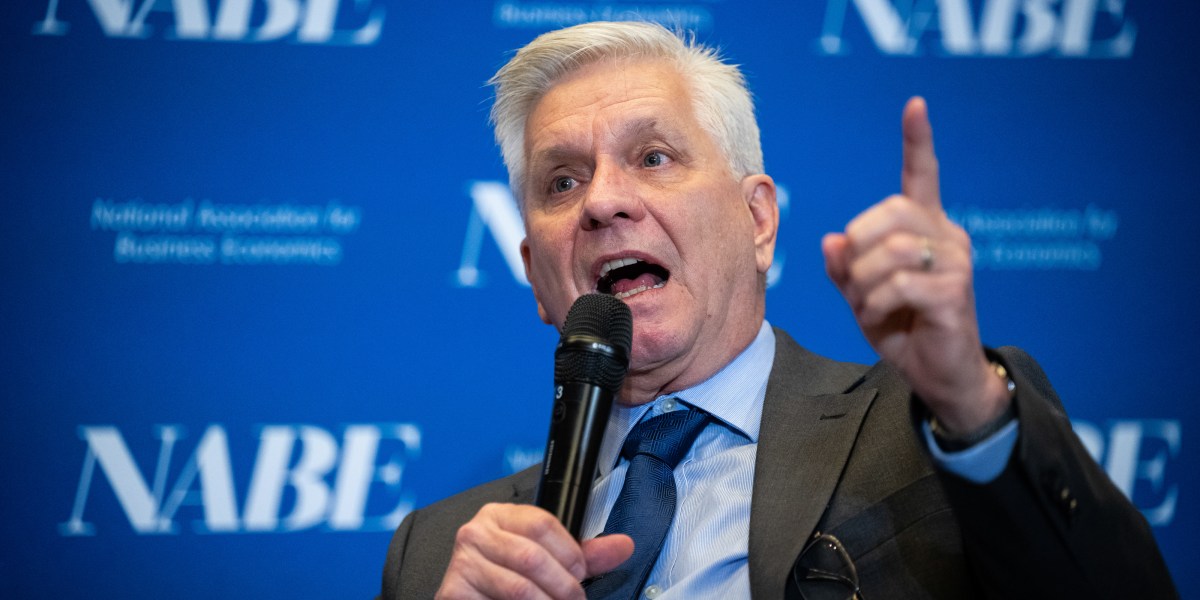
Federal Reserve Governor Christopher Waller on Monday indicated that a March interest rate cut is far from certain, citing a stronger-than-expected jobs report and the possibility that the labor market’s weakness in 2025 was a temporary anomaly. Waller’s comments suggest a potential shift in the central bank’s trajectory, potentially inviting criticism from former President Donald Trump.
Waller acknowledged the January jobs report, which showed employers adding 130,000 jobs, exceeded expectations. However, he cautioned that this positive data could be an isolated event. He stated that a similarly robust report in February would be necessary to confirm a genuine improvement in the labor market, which he described as having experienced a notably weak performance throughout last year. “As things stand today, I rate these two possible outcomes as close to a coin flip,” Waller said, speaking at a conference hosted by the National Association for Business Economists.
This stance represents a departure from Waller’s position in January, when he was one of two Federal Reserve governors to dissent against the decision to maintain the central bank’s key interest rate at approximately 3.6% following a series of three rate cuts at the finish of the previous year. Reductions in the Fed’s rate typically translate to lower borrowing costs for consumers and businesses, impacting mortgages, auto loans and business financing.
Waller also downplayed the potential impact of the Supreme Court’s recent decision to invalidate many of Trump’s tariffs. He suggested the ruling would likely have a “limited” effect on the economy and inflation, and therefore would not influence his views on interest rates. Although acknowledging the decision could “have a positive impact on spending and investment,” he emphasized the uncertainty surrounding the magnitude and duration of any such effect. He further noted the White House’s efforts to reimpose tariffs through alternative legal mechanisms, adding to the overall uncertainty.
According to Waller, if the February jobs report mirrors January’s performance, “indicating that downside risks to the labor market have diminished, it may be appropriate” to hold the Fed’s short-term rate steady and continue monitoring inflation and labor market strength. Conversely, if February’s data weakens or revises away the gains seen in January, a rate cut in March would be warranted.
Waller also addressed the unusual economic situation of sustained growth alongside minimal job creation in 2025. He anticipates that even the currently reported modest job gains for last year will likely be revised downward to negative figures. “This would be the first time in my career, my life, that I saw an economy growing like this, and zero job growth,” he stated, adding he is unsure how to interpret this phenomenon. He suggested that increased productivity, potentially stemming from adaptations made during the pandemic, could be a contributing factor.
The former president, on Friday, criticized the Federal Reserve following reports of slower economic growth in the final quarter of last year, with growth slowing to an annual rate of 1.4%, a decrease from 4.4% in the preceding quarter. Trump posted on social media, calling for “LOWER INTEREST RATES” and derisively referring to Chairman Jerome Powell as “’Two Late’ Powell,” a misspelling of his usual nickname, “Too Late.”
