
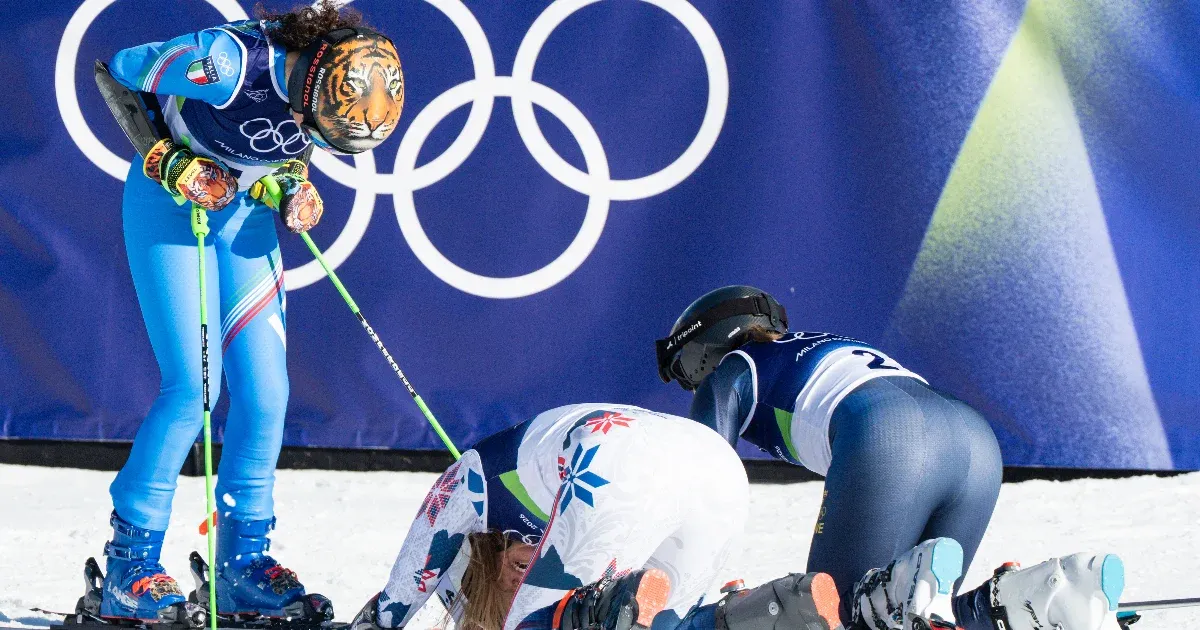
Federica Brignone of Italy secured her second gold medal of the 2026 Winter Olympics on Sunday, winning the women’s giant slalom at Cortina d’Ampezzo. The victory comes just four days after she triumphed in the super-G, making her the eighth Italian athlete to win two Olympic gold medals.
Brignone’s achievement is particularly remarkable given a severe leg injury she sustained in April 2025. During the Italian national championships, she collided with a gate in the giant slalom, fracturing her tibia in two places and tearing her cruciate ligament. The injury required 42 stitches and a lengthy rehabilitation process, casting doubt on her ability to compete at the Milan-Cortina Games.
“I came with doubts, with pain, without training, and now I am here with my second gold. It’s an unbelievable dream,” Brignone said after the race, as reported by Eurosport. She admitted that, in May 2025, she wasn’t even certain she would be able to walk normally again.
Brignone’s return to competition was gradual. She managed to participate in only one World Cup event in January, before arriving at the Olympics. She revealed she competed with a knee that was only 80 percent fit, requiring daily anti-inflammatory medication.
The 35-year-old Brignone emphasized the importance of a calm mindset in her success. She contrasted her experience with the 2024/2025 World Championships, where she felt the pressure of being a clear favorite, winning super-G gold but finishing second in the giant slalom by just one-tenth of a second. “I struggled much more when I came to the Olympics as I did before the World Championships,” she explained.
Her brother, Davide Brignone, serves as her coach, offering limited technical adjustments given the challenging spring snow conditions. He primarily advised her to manage her speed, as the first run of the giant slalom featured relatively gentle turns.
After a confident first run, Brignone spent the three-hour break watching the men’s biathlon, working with a physiotherapist, and listening to music, attempting to clear her mind of extraneous thoughts. She acknowledged a moment of tension before regaining composure before the second run. “I was coming down 30th, everyone was waiting for me, I crossed the finish line, I heard the shouting, and until I could look at the board, I kept saying, please, please, be first, and yes, it was incredible to win,” she recounted.
Brignone expressed a reluctance to revisit the footage of her accident. Following her first gold medal, social media was flooded with images of her surgery and the crash itself, prompting her to disconnect from social media for three days.
The victory was met with a remarkable display of sportsmanship from her competitors. Sweden’s Sara Hector and Norway’s Thea Louise Stjernesund, who tied for second place, bowed before Brignone after seeing the results. “For a moment I didn’t believe it, because something crazy happened. Let’s just say it was a little uncomfortable, but of course it was a really nice gesture on their part,” Brignone said. She described a strong bond with her fellow racers, recalling their supportive energy when she visited the World Cup in Sölden in October, still recovering from her injury. “On that day, at the finish of October, I felt that this was what I was missing. And then I said I want to be an athlete again, I want to be among them, as long as I can, even at 35. And now, three and a half months later, I won, it’s incredible.”
Italy has achieved a record-breaking performance at the Milan-Cortina Games, securing eight gold medals and a total of twenty, surpassing their previous best of eleven medals from the 2006 Turin Olympics. Further opportunities for Italian athletes to add to the medal count remain in the second week of competition.
