
“`html
High-Velocity Clouds Discovered Feeding Star Formation in Galaxy M83
Table of Contents
Astronomers have identified high-velocity clouds (HVCs) in the nearby galaxy M83, offering insights into how galaxies sustain star formation. these clouds, moving at speeds distinct from the galaxy’s rotation, suggest an external source of gas fueling stellar birth in the Southern Pinwheel Galaxy.
Unveiling the Mystery of Star Formation in M83
M83, also known as the Southern Pinwheel galaxy, is a barred spiral galaxy approximately 15 million light-years away. Its active star formation has long puzzled astronomers, as the available material seemed insufficient to support it [1]. A team of Japanese researchers, led by maki Nagata from the university of Tokyo’s Institute of Astronomy, may have found the answer: high-velocity clouds providing a fresh supply of gas [2].
Did You Know? The atacama Large Millimeter/submillimeter Array (ALMA) is located in the Atacama Desert of northern Chile because of the area’s high altitude and dry climate, which provide ideal conditions for radio astronomy.
High-Velocity clouds: Galactic Fuel Tanks
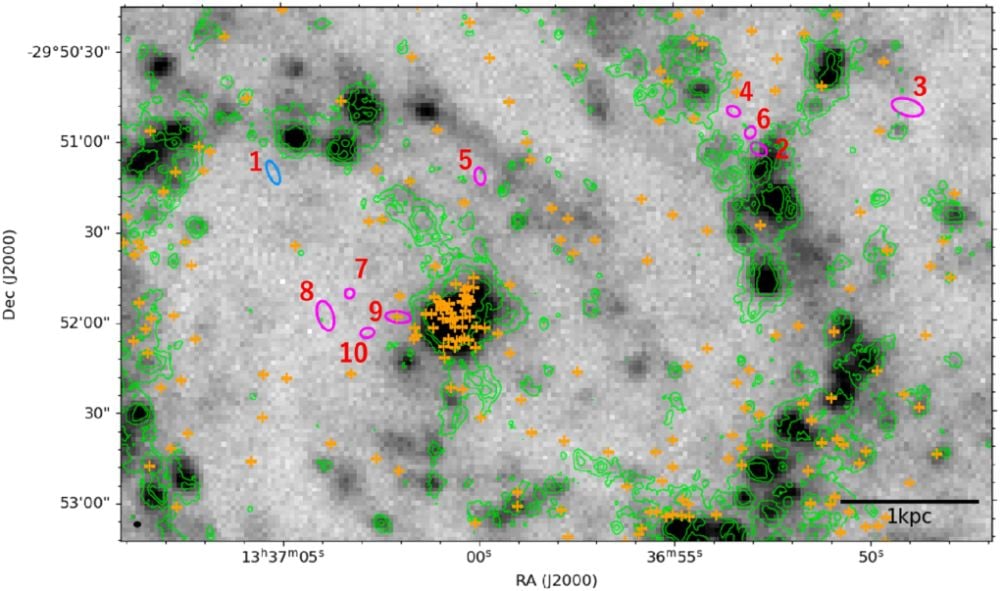
The research, published in *The Astrophysical Journal*, utilized data from the Atacama Large Millimeter/submillimeter Array (ALMA) to study the motion of carbon monoxide (CO) in M83. Astronomers use CO as a tracer for molecular hydrogen, the gas essential for star formation. The team discovered ten HVCs with unusual velocities relative to the galactic disk [3].
These HVCs have radii ranging from 30 to 80 parsecs and masses around 105 solar masses. Their velocity dispersions, ranging from 3-20 km s-1, are higher than those of regular disk clouds.
Pro Tip: Understanding the velocity dispersion of gas clouds helps astronomers determine their stability and potential for collapse, which is a crucial step in star formation.
External Origins and Galactic Evolution
While some HVCs can originate from supernova explosions within a galaxy, the researchers resolute that only one of the ten HVCs in M83 could be attributed to such an event. The remaining
