Exploring Campania: A Guide to Pompeii, Herculaneum, and Paestum
Campania’s archaeological zone surrounding Pompeii preserves first-century Roman civilization across multiple sites, offering a contrast to Pompeii’s 3.5 million annual visitors and theme-park atmosphere. While Pompeii receives millions of visitors yearly and has become in parts an experience of a crowded theme park, the surrounding Vesuvian area, Bay of Naples, and Campanian coast contain at least six other sites of equivalent or greater archaeological interest with a small fraction of the visitor numbers.
The volcanic eruption of AD 79 buried not only Pompeii but the entire northern flank of the Bay of Naples, with each buried site preserving a different aspect of Roman life, social class, or building type. Together, these locations constitute the most complete archaeological documentation of first-century AD Roman civilization anywhere in the world. Shifting the focus from how Pompeii ended to how it functioned reveals interconnected spaces around the Forum, where religious, commercial, and public business buildings gathered.
Materials and Preservation at Herculaneum
This process preserves wooden furniture, doors, staircases, roof structures, and foodstuffs that Pompeii cannot provide. Approximately 20% of the ancient city has been excavated, while the rest lies under the modern town of Ercolano.

Herculaneum rewards close attention to materials through carbonized wooden objects and architectural elements, recovering items that normally disappear as wood decays, including partitions, textiles, ropes, and parts of a wooden ceiling retaining traces of color and gilding. Wax tablets, inscriptions, and graffiti further record legal, commercial, and social life, helping replace anonymous inhabitants with individuals whose names and affairs can sometimes be recovered.
Greek Roots at Paestum and Cuma
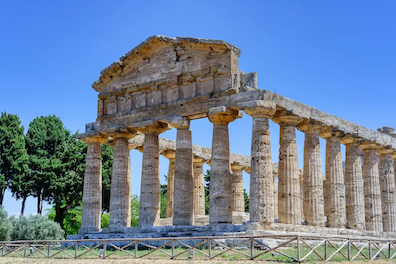
South of Salerno, Paestum widens the historical frame by taking the story back to Greek settlement in southern Italy. Founded by Greek settlers as Poseidonia, the city subsequently passed through Lucanian and Roman phases. Its three great Doric temples—the Temple of Hera I from circa 550 BC, the Temple of Hera II from circa 460 BC, and the Temple of Ceres from circa 500 BC—survive within a much larger urban site as the best-preserved Greek temples anywhere outside of Sicily and Greece itself. The adjacent Paestum Museum houses the Tomb of the Diver from 480 BC, noted as the only surviving example of Greek figurative painting on stone from the classical period.
Further north on the Phlegrean Fields coast, Cuma represents the first Greek colony on the Italian mainland, established approximately 740 BC with an acropolis and temples. Meanwhile, objects removed from excavations in Naples restore some of the color and detail missing from the buildings, raising the question of how visitors choose to experience these interconnected sites across the region.