
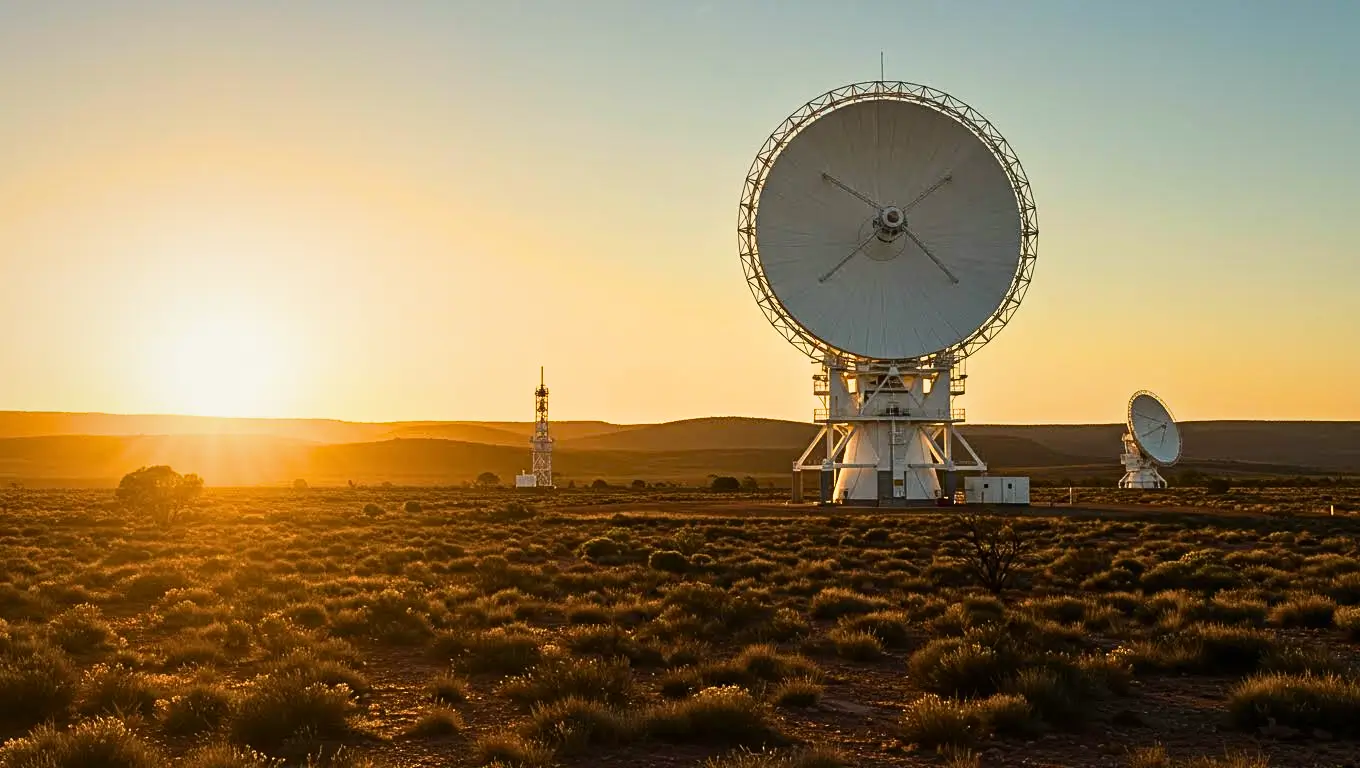
Europe Bolsters deep Space Communications with Inauguration of Cutting-Edge Australian Antenna
New Norcia, Australia – Europe has significantly expanded its deep space communication capabilities with the official launch of a new antenna at the New Norcia station in Western Australia. The facility,dubbed “New Norcia 3,” represents a major technological leap forward,enabling communication with spacecraft millions,even billions,of kilometers from Earth and solidifying Europe’s position as a key player in space exploration.
The antenna’s advanced design centers around extreme precision and ultra-low temperatures. Its components are cooled too a staggering -263°C, just above absolute zero, allowing it to detect incredibly faint signals from distant probes. Coupled with highly accurate clock and timing systems, the antenna ensures seamless, lag-free data exchange crucial for controlling complex space missions.
“We can therefore see it as a giant ear, capable of listening to the slightest whispers coming from the cosmos,” highlights the significance of the technology.
The strategic location of New Norcia was paramount in the decision to build the antenna there. Its geographical position provides continuous coverage for exploration missions, complemented by existing ESA stations in Malargue, Argentina, and Cebreros, Spain. This global distribution makes New Norcia the first ESA station boasting two antennas dedicated to deep space communication.
Australia already serves as a vital hub for space activity, tracking rockets like Vega-C and Ariane 6, and supporting the Biomass mission, which studies forests and the carbon cycle. It’s also the site where payloads launched from Kourou,French Guiana,separate from their launchers.
The inauguration of New Norcia 3 signifies Europe’s ambition to achieve greater autonomy and control in space. By establishing direct communication links with its spacecraft,Europe reduces its reliance on other nations’ infrastructure.
“Ultimately, with ‘New Norcia 3’, Europe shows that it wants be among the great space powers,” the article states, framing the antenna as “a declaration of scientific independence.”
The new antenna isn’t just a technical achievement; it’s a critical investment in Europe’s future in space,positioning the continent to potentially be the first to detect any future signals originating from beyond our planet.
