
Interstellar Comet 3I/ATLAS Observed by ESA’s Mars Orbiters
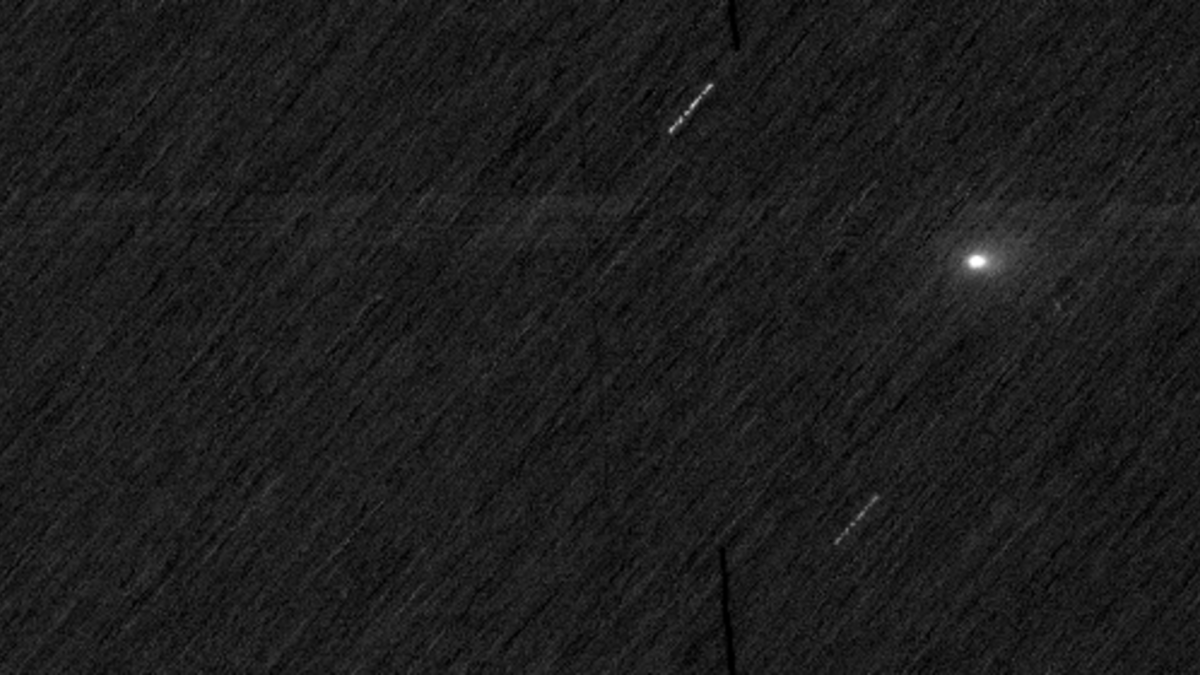
ESA’s Mars express and ExoMars Trace Gas Orbiter (TGO) have recently focused their instruments on comet 3I/ATLAS, a rare interstellar visitor currently making its way through our solar system. While the comet remains exceptionally faint,the observations represent a unique possibility to study a celestial body originating outside our own planetary neighborhood.
Currently, a visible coma - the cloud of gas and dust surrounding the comet’s nucleus – has not been detected in images from the Mars orbiters, though scientists anticipate it may become apparent as the comet warms with closer proximity to the Sun. The challenge of capturing these images is significant; according to Nick Thomas, principal investigator of the CaSSIS camera, the comet is 10,000 to 100,000 times dimmer than typical targets for the instrument.
Initial attempts to identify 3I/ATLAS in Mars Express images have been hampered by exposure limitations. The orbiter’s maximum exposure time of 0.5 seconds contrasts with the five-second exposures used by the ExoMars TGO. Science teams are continuing to analyse data from both orbiters, including combining multiple Mars Express images, in an effort to detect the faint comet. They are also analyzing the light spectrum of the comet using the OMEGA and SPICAM spectrometers on Mars Express, and the NOMAD spectrometer on ExoMars TGO, though the luminosity of the coma and tail remains a factor in the accuracy of spectral characterization.
Comet 3I/ATLAS is only the third interstellar comet ever observed, following 1I/ʻOumuamua (2017) and 2I/Borisov (2019). These objects offer valuable insights into planetary formation processes occurring beyond our solar system. The comet was first detected on July 1, 2025, by the ATLAS telescope in Chile. Astronomers hypothesize that 3I/ATLAS might potentially be exceptionally old,potentially three billion years older than our own solar system,which is estimated to be 4.6 billion years old.
Looking ahead, ESA plans to observe the comet with its Juice (Jupiter Icy Moons Explorer) mission next month. While Juice will be at a greater distance from 3I/ATLAS than the Mars orbiters,it will be positioned to study the comet shortly after its closest approach to the Sun,when it is expected to be at peak activity. Data from these observations are anticipated in February 2026.
These observations are informing preparations for ESA’s future Comet Interceptor mission, scheduled for launch in 2029. This mission will await a suitable target – a pristine comet from the Oort Cloud or, potentially, another interstellar object like 3I/ATLAS – and conduct a close-up study. Michael Kueppers, Comet Interceptor project scientist, notes that the increasing number of discovered interstellar objects, each exhibiting unique characteristics, underscores the potential for a close encounter mission to considerably advance our understanding of these interesting celestial bodies.
