
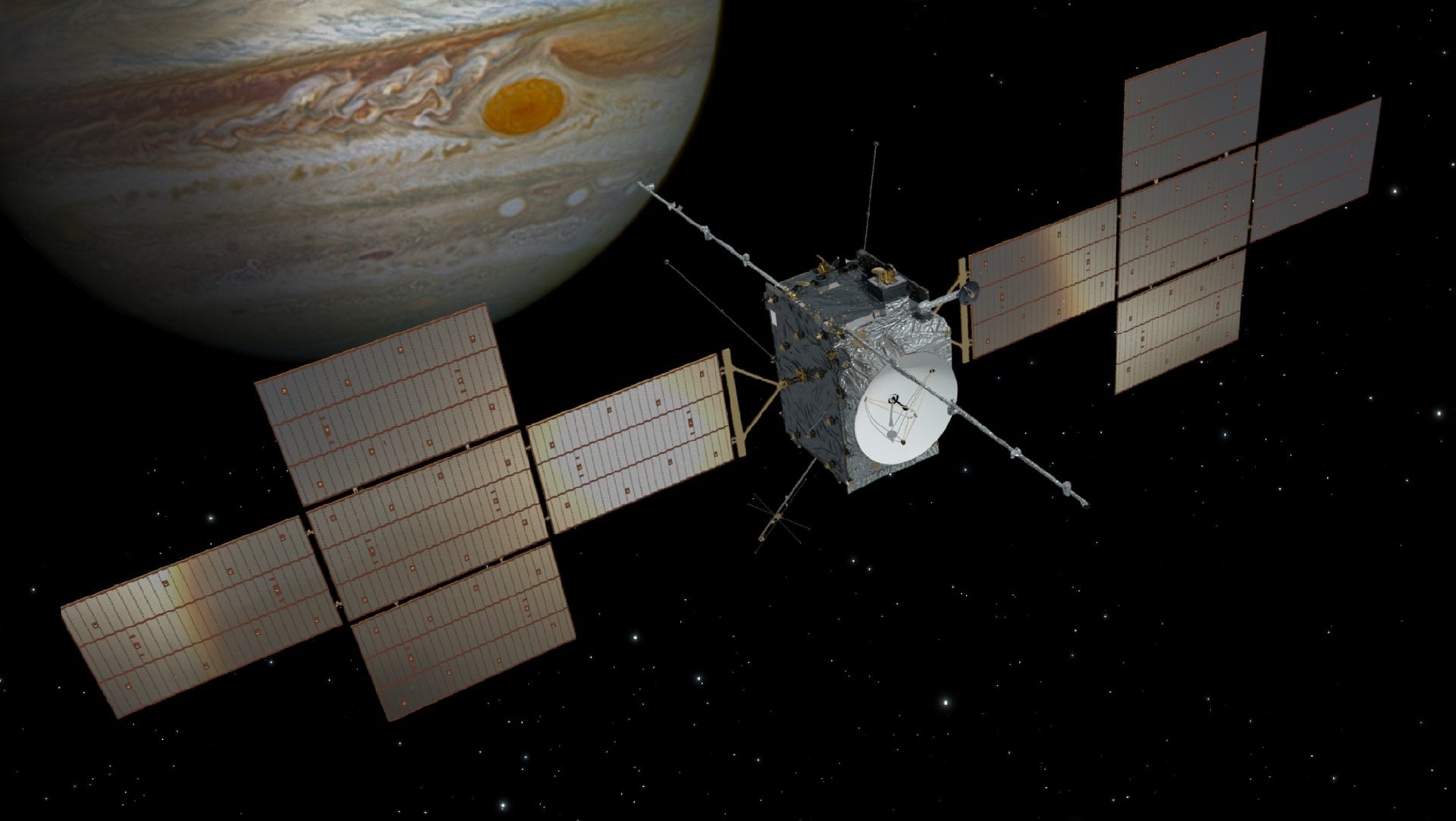
ESA Successfully recovers Communications with JUICE Ahead of Venus Flyby
Just days before a critical flyby of Venus, the European Space Agency (ESA) successfully restored communications with it’s Jupiter Icy Moons Explorer (JUICE) probe after a communications anomaly threatened the mission. Airbus, JUICE’s manufacturer, played a key role in the restoration efforts.
The issue arose on July 16th when a ground-based antenna within the ESA’s Deep Space Network failed to connect with the spacecraft. initial diagnostics ruled out a problem with the ground station itself, leading the JUICE team at the European Space Operations Center (ESOC) to suspect multiple system failures onboard.This prompted JUICE to enter survival mode, initiating a spin and relying on its antenna to intermittently sweep across Earth, transmitting a signal only once per hour. Though, no signal was detected, intensifying concerns.
Faced with a potential 14-day wait for the spacecraft’s next automatic reset – which would have delayed crucial Venus flyby preparations – the team opted for a more immediate, but challenging, solution: “blind messaging.” This involved sending commands towards JUICE, hoping they would be received by one of its backup low-gain antennas. The difficulty was compounded by JUICE’s distance of approximately 200 million kilometers (125.25 million miles) from Earth, positioned on the opposite side of the Sun, resulting in a 22-minute signal delay.
After nearly 20 hours of continuous effort, the team received a response. The blind commands successfully activated JUICE’s signal amplifier,re-establishing contact. Investigations revealed the spacecraft was fully functional and on course for its Venus flyby. The anomaly was traced to a timing issue within the software controlling the signal amplifier’s activation and deactivation.”Losing contact with a spacecraft is one of the most serious scenarios we can face,” explained Angela Dietz, Juice Spacecraft Operations Manager, in an ESA press release. “With no telemetry, it is much more arduous to diagnose and resolve the root cause of an issue. Waiting was not an option. We had to act fast. Waiting two weeks for the reset would have meant delaying crucial preparations for the Venus flyby.”
Dietz further stated, “It was a subtle bug, but one that we were prepared to investigate and resolve. we have identified a number of possible ways to ensure that this does not happen again, and we are now deciding which solution would be the best to implement. This was a textbook example of teamwork under pressure. Thanks to the team’s calm and methodical approach, we were able to recover Juice without any lasting impact on the mission.”
JUICE will make its closest approach to Venus at 07:28 CEST on Sunday, August 31st (01:28 EST; 10:28 PST, Aug.30th). This flyby is the first of four planned gravity-assist maneuvers. The probe previously completed a gravity assist maneuver with the Earth-Moon system in August 2024, and two more are scheduled with Earth in September 2026 and January 2029. These maneuvers are crucial for adjusting JUICE’s trajectory, given its ample mass of 6000 kg (13230 lbs), and will ultimately enable its rendezvous with Jupiter in July 2031.
