ESA Hera Returns First Close-Up Images of Didymos Asteroid After Arrival
Europe’s Hera spacecraft has returned its first close-up observations of the Didymos binary asteroid system, giving scientists their initial detailed look at the site where NASA’s DART mission altered an asteroid’s orbit in 2022, Techno-Science reported.
-
The Tech TL;DR:
- Hera imaged Didymos from 28.5 km away at 2.7 m/pixel resolution, revealing an equatorial ridge shaped by the asteroid’s 2.2-hour rotation.
- Multispectral and thermal instruments are mapping surface composition and distinguishing solid boulders from porous material across both bodies.
- DART’s 6.1 km/s impact shortened Dimorphos’s orbit by 33 minutes — more than models predicted — and Hera must now determine whether a crater formed or the moonlet’s shape changed globally.
Hera arrived at the Didymos system on November 4 after a two-year cruise, ESA confirmed. The spacecraft acquired its first close-up image of the 780-meter primary asteroid on November 6 from roughly 60 kilometers out using its Asteroid Framing Camera, ScienceDaily reported.
A second observation on the same day from 28.5 kilometers yielded a resolution of 2.7 meters per pixel, showing a spinning-top shape and a sharp equatorial ridge, Techno-Science reported. Didymos completes one rotation every 2.2 hours, a spin rate that likely drives loose material toward the equator to build that ridge.
“The first thing we said was wow!” said Patrick Michel, Hera principal investigator and director of research at CNRS / Observatoire de la Côte d’Azur, speaking to ScienceDaily. Sir Brian May, a member of the Hera science team, noted the stereoscopic view from 29.7 km at 2.8 m/pixel makes the ridge’s smoothness apparent against the rock-strewn terrain elsewhere, ESA reported.
Hera’s instrument suite targets the deflection unknowns
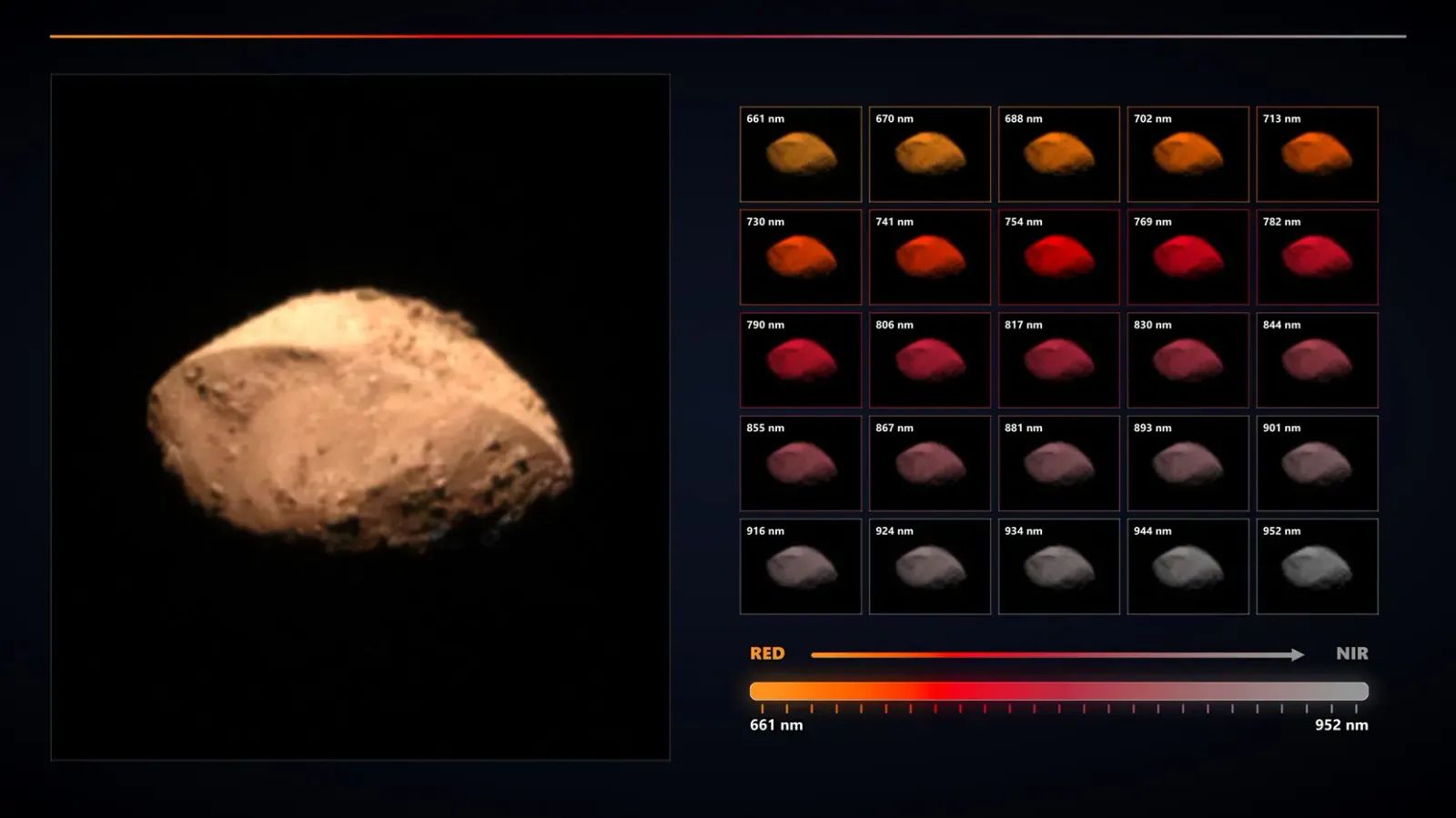
The mission carries three primary imagers to resolve the ambiguity left by DART. The Asteroid Framing Camera handles monochrome photography and navigation. HyperScout H captures reflected light across 25 color bands, some invisible to human eyes, enabling spectral matching against terrestrial minerals and meteorites, Techno-Science reported. The Thermal Infrared Imager (TIRI) maps surface temperature; solid rock dissipates heat more slowly than porous or fragmented material, revealing structural integrity, Phys.org reported.
Dimorphos, the 151-meter moonlet DART struck, remains largely hidden in shadow in visible-light frames. TIRI’s infrared view, however, shows the entire body glowing in cool purple, confirming its position and thermal properties, Phys.org reported.
Ground-based observatories measured the 33-minute orbital period reduction — give or take a minute — but the magnitude exceeded pre-impact predictions, Phys.org reported. Determining whether the collision carved a distinct crater or reshaped the moonlet more broadly is critical for validating kinetic impact models.
Ejected debris may have painted Didymos
Scientists are examining whether material thrown from Dimorphos during the impact crossed the roughly one-kilometer gap to Didymos.
“Since we expect a lot of impact-ejected material to have made it across the approximately 1 km of space from Dimorphos to Didymos, it may be that some of these characteristics originate from this transport of material,” said Michael Kueppers, Hera mission scientist, quoted by ScienceDaily. Hera’s multispectral data will help discriminate between native surface features and potential DART-generated deposits.

Hera deploys CubeSats Juventas and Milani for close study
Hera will spend at least six months surveying the system. In early 2027, it will deploy two CubeSats — Juventas and Milani — to fly closer and probe internal structure with radar and spectral instruments, Smithsonian Magazine reported.
Juventas will attempt to land on Dimorphos to measure surface mechanical properties and the gravity field directly, Smithsonian Magazine reported. The German Aerospace Center (DLR) leads the scientific work on the framing cameras, while the German Space Agency at DLR coordinates Germany’s contributions, Military Aerospace reported.
Didymos, discovered on April 11, 1996, by Joseph Montani of Spacewatch at Kitt Peak National Observatory southwest of Tucson, Arizona, is a near-Earth binary asteroid system. Its name, meaning “twin” in Greek, was suggested by Montani. Scientists first suspected a moon after detecting multiple echoes in data from NASA’s Goldstone Solar System Radar in the Mojave Desert near Barstow, California.
Studies by the DART mission’s science team indicate Didymos’ surface is 40–130 times as old as Dimorphos — about 12.5 million years compared to less than 300,000 years — and that Dimorphos likely formed from material spun off from Didymos in a large mass-shedding event.
ESA plans to release sharper images of both asteroids on November 25 during a live event at the Berlin Museum of Natural History, Phys.org reported.
// Pseudo-code for Hera HyperScout H spectral band processing
const bands = 25;
const wavelengthRange = [400, 2500]; // nanometers
function analyzeSurface(reflectanceCube) {
  const signatures = reflectanceCube.map(pixel =>
    pixel.bands.map((reflectance, i) => ({
      band: i,
      wavelength: wavelengthRange[0] + (i * (wavelengthRange[1]-wavelengthRange[0])/bands),
      reflectance
    }))
  );
  return matchMineralLibrary(signatures);
}