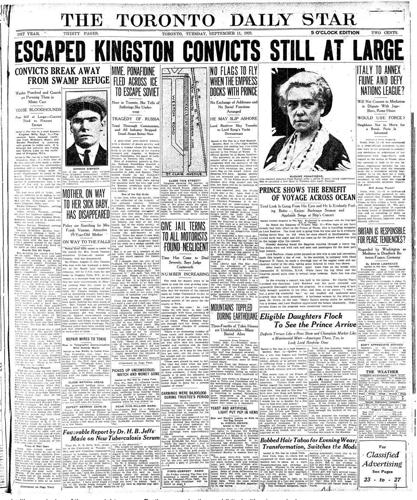
Ernest Hemingway worked and lived in Toronto from 1920 to 1923
Ernest Hemingway arrived in Toronto in January 1920 as a 20-year-old war hero, eventually resigning from the Toronto Daily Star on December 27, 1923, cbc.ca reported.
A Grand Arrival at Lyndhurst Street
The future Nobel laureate initially came to Canada at the invitation of family friend Harriet Connable. She had met the young veteran after he returned from the Italian front during the First World War, where he had been severely wounded by shrapnel in 1918 while serving as an ambulance driver.
Connable invited Hemingway to Toronto to act as a mentor to her son, Ralph. Her husband, Ralph Senior—a major advertiser for the Toronto Daily Star—helped secure the young writer a position at the newspaper. Rather than settling into a working-class boarding house, Hemingway stayed at the Connable mansion located at 153 Lyndhurst Street.
Reporting on Prohibition and Rum Running
The Toronto that greeted Hemingway was a conservative, white-Anglo-Saxon city defined by its churches and banks. Working out of the Star’s former head office at 18 to 20 King Street West, he began writing uncredited stories covering local life, fly fishing, municipal politics, and the city’s active rum-running trade during the prohibition era.
His impressions of the city and its people were captured in a satirical 1923 poem titled I Like Canadians, published under the pseudonym “A Foreigner.” In the piece, he observed that locals “go home at night,” have well-fitting hats, and “really believe that they won the war.”
The Clash With Harry Hindmarsh
Despite the relationships at the Star which would fund his life for years to come, Hemingway chafed against Toronto’s conservative pace. When his wife, Hadley, became pregnant, the couple returned to Toronto in September 1923, staying temporarily at The Selby Hotel before moving into apartments at 1597 Bathurst Street.

Hemingway quickly grew miserable. He complained in letters to Ezra Pound and Sylvia Beach that the city was impossible to live in and that the paper demanded too much time. Relations soured further under new boss Harry Hindmarsh, the son-in-law of the editor-in-chief. Hindmarsh assigned punishing schedules and trivial tasks, culminating in a trip to New York that forced Hemingway to miss the birth of his child.
Livid, Hemingway returned to Toronto and threatened the city editor before officially tendering his resignation on December 27, 1923. He left behind a city that had funded his early apprenticeship, yet had driven him permanently toward the literary circles of Europe.