
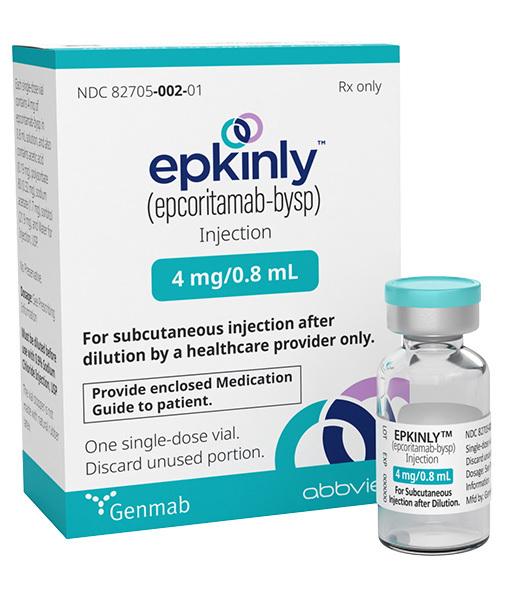
Long-term data from a clinical trial show that more than half of patients with relapsed or refractory large B-cell lymphoma (LBCL) who achieved a complete response (CR) with the bispecific antibody epcoritamab (Epkinly) remained in remission at three years, and 63% were still alive, according to results published earlier this month in the Annals of Hematology.
The EPCORE NHL-1 trial, involving 157 patients with relapsed or refractory CD20+ mature B-cell non-Hodgkin lymphoma – including 139 with diffuse large B-cell lymphoma – demonstrated a 41% complete response rate at the three-year mark. This durability occurred despite 75% of patients having previously failed at least two lines of treatment and 39% having already undergone CAR T-cell therapy, according to the study authors.
Among patients who achieved a CR, 53% remained in remission at the time of data cutoff, with the longest CR exceeding 43 months. 45% of the 19 patients assessed for measurable residual disease (MRD) achieved MRD negativity during the study. Investigators reported that an estimated 53% of patients with a CR remained progression-free at three years, and 75% had not initiated new anti-lymphoma therapy.
The median duration of CR was 36.1 months, representing one of the longest median durations of complete response observed for approved bispecific antibodies in this patient population. Median progression-free survival for the overall study population was 4.2 months, with most patients who remained on epcoritamab beyond one year of treatment remaining progression-free.
Epcoritamab, co-developed by AbbVie and Genmab, received accelerated approval from the U.S. Food and Drug Administration (FDA) in May 2023 for relapsed or refractory DLBCL. The FDA granted accelerated approval for relapsed or refractory follicular lymphoma (FL) in June 2024. More recently, in November 2025, the FDA approved epcoritamab in combination with lenalidomide and rituximab for FL as early as the first relapse, based on the EPCORE FL-1 trial.
The EPCORE NHL-1 trial’s primary endpoint was overall response rate, which was 59% at the three-year mark. As of May 3, 2024, median follow-up was 37.1 months. Median duration of response was 20.8 months. Median overall survival for the overall population was 18.5 months, and was not reached for patients with a CR.
The most common adverse event observed in the trial was cytokine release syndrome, affecting 51% of patients, with no new cases reported during extended follow-up. Infections were seen in 57% of patients. Treatment-emergent adverse events led to discontinuation in 17% of patients, most commonly due to COVID-19. Deaths attributable to adverse events occurred in 13% of patients.
In January 2026, AbbVie and Genmab announced topline results from the Phase 3 EPCORE DLBCL-1 trial, evaluating epcoritamab against investigator’s choice of chemoimmunotherapy in patients with relapsed/refractory DLBCL. The study demonstrated a 26% improvement in progression-free survival (HR: 0.74; 95% CI, 0.60-0.92), with improvements in complete response rates, duration of response, and time to next treatment. However, the trial did not demonstrate a statistically significant improvement in overall survival (HR: 0.96; 95% CI, 0.77-1.20).
Genmab and AbbVie are continuing to investigate epcoritamab as a monotherapy and in combination with other treatments in several ongoing Phase 3 trials.
