Engineered Signaling Centers Trigger Human Trunk Morphogenesis In Vitro
Scientists have engineered signaling centers that trigger trunk morphogenesis in vitro, according to a study published in Nature.
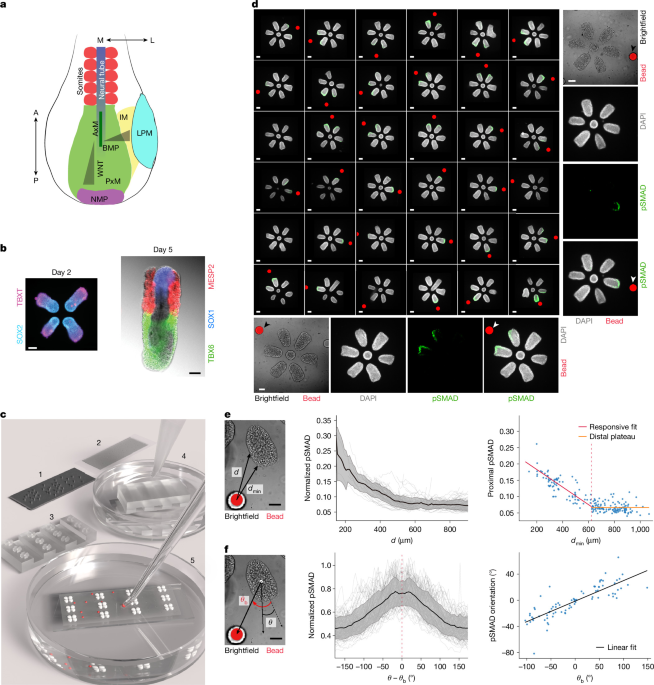
The breakthrough demonstrates how spatially controlled Wnt, FGF, and BMP signals can induce axial elongation and segmentation in human pluripotent stem cell aggregates. The resulting structures display a sequential arrangement of neural tube, somites, and lateral plate mesoderm, mirroring the human trunk.
Replacing Embryonic Organizers
In vertebrate embryos, the node and primitive streak act as signaling centers that emit morphogen gradients to pattern the body axis. Previous human stem cell models, including gastruloids and axial elongation systems, achieved symmetry breaking and anteroposterior organization but lacked engineered control over the signaling centers themselves.
The new work uses micropatterned substrates to immobilize ligands at defined positions, creating synthetic sources of Wnt, FGF, and BMP that mimic the spatiotemporal dynamics of the embryonic organizer and tail bud.
Gradients Dictate Cellular Fates
The engineered centers generate concentration gradients that cells interpret to adopt distinct fates along the anteroposterior and mediolateral axes. High Wnt and FGF near the signaling center maintain neuromesodermal progenitors, while decreasing levels permit segmentation clock oscillations and somite formation. Lateral BMP signaling patterns the paraxial mesoderm and lateral plate territories.
Recapitulating Embryonic Clocks
Live imaging of a Hes7 reporter revealed traveling waves of segmentation clock gene expression moving posterior to anterior across the presomitic mesoderm, matching the period and wavelength observed in human embryos. The waves arrest at a determination front defined by the FGF gradient, triggering somite boundary formation.
“The system reconstitutes the dynamics of human somitogenesis, including segmentation clock waves,” the researchers said. This research is part of a broader effort to understand somitogenesis, including a 2023 study by Miao et al. published in Nature that focused on the reconstruction and deconstruction of the process in vitro.
Unanswered Questions and Public Data
The authors note that the system does not yet incorporate all tissues of the trunk, such as vascular networks or mature organ primordia. The analysis code and datasets supporting the findings are deposited on Zenodo under DOI 10.5281/zenodo.22756590.
The research also contributes to understanding the lateral plate mesoderm, a topic explored by Prummel, Nieuwenhuize, and Mosimann in a 2020 Development article, and relates to the broader field of developmental genetics, including the role of signaling centers as discussed by Cambray and Wilson in a 2007 Development paper.