
Chemists Directly Grow Diamonds Using an Electron Beam
Researchers have successfully synthesized nanodiamonds from adamantane molecules using an electron beam, challenging previous assumptions about the interaction between electron beams and organic matter. The breakthrough, published in Science on September 4, 2025, demonstrates a new method for controlling chemical reactions and offers insights into diamond formation in natural settings.
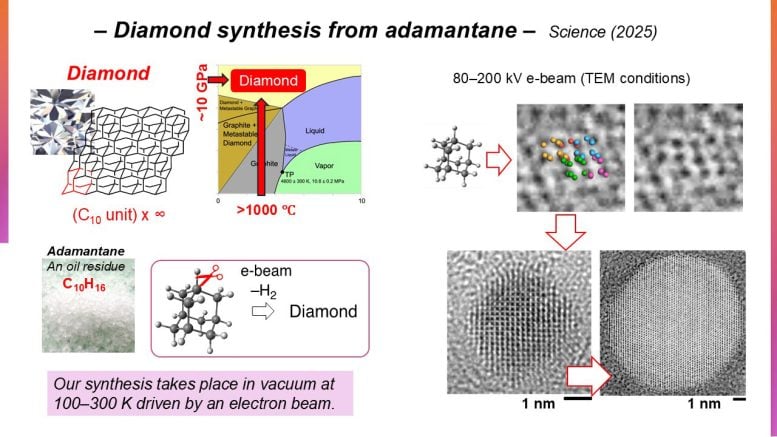
The team,led by Eiichi Nakamura,utilized transmission electron microscopy (TEM) to monitor the conversion of solid adamantane under electron irradiation. Submicrocrystals were bombarded with electrons at energies of 80-200 kiloelectron volts at temperatures ranging from 100-296 kelvins in a vacuum for tens of seconds. This process revealed the step-by-step formation of nanodiamonds, a feat previously thought impractical due to the expectation that electron beams would rapidly decompose organic molecules.
“Computational data gives you ‘virtual’ reaction paths, but I wanted to see it with my eyes,” explained Nakamura, who has spent 30 years in synthetic chemistry and 15 years performing computational quantum chemical calculations. “However, the common wisdom among TEM specialists was that organic molecules decompose quickly as you shine an electron beam on them. My research since 2004 has been a constant battle to show otherwise.”
The experiment resulted in the creation of defect-free, cubic nanodiamonds up to 10 nanometers in diameter, accompanied by the release of hydrogen gas. Time-resolved TEM images showed adamantane oligomers evolving into spherical nanodiamonds,with the rate of C-H bond cleavage playing a key role in the process. Crucially, other hydrocarbons tested did not yield nanodiamonds, confirming adamantane’s unique suitability as a precursor.
This research has broad implications for fields like electron lithography,surface engineering,and electron microscopy,offering a new understanding of how to control chemistry at the nanoscale. The findings also support existing theories about diamond formation in meteorites and uranium-bearing sedimentary rocks, suggesting high-energy particle irradiation could be the driving force. Nakamura also believes the method could be used to synthesize doped quantum dots, vital components for quantum computers and sensors.
“This example of diamond synthesis is the ultimate exhibition that electrons do not destroy organic molecules but let them undergo well-defined chemical reactions, if we install suitable properties in molecules to be irradiated,” Nakamura stated. He envisions this work will fundamentally change how scientists approach interactions under electron irradiation.
The study, titled “Rapid, low-temperature nanodiamond formation by electron-beam activation of adamantane C-H bonds,” was authored by Jiarui Fu, Takayuki Nakamuro and Eiichi Nakamura. (DOI: 10.1126/science.adw2025). The research was funded by JSPS KAKENHI and JST PRESTO.
